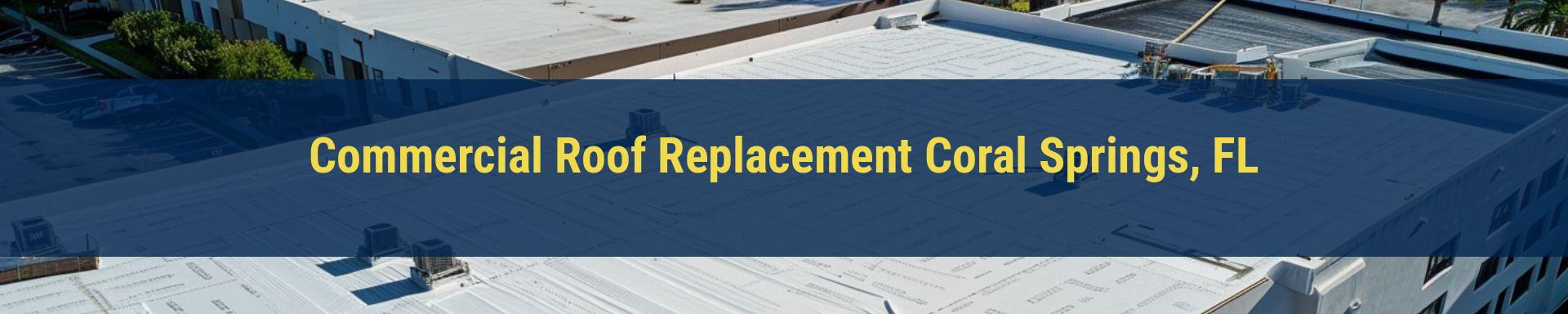
Commercial Roofing Pompano Beach delivers system-led commercial roof replacement in Coral Springs, Florida by replacing commercial roof assemblies that have become unreliable because of repeated leaks, moisture-loaded insulation, wide-span membrane fatigue, drainage failure, storm damage, attachment weakness, or roof-layer deterioration. Commercial Roofing Pompano Beach replaces commercial roofs on University Drive retail centers, Sample Road and Wiles Road commercial buildings, Atlantic Boulevard business properties, Coral Ridge Drive sites, office and medical facilities, schools, civic buildings, multifamily communities, hospitality assets, warehouse units, mixed-use properties, service buildings, and other flat or low-slope commercial facilities where northwest Broward County heat, heavy summer rainfall, humid inland exposure, hurricane-season uplift, rooftop HVAC density, managed drainage conditions, large roof-field movement, failing seams, weakened flashings, ponding areas, wet insulation, and deck-readiness concerns can make another repair cycle or surface coating unsuitable.
The Coral Springs-specific replacement outcomes below show how commercial roof replacement is organized around wide commercial roof fields, corridor-based retail and medical properties, school and civic roof demands, drainage-district water movement, rooftop equipment load, moisture investigation, recover eligibility, wind-uplift securement, phased occupancy planning, replacement-system compatibility, and documented roof asset control across northwest Broward commercial properties.
- Replacement trigger review for Coral Springs commercial roofs → recurring leaks, broad membrane fatigue, open seams, brittle flashings, repeated repair areas, ponding fields, saturated insulation, soft walking zones, rooftop equipment wear, storm-stressed edges, school or civic facility disruption, retail tenant complaints, and wide-span roof movement are reviewed as one assembly-wide condition → replacement is pursued when the roof has become a recurring performance liability rather than a set of isolated defects that can still be repaired independently.
- Wide-span moisture and roof-layer investigation before reroofing → trapped moisture, wet insulation, abandoned patch materials, overloaded roof layers, blistered membrane sections, deteriorated cover boards, loose fasteners, hidden deck movement, failed lap areas, and drainage-related substrate damage are checked before the replacement system is specified → the replacement scope is based on the condition of the full roof assembly instead of the visible condition of the exposed membrane alone.
- Recover, partial tear-off, and full tear-off route selection for Coral Springs buildings → roof weight, layer count, moisture content, deck condition, membrane compatibility, perimeter attachment, roof-span size, rooftop equipment layout, drainage performance, manufacturer requirements, code constraints, tenant disruption risk, and long-term ownership plans are evaluated before selecting recover, partial tear-off, staged replacement, or full tear-off → the reroofing route fits the building’s technical condition rather than defaulting to the quickest replacement option.
- Drainage reconstruction for Coral Springs low-slope roof assemblies → undersized drains, damaged scuppers, weak gutter discharge, parapet-side water paths, equipment-shadowed ponding, broad roof-field low spots, slow runoff zones, overflow limitations, drainage-district discharge constraints, and heavy-rain water loading are corrected during replacement planning → the new roof is not installed over the same water-management defects that caused membrane fatigue, wet insulation, interior staining, and repeat leak behaviour.
- Replacement assembly matching for inland Broward commercial properties → TPO, PVC, EPDM, modified bitumen, built-up roofing, metal roofing, recover assemblies, or full tear-off systems are matched to roof span, deck readiness, drainage layout, rooftop HVAC density, wind-uplift demand, rainfall load, humidity exposure, school or civic use, medical-office occupancy, retail operating needs, attachment method, manufacturer compatibility, warranty goals, and lifecycle value → the selected roof system reflects Coral Springs operating conditions rather than simple material substitution.
- Perimeter, flashing, penetration, and equipment-zone rebuilding → coping, edge metal, parapets, wall transitions, curbs, vent stacks, skylight perimeters, HVAC penetrations, service entries, roof drains, scuppers, gutters, expansion points, walk pads, mechanical supports, school access routes, multifamily transition points, and equipment curbs are rebuilt where old detailing has allowed water entry, uplift movement, sealant failure, vibration wear, or maintenance-traffic damage → replacement work strengthens the interface zones most likely to determine whether the new commercial roof assembly performs long term.
- Phased replacement planning for occupied Coral Springs properties → retail trading hours, medical-office appointments, school or civic schedules, multifamily circulation, tenant access, parking areas, pedestrian routes, material staging, lift placement, debris removal, rooftop equipment access, weather windows, and hurricane-season timing are coordinated as part of the replacement plan → reroofing is sequenced to reduce disruption, protect public access, maintain building operations, and control worksite risk during replacement.
- Replacement closeout records for Coral Springs roof assets → pre-replacement findings, moisture observations, core-cut results where used, tear-off notes, deck preparation, insulation decisions, drainage corrections, perimeter rebuilds, installed system details, equipment-zone work, inspection results, warranty conditions, access constraints, storm-readiness notes, and completion status are documented for owners, property managers, facility teams, insurers, tenants, school or civic stakeholders, multifamily managers, medical-office operators, retail managers, and capital-planning records → closeout supports warranty administration, insurance review, maintenance planning, future budgeting, storm preparation, and long-term commercial roof asset control.
What Commercial Roof Replacement Services Do We Provide In Coral Springs, FL?
Commercial Roofing Pompano Beach delivers system-led commercial roof replacement across Pompano Beach and the surrounding Broward County commercial roofing area by removing failed, saturated, storm-damaged, incompatible, code-limited, or end-of-service-life roof assemblies and installing replacement systems designed around verified roof failure, building use, storm exposure, drainage performance, and long-term asset control. Commercial Roofing Pompano Beach replaces commercial roofs on Atlantic Boulevard retail properties, Federal Highway commercial buildings, Cypress Creek-area business assets, marina-adjacent facilities, beachfront and hospitality properties, medical offices, multifamily structures, restaurants, warehouse units, light industrial buildings, service facilities, mixed-use properties, and nearby commercial properties across Deerfield Beach, Lighthouse Point, Lauderdale-by-the-Sea, Fort Lauderdale, Oakland Park, Wilton Manors, Margate, Coconut Creek, Coral Springs, Tamarac, North Lauderdale, and Lauderdale Lakes.
Commercial roof replacement in this Broward County service area is driven by Atlantic salt air, Intracoastal and canal moisture, hurricane-season uplift, wind-driven rain, South Florida UV exposure, humid heat, rooftop HVAC density, heavy rainfall, corrosion-sensitive metal details, drainage restriction, occupied-property phasing, and repeated service access. These conditions can move a roof beyond commercial roof repair, commercial roof restoration, commercial roof coatings, or recover suitability when repeated leaks, wet insulation, membrane breakdown, flashing collapse, deck concerns, drainage failure, storm displacement, or weakened attachment has compromised the wider roof assembly.
- Replacement threshold review for Broward County commercial roof assemblies → repeated leak history, widespread membrane deterioration, failed seams, flashing collapse, ponding exposure, wet insulation, soft substrate areas, storm damage, edge-metal instability, corrosion-prone details, rooftop equipment wear, prior repair saturation, and end-of-service-life behaviour are reviewed as one roof-system condition → Commercial Roofing Pompano Beach recommends replacement when the assembly has reached system-wide failure rather than isolated repairable defects, coating-correctable wear, or restoration-suitable ageing.
- Repairable, restorable, coatable, recoverable, and tear-off roof separation → localized leak areas, maintainable membrane fields, restoration candidates, coating-suitable surfaces, recover candidates, overloaded roof layers, trapped moisture, incompatible assemblies, compromised perimeter details, drainage-limited areas, and full tear-off conditions are separated through roof condition review, moisture evidence, deck assessment, attachment review, manufacturer compatibility, code constraints, and lifecycle planning → property owners receive a replacement route based on technical roof status rather than repeated patching, premature coating, or default reroofing.
- Replacement system matching for Pompano Beach-area commercial properties → TPO, PVC, EPDM, modified bitumen, built-up roofing, commercial metal roofing, coating-supported recover, staged replacement, partial tear-off, or full tear-off systems are matched to roof span, deck readiness, drainage layout, rooftop equipment density, salt-air exposure, wind-uplift demand, rainfall load, humidity stress, restaurant exhaust areas, marina-service routes, warehouse operations, medical-office occupancy, multifamily circulation, attachment method, warranty goals, and lifecycle value → the selected roof assembly reflects Broward County operating conditions instead of simple material substitution.
- Moisture, insulation, substrate, and deck preparation before installation → saturated insulation, compressed insulation, damaged cover boards, trapped moisture, soft spots, deck staining, fastener withdrawal, corrosion concerns, deflection, overloaded roof build-ups, abandoned repair layers, incompatible materials, storm-compromised sections, and unsuitable recover surfaces are opened, tested, removed, replaced, reinforced, or prepared before new materials are installed → the replacement roof starts from a dry, compatible, attachment-ready, and performance-suitable base.
- Drainage correction before the new roof assembly is committed → undersized drains, damaged scuppers, weak gutter discharge, blocked flow paths, parapet-side water routes, equipment-shadowed ponding, low-slope runoff bottlenecks, overflow limitations, sand or salt residue, tree-debris buildup, heavy-rain discharge constraints, and recurring ponding fields are corrected during replacement planning → the new commercial roof is not installed over the same water-management defects that caused membrane fatigue, wet insulation, interior staining, corrosion, and repeated leak behaviour.
- Perimeter, flashing, penetration, and rooftop equipment rebuilding → parapets, coping, edge metal, roof-to-wall transitions, curbs, vents, skylights, HVAC penetrations, pipe penetrations, conduit runs, service entries, drains, scuppers, gutters, walk pads, equipment supports, restaurant exhaust zones, marina-service paths, mechanical access routes, and uplift-sensitive edges are rebuilt where wind-driven rain, salt air, ageing sealant, rooftop traffic, vibration, drainage backup, or poor detailing can compromise the new assembly → replacement scope restores waterproofing continuity at the interfaces most likely to determine long-term commercial roof performance.
- Storm-resistant replacement planning for coastal and inland Broward exposure → wind-uplift exposure, perimeter securement, membrane attachment, flashing reinforcement, drainage capacity, rooftop equipment layout, debris impact risk, corrosion-sensitive metal details, fastener performance, roof-edge stability, post-storm inspection needs, and hurricane-season timing are built into the replacement strategy → the new roof assembly is planned for Broward County storm behaviour rather than material preference alone.
- Occupied-property phasing for active commercial buildings → retail trading hours, medical-office appointments, hospitality operations, restaurant service windows, warehouse access, marina-service activity, multifamily circulation, tenant entrances, loading areas, parking movement, pedestrian routes, lift placement, material staging, debris removal, rooftop equipment access, and weather windows are coordinated during replacement planning → reroofing is sequenced to protect occupancy, maintain business continuity, reduce public-access risk, and control worksite disruption.
- Replacement documentation, warranty evidence, and lifecycle closeout → existing roof failure, tear-off findings, moisture observations, deck preparation, insulation decisions, drainage corrections, installed materials, flashing details, perimeter attachment, rooftop equipment treatment, storm-readiness notes, inspection results, manufacturer requirements, warranty-relevant conditions, access constraints, phasing notes, and remaining owner considerations are documented for owners, property managers, facility teams, insurers, tenants, hospitality operators, restaurant owners, marina-adjacent property managers, retail managers, logistics occupants, multifamily operators, medical-office managers, and capital-planning records → closeout supports warranty administration, insurance review, maintenance planning, storm preparation, budgeting, and long-term commercial roof asset control.
For commercial properties throughout the Pompano Beach and Broward County service area, the correct replacement strategy depends on whether the roof has reached system-wide failure, whether moisture has entered insulation or deck components, whether drainage defects must be redesigned, whether rooftop equipment needs re-detailing, whether commercial roof coatings or restoration remain technically viable, whether a recover is code-appropriate, and whether full tear-off is required for a reliable new assembly. Commercial Roofing Pompano Beach evaluates each replacement through roof condition, building use, occupancy risk, storm exposure, drainage behaviour, insulation integrity, deck readiness, equipment layout, uplift resistance, coastal corrosion risk, warranty context, and lifecycle value, giving owners and property managers a replacement strategy built around long-term roof performance rather than short-term reroofing assumptions.
Have a question about a commercial roof replacement project?
What Conditions Show That A Coral Springs Commercial Roof Has Reached Replacement Stage?
A Coral Springs commercial roof reaches replacement stage when deterioration is no longer limited to repairable seams, flashings, drains, penetrations, or membrane zones and instead affects the dependable performance of the wider roof assembly. This threshold can develop across University Drive retail centers, Sample Road and Wiles Road commercial buildings, Atlantic Boulevard and Coral Ridge Drive properties, medical and professional offices, schools, civic facilities, multifamily communities, hospitality assets, warehouse units, service buildings, and mixed-use properties where northwest Broward heat, prolonged humidity, heavy summer rainfall, hurricane-season uplift, broad roof-span movement, dense rooftop HVAC layouts, recurring ponding, and repeated service access accelerate assembly-wide decline.
The Coral Springs replacement indicators below identify when continued patching, localized membrane work, coating, restoration, or recover would retain the underlying failure rather than return the commercial roof to stable long-term service.
- Membrane deterioration is distributed across broad roof areas → TPO or PVC welds, EPDM seams, modified bitumen laps, built-up roof surfaces, patch boundaries, expansion zones, and coated membrane fields show widespread splitting, shrinkage, blistering, puncture accumulation, cracking, adhesion loss, or surface fatigue → replacement planning becomes necessary when the waterproofing field can no longer be divided into dependable repair zones.
- Leak patterns continue after several forms of corrective work → water entry returns after seam repairs, flashing reconstruction, drain clearing, equipment-curb work, coating application, or localized membrane replacement and begins affecting separate retail, medical, school, civic, office, multifamily, or hospitality areas → recurring failure indicates that deterioration is embedded across the assembly rather than confined to one visible opening.
- Moisture has spread through large insulation zones → moisture mapping, core cuts, soft walking areas, recurring dampness, thermal anomalies, or interior evidence identifies saturated, compressed, displaced, or deteriorated insulation beneath multiple roof sections → replacement is required when insulation removal, drainage rebuilding, and membrane renewal must be coordinated across a substantial part of the roof.
- Broad ponding fields reflect permanent drainage deformation → water remains after drains and scuppers are cleared because insulation has compressed, low areas have settled, substrate sections have deflected, equipment interrupts runoff, or the original slope no longer supports controlled discharge → replacement planning allows tapered insulation, crickets, sumps, drains, scuppers, overflow routes, and roof-field elevations to be reconstructed as one drainage system.
- Large roof-span movement is exceeding the capacity of localized repairs → thermal cycling and structural movement repeatedly reopen seams, wall transitions, curb flashings, expansion details, termination points, perimeter joints, and previous repair boundaries → continued sealing is no longer viable when movement affects the relationship between multiple roof components across the building.
- Rooftop HVAC concentration has created assembly-wide service damage → condenser banks, equipment curbs, pipe supports, conduit routes, platforms, walk paths, penetrations, and access zones show repeated abrasion, compression, punctures, vibration wear, flashing separation, blocked runoff, and wet insulation → replacement planning becomes necessary when mechanical zones must be redesigned, re-detailed, and protected within a new roof assembly.
- School, civic, medical, or multifamily occupancy can no longer tolerate recurring roof failure → leaks, emergency closures, interior protection, repeated contractor access, noise, drainage problems, and temporary repairs repeatedly disrupt classrooms, public areas, treatment spaces, offices, resident units, corridors, or shared facilities → planned replacement provides a controlled delivery route where continued reactive repair creates unacceptable operational risk.
- Perimeter securement has lost dependable hurricane resistance → coping, edge metal, termination bars, fasteners, membrane perimeters, parapet flashings, and rooftop equipment connections show recurring movement, loosening, open joints, displacement, or storm-related fatigue across multiple elevations → replacement becomes necessary when wind-uplift resistance must be rebuilt through the full attachment and perimeter network.
- Existing roof layers cannot support a technically reliable recover → excessive layer count, trapped moisture, incompatible membranes, unstable adhesion, uncertain attachment, overloaded build-up, poor drainage, damaged cover boards, or code and manufacturer limitations make overlay work unsuitable → partial or full tear-off is required to remove concealed failure before a new system is installed.
- The supporting substrate or deck has become inconsistent across the roof → soft zones, deck staining, corrosion, deflection, fastener withdrawal, damaged cover boards, substrate movement, or concealed deterioration is present beneath separate membrane areas → replacement planning allows the roof to be opened systematically so defective supporting materials can be mapped, repaired, reinforced, and prepared for new attachment.
- Protective coatings no longer have a viable substrate → coatings repeatedly blister, peel, crack, lose adhesion, expose seams, fail in ponding zones, or separate over moisture-affected surfaces despite previous preparation → replacement is the responsible pathway when the underlying membrane, insulation, or substrate can no longer support another restoration cycle.
- Storm damage extends across interdependent roof components → lifted laps, displaced flashings, loose edge metal, stressed fasteners, punctured membrane, drainage overflow, equipment-zone movement, and wind-driven rain entry are present across connected areas → replacement or staged tear-off becomes appropriate when repair would leave weakened attachment, concealed moisture, or damaged roof layers within the assembly.
- Repair frequency is no longer producing lifecycle value → emergency calls, tenant complaints, repeated leak investigations, temporary patches, drainage visits, equipment-zone repairs, coating touch-ups, and interior damage continue without establishing stable roof performance → replacement planning converts recurring operating expense into a defined asset-renewal strategy.
- The roof no longer meets current property and asset requirements → retail operations, medical occupancy, school schedules, civic use, multifamily living, hospitality demand, rooftop mechanical loads, insurance expectations, warranty objectives, storm-readiness needs, or long-term ownership plans exceed the dependable capacity of the existing assembly → commercial roof replacement becomes necessary to align the roof with present building use and future lifecycle requirements.
Commercial Roofing Pompano Beach determines whether a Coral Springs commercial roof has reached replacement stage through membrane condition, leak chronology, moisture distribution, insulation performance, roof-span movement, drainage geometry, rooftop equipment configuration, roof-layer compatibility, perimeter attachment, wind-uplift resistance, substrate and deck readiness, recover eligibility, occupancy constraints, warranty requirements, and remaining service value. Replacement planning begins when verified evidence shows that repair, restoration, coating, or recover would preserve system-wide weakness rather than deliver a dry, stable, drainage-corrected, storm-ready commercial roof assembly.
Have a question about a commercial roof replacement project?
Which Assembly Failures Make Commercial Roof Replacement The Correct Path In Coral Springs?
Commercial roof replacement becomes the correct path in Coral Springs when deterioration is distributed through the membrane, insulation, drainage plane, perimeter attachment, rooftop equipment zones, substrate, or deck and can no longer be isolated into technically dependable repair areas. Replacement-level failure can develop across University Drive retail centers, Sample Road and Wiles Road commercial properties, Atlantic Boulevard and Coral Ridge Drive buildings, medical and professional offices, schools, civic facilities, multifamily communities, hospitality assets, warehouse units, service properties, and mixed-use buildings exposed to northwest Broward heat, prolonged humidity, intense summer rainfall, hurricane-season uplift, broad roof-span movement, concentrated HVAC equipment, recurring ponding, and frequent maintenance access.
The Coral Springs roof-system failures below explain what commercial roof replacement resolves when localized repair, commercial roof coatings, restoration, or recover would leave the underlying assembly weakness in place.
- Waterproofing failure distributed across an expansive roof field → TPO and PVC welds, EPDM seams, modified bitumen laps, built-up roof surfaces, patch boundaries, expansion zones, and coated membrane areas show widespread splitting, shrinkage, blistering, punctures, cracking, adhesion loss, or repeated reopening → replacement removes the fragmented waterproofing field and installs a continuous assembly designed around the building’s roof span, movement, drainage, and storm exposure.
- Recurring leaks across separate occupied areas → moisture continues after seam repair, flashing reconstruction, drain clearing, curb correction, coating work, or localized membrane replacement and begins affecting retail units, classrooms, civic spaces, medical suites, offices, multifamily interiors, or hospitality areas → replacement resolves the connected moisture pathway rather than extending another repair cycle around individual interior symptoms.
- Extensive insulation saturation beneath the visible membrane → core cuts, moisture surveys, thermal evidence, soft walking areas, recurring dampness, or interior leak patterns identify wet, compressed, displaced, or deteriorated insulation across multiple roof zones → replacement exposes and removes compromised insulation before new tapered or compatible insulation and waterproofing are installed.
- Broad ponding caused by permanent roof-field deformation → standing water remains after drains and scuppers are cleared because insulation has compressed, structural areas have settled, substrates have moved, rooftop equipment obstructs runoff, or the original drainage slope has been lost → replacement allows crickets, sumps, tapered insulation, drains, scuppers, overflow routes, and roof-field elevations to be reconstructed as one water-management system.
- Drainage capacity no longer matching heavy northwest Broward rainfall → drains, scuppers, gutters, downspouts, strainers, parapet channels, and overflow provisions are undersized, damaged, restricted, or poorly positioned for the roof’s runoff volume → replacement corrects discharge capacity and outlet relationships before the new roof membrane is committed.
- Large-span thermal movement repeatedly defeating localized repairs → expansion and contraction reopen seams, curb flashings, wall transitions, terminations, perimeter joints, movement details, and previous patch boundaries across the roof → replacement integrates compatible membrane, flashing, attachment, and movement detailing into one coordinated assembly rather than resealing individual symptoms.
- Rooftop HVAC concentration damaging connected waterproofing zones → condenser banks, equipment curbs, pipe supports, conduit routes, platforms, walk pads, access paths, and penetrations show repeated vibration wear, membrane abrasion, punctures, shifted supports, flashing separation, drainage shadowing, and wet insulation → replacement re-details mechanical curbs, penetrations, supports, service routes, and adjoining waterproofing within the new roof design.
- School, civic, medical, or multifamily roof demands exceeding the remaining assembly → recurring leaks, closures, interior protection, emergency access, noise, rooftop work, and drainage problems repeatedly affect classrooms, public facilities, treatment areas, offices, resident units, or shared spaces → replacement provides a planned, phased renewal strategy where reactive repair can no longer protect occupancy reliably.
- Flashing failure extending across the roof-interface network → parapets, curbs, roof-to-wall transitions, service entries, vents, skylights, drains, scuppers, coping, edge details, and mechanical penetrations show recurring movement, open joints, sealant breakdown, or wind-driven rain entry → replacement rebuilds the full transition system instead of preserving a network of independently failing details.
- Perimeter attachment no longer providing dependable uplift resistance → coping shifts, edge metal loosens, membrane perimeters move, fasteners become stressed, terminations open, flashings displace, or rooftop equipment connections lose stability across multiple elevations → replacement reconstructs the perimeter, membrane attachment, flashing, and fastening system for coordinated hurricane-season performance.
- Multiple existing roof layers preventing reliable recover → excessive layer count, trapped moisture, incompatible membranes, unstable insulation, uncertain attachment, added weight, poor drainage, damaged cover boards, manufacturer restrictions, or code limitations make overlay installation unsuitable → partial or full tear-off removes concealed failure before a compatible replacement system is installed.
- Substrate or deck instability below separate roof areas → soft zones, deck staining, corrosion, deflection, fastener withdrawal, damaged cover boards, trapped moisture, or substrate movement prevents predictable attachment and undermines surface repairs → replacement exposes the supporting base so defective areas can be mapped, repaired, reinforced, replaced, and prepared for the new roof.
- Protective coatings no longer supported by a viable substrate → coatings repeatedly peel, blister, crack, chalk, lose adhesion, expose seams, or fail in ponding zones despite previous preparation and repair → replacement resolves the membrane, moisture, insulation, drainage, and substrate failures that make another coating or restoration cycle unreliable.
- Storm damage affecting interdependent roof components → lifted laps, punctured membranes, displaced flashings, loose perimeter metal, stressed fasteners, equipment movement, drainage overflow, and wind-driven water entry occur across connected areas → staged or full replacement removes storm-compromised materials instead of leaving weakened attachment, wet insulation, or damaged roof layers inside the assembly.
- Repeated corrective work producing no stable lifecycle improvement → leak investigations, drainage visits, temporary patches, seam repairs, flashing work, equipment-zone corrections, coating touch-ups, interior remediation, and storm response continue without dependable performance → replacement converts recurring operating expenditure into a defined roof-renewal programme with measurable asset value.
- An obsolete roof configuration no longer supporting Coral Springs property use → retail operations, school schedules, civic access, medical occupancy, multifamily living, hospitality activity, rooftop mechanical demand, insurance expectations, warranty objectives, storm-readiness requirements, or long-term ownership plans exceed the reliable capacity of the existing roof → replacement aligns the new assembly with current building use, exposure, drainage, equipment, and lifecycle requirements.
Commercial Roofing Pompano Beach resolves Coral Springs replacement-level roof failure by removing the membrane, insulation, drainage, flashing, perimeter, attachment, substrate, or deck conditions that prevent the existing assembly from returning to dependable service. The replacement pathway is defined through verified leak history, moisture distribution, roof-span movement, drainage performance, rooftop equipment configuration, wind-uplift resistance, roof-layer compatibility, recover eligibility, deck readiness, occupancy constraints, warranty requirements, and long-term lifecycle value rather than default material substitution or another short-term repair cycle.
Have a question about a commercial roof replacement project?
When Does A Coral Springs Commercial Roof Need Replacement Assessment?
In Coral Springs, replacement assessment becomes appropriate when a broad commercial roof field can no longer be stabilized through localized repair, restoration, coating, or recover work. University Drive retail centers, Sample Road and Wiles Road commercial buildings, Atlantic Boulevard and Coral Ridge Drive properties, medical offices, schools, civic facilities, multifamily communities, hospitality assets, service buildings, warehouse units, and mixed-use properties can develop assembly-wide deterioration from northwest Broward heat, prolonged humidity, heavy summer rainfall, hurricane-season uplift, large roof-span movement, dense rooftop HVAC layouts, drainage-district water demand, repeated ponding, seam fatigue, flashing breakdown, wet insulation, and perimeter attachment loss.
The decisive evidence is usually distributed across the roof rather than concentrated at one leak point. Saturated insulation beneath several membrane zones, widespread seam failure, repeated ponding across broad roof areas, recurring leaks after patching, soft substrate sections, failed perimeter securement, storm-stressed flashings, or moisture migrating between rooftop equipment zones can indicate that the existing assembly has lost the continuity required for reliable long-term service. Replacement assessment then tests whether a recover remains compatible, whether partial tear-off can isolate failed sections, or whether full tear-off is required to correct insulation, drainage, deck, attachment, and waterproofing defects together.
Commercial Roofing Pompano Beach evaluates Coral Springs replacement candidates through roof-span condition, membrane and seam integrity, moisture distribution, insulation performance, substrate readiness, drainage capacity, rooftop equipment layout, perimeter attachment, wind-uplift resistance, recover eligibility, school or civic occupancy, tenant disruption risk, warranty requirements, and lifecycle value. The outcome identifies the technically sound route: restoration where the assembly remains viable, recover where moisture and code conditions permit, staged replacement where failure is limited, or full commercial roof replacement where system-wide deterioration prevents dependable reuse of the existing roof build-up.
Have a question about a commercial roof replacement project?