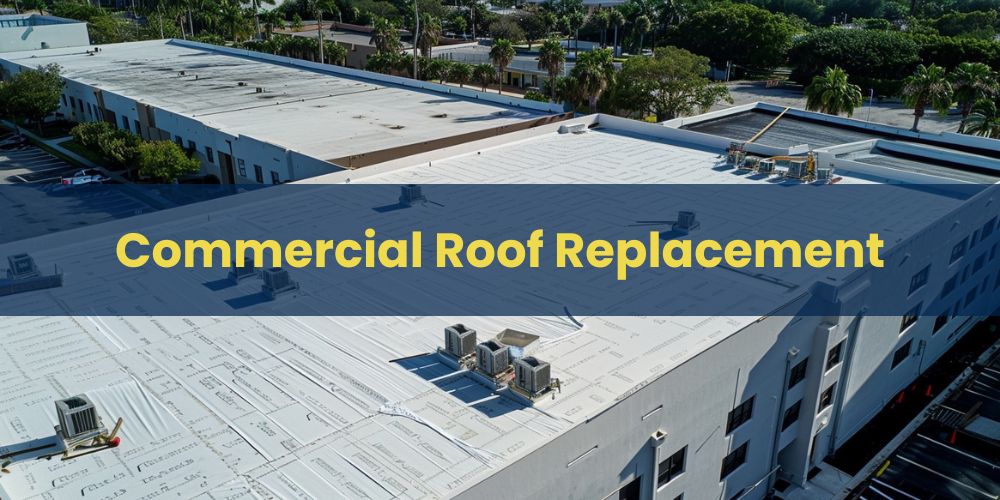
Commercial Roofing Pompano Beach provides commercial roof replacement for flat, low-slope, and sloped commercial buildings across Pompano Beach, Florida. Commercial roof replacement in Pompano Beach is performed under South Florida heat, Atlantic coastal humidity, salt-air exposure, storm-season rainfall, wind-driven moisture, coastal wind uplift, drainage-sensitive roof geometry, rooftop equipment density, and year-round service access demands that directly affect system selection, tear-off requirements, substrate condition, insulation performance, attachment design, flashing integration, drainage reliability, and long-term waterproofing performance across warehouses, retail plazas, office buildings, medical facilities, hospitality properties, food-service buildings, industrial units, service facilities, and multi-tenant commercial properties. Commercial roof replacement removes or rebuilds a failed, expired, saturated, unstable, or economically unviable roof assembly by replacing deteriorated membranes, failed seams, degraded coatings, compromised flashings, damaged insulation, weakened deck areas, unstable fasteners, corroded edge metals, drainage defects, rooftop equipment interfaces, and incompatible prior repair zones with a new commercial roofing system matched to the building’s exposure conditions and operational requirements. In Pompano Beach conditions, replacement performance is determined by how accurately the existing failure state, moisture burden, roof structure, wind exposure, drainage design, building use, and selected roof system are connected into a durable long-term assembly.
- South Florida heat and continuous UV exposure across Pompano Beach commercial roofs → accelerate membrane ageing, coating oxidation, seam fatigue, adhesive decline, sealant shrinkage, fastener stress, thermal movement, and surface brittleness across existing roof assemblies → commercial roof replacement must remove or isolate materials that can no longer maintain waterproofing continuity, dimensional stability, or serviceable movement tolerance → replacement becomes the correct strategy when repeated repairs cannot prevent cracking, seam reopening, coating failure, membrane splitting, and heat-driven leak recurrence.
- Atlantic coastal humidity, salt-air exposure, and wind-driven moisture near Pompano Beach → keep roof edges, fasteners, flashings, metal terminations, gutters, scuppers, insulation edges, roof-to-wall transitions, and penetration details exposed to corrosion-prone and moisture-heavy conditions → commercial roof replacement must address deteriorated edge metals, weakened attachment points, saturated insulation, corroded fasteners, compromised substrate areas, and moisture-contaminated roof layers before the new system is installed → replacement fails as a long-term solution if hidden moisture, unstable deck areas, corroded components, or incompatible underlying materials remain inside the roof assembly.
- Storm-season rainfall and drainage-sensitive roof geometry across Pompano Beach commercial buildings → place heavy water volume onto drains, scuppers, gutters, crickets, valleys, parapet edges, low points, roof-to-wall transition zones, and equipment-adjacent drainage paths → commercial roof replacement must correct ponding zones, improve water discharge, rebuild drainage-adjacent details, coordinate slope limitations, and integrate the new membrane, panel, or coating-compatible assembly with reliable flow paths → replacement that does not resolve drainage defects remains exposed to hydrostatic pressure, insulation saturation, deck deterioration, seam stress, premature membrane ageing, and recurring leak activation.
- Coastal wind uplift, rooftop equipment density, service traffic, and previous repair accumulation → concentrate replacement complexity at roof edges, corners, HVAC curbs, exhaust fans, pipe penetrations, pitch pockets, access routes, walkway zones, equipment supports, fastener rows, patch clusters, and parapet interfaces → commercial roof replacement must redesign attachment, perimeter securement, flashing transitions, penetration detailing, equipment clearances, service-access protection, and repair-contaminated areas as part of one integrated roof assembly → replacing only the visible field roof while leaving weak edges, unstable penetrations, incompatible repair zones, or high-traffic damage paths unresolved allows multi-point roof failure to reappear inside the new system.
Commercial Roofing Pompano Beach delivers commercial roof replacement as a system-level rebuild service, assessing existing roof type, replacement trigger, leak history, repair history, membrane failure, seam failure, coating breakdown, flashing condition, edge metal stability, fastener security, corrosion patterns, wind uplift vulnerability, drainage behaviour, ponding exposure, gutter and scupper performance, rooftop penetration detailing, HVAC curb interfaces, pitch pocket condition, equipment support zones, service-traffic impact, substrate moisture, insulation saturation, deck condition, structural suitability, tear-off requirements, recover viability, roof system compatibility, code-related constraints, operational disruption risk, and remaining roof service life before defining the correct commercial roof replacement scope, insulation plan, attachment method, drainage correction, flashing package, penetration treatment, access protection, partial replacement, recover assembly, or full commercial roof replacement strategy.
What Commercial Roof Replacement Conditions Does Commercial Roofing Pompano Beach Evaluate?
Commercial Roofing Pompano Beach evaluates commercial roof replacement conditions across flat, low-slope, and sloped buildings where the main question is no longer whether a defect can be repaired, but whether the existing roof assembly can still support reliable waterproofing, stable attachment, dry insulation, functional drainage, and long-term service life. In Pompano Beach, replacement decisions are shaped by South Florida heat, Atlantic coastal humidity, salt-air corrosion, storm-season rainfall, wind-driven moisture, coastal uplift pressure, rooftop equipment density, and drainage-sensitive commercial roof geometry. These conditions determine whether the correct path is continued repair, partial replacement, recover installation, full tear-off, roof system conversion, insulation replacement, drainage redesign, or full commercial roof replacement.
The commercial roof replacement conditions evaluated by Commercial Roofing Pompano Beach include:
- End-of-life roof assembly failure → the existing roof has reached a condition where membranes, panels, coatings, seams, flashings, fasteners, insulation, or deck interfaces can no longer maintain waterproofing continuity under normal exposure → Pompano Beach heat, UV load, coastal moisture, stormwater volume, and repeated service access accelerate ageing across multiple roof components at once → recurring leaks, brittle membranes, open laps, coating failure, corrosion, saturated insulation, and unstable repairs begin to overlap → full commercial roof replacement becomes the correct strategy when isolated repair no longer restores system-level performance.
- Widespread moisture burden beneath the roof surface → water has moved beyond the original entry point and affected insulation, cover board, deck areas, substrate layers, or multiple roof zones → Atlantic humidity, storm-season rainfall, wind-driven rain, and low-slope drainage limitations can keep moisture trapped inside the roof assembly even when the surface defect appears repairable → hidden saturation, damp insulation, deck staining, substrate softening, corrosion, and recurring interior leaks develop away from the visible failure point → replacement scope must remove or isolate moisture-damaged materials before a new roof system is installed.
- Tear-off versus recover suitability → the existing roof is evaluated to determine whether it must be removed completely or whether a new recover assembly can be installed over a stable substrate → recover may be viable when the roof is dry, structurally sound, compatible with the new system, and not overloaded by excessive layers → full tear-off becomes necessary when trapped moisture, unstable insulation, failed attachment, contaminated repairs, deteriorated deck areas, or incompatible materials remain below the visible roof surface → Commercial Roofing Pompano Beach determines replacement method from roof condition, not from a generic install preference.
- Drainage failure that cannot be solved through repair alone → low points, blocked scuppers, undersized gutters, weak crickets, parapet-edge flow restrictions, settlement depressions, or roof-to-wall drainage defects repeatedly hold water against the roof assembly → Pompano Beach storm-season rainfall places high water volume on flat and low-slope commercial roofs, making drainage reliability a replacement-level issue when ponding keeps reactivating leaks → membrane deformation, seam stress, coating breakdown, insulation saturation, corrosion, and deck deterioration develop when water remains trapped on the roof → replacement must rebuild drainage logic, not simply install a new surface over the same water-retention pattern.
- Perimeter, edge, and wind-uplift instability → roof edges, corners, termination points, metal fascias, fastener rows, clips, attachment zones, and parapet interfaces no longer resist coastal uplift forces reliably → Pompano Beach wind exposure and storm activity concentrate mechanical stress at the perimeter before the field roof always shows obvious failure → lifted edges, loose fasteners, displaced flashing, edge-metal movement, membrane flutter, panel shift, and recurring perimeter leaks signal that attachment design has become part of the failure condition → replacement must restore uplift resistance, edge securement, and perimeter weatherproofing as one integrated assembly.
- Rooftop equipment and penetration overload → HVAC curbs, exhaust fans, pipe penetrations, vents, pitch pockets, equipment supports, access routes, and service zones have created too many unstable interruption points across the roof surface → equipment vibration, maintenance traffic, wind-driven rain, and thermal movement in Pompano Beach weaken flashing packages, curb transitions, sealants, boots, patches, and roof-mounted interfaces → repeated leak repairs around equipment zones become less reliable as water-entry points multiply → replacement must redesign penetration detailing, curb integration, equipment clearances, and service-access protection instead of only replacing the open field roof.
- Material mismatch and accumulated repair contamination → old patches, mastics, coating overlays, welded repairs, repair plates, incompatible membranes, corroded metal details, and repeated leak corrections create an uneven roof assembly that no longer behaves as one system → South Florida heat, salt-air exposure, coastal moisture, and rooftop traffic cause original materials and repair materials to expand, bond, age, and shed water differently → patch-edge leaks, coating incompatibility, adhesive failure, corrosion creep, open transitions, and multi-area recurrence become common → replacement becomes more appropriate when the roof can no longer be made continuous through repair or restoration.
- Roof system conversion requirement → the existing roof type may no longer match the building’s exposure, use, drainage conditions, chemical exposure, wind load, maintenance access, or energy-performance needs → Pompano Beach buildings with food-service exhaust, heavy rooftop equipment, coastal corrosion exposure, ponding-prone low-slope areas, or high solar gain may require a different replacement system than the roof originally installed → selecting TPO, PVC, EPDM, modified bitumen, metal roofing, built-up roofing, or a coating-compatible recover assembly requires matching material behaviour to the building’s actual operating conditions → replacement should solve the performance mismatch that caused the previous roof to fail.
- Operational continuity during replacement → the replacement plan must account for tenants, equipment access, business hours, weather windows, staging areas, material movement, safety zones, interior protection, and water-tight daily closeout → commercial buildings in Pompano Beach often need roof replacement without unnecessary disruption to retail operations, medical facilities, hospitality properties, warehouses, food-service buildings, or multi-tenant spaces → poorly sequenced replacement can expose interiors, interrupt operations, or leave unfinished roof areas vulnerable to sudden storm rainfall → Commercial Roofing Pompano Beach evaluates replacement sequencing as part of the roof system strategy, not as a separate construction detail.
Commercial Roofing Pompano Beach determines commercial roof replacement scope by separating repairable conditions from replacement-level failure states. The evaluation considers roof age, system type, leak history, repair history, moisture burden, insulation condition, deck stability, substrate suitability, drainage defects, wind uplift exposure, perimeter security, rooftop equipment complexity, penetration density, prior repair compatibility, material selection, recover viability, tear-off requirements, operational disruption risk, and long-term service expectations. This ensures that commercial roof replacement, recover installation, partial replacement, insulation replacement, drainage redesign, flashing rebuild, penetration treatment, access protection, roof system conversion, or full commercial roof replacement is selected according to how the existing roof has failed under Pompano Beach conditions.
Have a question about a commercial roofing project?
How Does Commercial Roofing Pompano Beach Decide Whether Replacement Is Necessary?
Commercial Roofing Pompano Beach decides whether commercial roof replacement is necessary by testing whether the existing roof can still support reliable waterproofing, dry insulation, stable attachment, functional drainage, safe edge securement, and realistic service life. Replacement is not recommended simply because a roof has damage. It becomes necessary when repair, coating, restoration, or partial correction can no longer control the failure pattern. On Pompano Beach commercial buildings, South Florida heat, Atlantic coastal humidity, salt-air exposure, storm-season rainfall, wind-driven moisture, coastal wind uplift, rooftop equipment density, service traffic, and low-slope drainage behaviour can push an ageing or saturated roof assembly beyond the point where isolated repairs provide durable value.
The replacement necessity checks used by Commercial Roofing Pompano Beach include:
- Repair no longer restores system-level performance. Repeated repairs may stop individual symptoms for a short period → Pompano Beach heat movement, stormwater loading, coastal moisture, rooftop traffic, and wind-driven rain can expose the same underlying failure across seams, flashings, coatings, edges, penetrations, drains, or prior repair zones → replacement becomes necessary when the roof keeps producing new failures faster than targeted repairs can control them → Commercial Roofing Pompano Beach separates repairable damage from a roof assembly that has lost reliable system performance.
- Moisture burden has moved beyond isolated repair zones. Wet insulation, saturated cover board, soft substrate, deck staining, trapped vapour, recurring interior leaks, odour, corrosion, or moisture spread across multiple roof areas can make local repair ineffective → Atlantic humidity and storm-season rainfall in Pompano Beach can keep water active beneath membranes, coatings, panels, asphaltic layers, and older repair areas even after the surface appears dry → replacement becomes stronger when moisture-contaminated materials cannot be dried or removed inside a limited repair scope → Commercial Roofing Pompano Beach evaluates whether the roof requires partial replacement, full tear-off, or full commercial roof replacement.
- Drainage failure keeps reloading the roof assembly. Ponding zones, settlement depressions, blocked scuppers, undersized gutters, weak crickets, low points, parapet-edge water paths, and equipment-adjacent drainage restrictions can repeatedly load the same roof areas → Pompano Beach storm-season rainfall can turn drainage defects into hydrostatic pressure, seam stress, membrane deformation, coating breakdown, insulation saturation, and deck deterioration → replacement becomes necessary when drainage correction cannot be separated from rebuilding the roof assembly → Commercial Roofing Pompano Beach evaluates replacement with drainage redesign, tapered work, improved discharge paths, or rebuilt low-slope water-management details.
- Attachment, edge, or uplift resistance is no longer reliable. Lifted edges, membrane flutter, displaced edge metal, loose termination bars, fastener back-out, cracked washers, panel movement, clip failure, coping movement, and perimeter leakage can signal deeper restraint failure → coastal wind uplift, salt-air corrosion, Atlantic humidity, and storm exposure in Pompano Beach can weaken roof securement before the field roof looks fully failed → replacement becomes necessary when local edge repair cannot restore wind resistance, attachment stability, and perimeter waterproofing → Commercial Roofing Pompano Beach reviews whether the roof needs a new attachment design, perimeter package, flashing system, or full replacement assembly.
- Roof surfaces no longer support coating or restoration. Restoration or coating may be viable when the roof is dry, stable, compatible, and still structurally serviceable → Pompano Beach solar intensity, salt-air residue, ponding exposure, food-service exhaust, stormwater loading, and rooftop traffic can create coating delamination, membrane brittleness, widespread cracking, exposed substrate, adhesion loss, corrosion spread, and unstable prior repairs → replacement becomes necessary when the existing roof cannot accept a reliable restoration system → Commercial Roofing Pompano Beach separates recoverable roof surfaces from surfaces that would only conceal deeper failure.
- Rooftop equipment and penetration density has overwhelmed the existing roof. HVAC curbs, exhaust fans, pipe penetrations, pitch pockets, vents, skylights, roof hatches, equipment supports, conduit routes, and service paths can create too many unstable interruption points → Pompano Beach rooftop equipment density, service access, vibration, heat movement, curb-side runoff, and wind-driven rain can make repeated detail repairs unreliable → replacement becomes necessary when penetration flashing, equipment clearances, service-route protection, and curb integration need to be redesigned as part of the roof system → Commercial Roofing Pompano Beach evaluates whether replacement should include rebuilt penetrations, upgraded details, walk pads, and equipment-zone protection.
- Prior repair layers have made the roof assembly incompatible. Old patches, mastics, coating overlays, welded repairs, repair plates, sealant beads, fastener treatments, incompatible membranes, and repeated repair zones can prevent the roof from behaving as one continuous assembly → South Florida heat, salt-air moisture, stormwater exposure, and rooftop traffic can make repair materials expand, bond, age, and shed water differently from the original roof system → replacement becomes necessary when repair contamination makes new repair, coating, restoration, or recover work unreliable → Commercial Roofing Pompano Beach determines whether the existing roof must be removed, partially replaced, or rebuilt before a new system is installed.
- The roof system no longer matches the building’s exposure or use. A roof that once worked may become unsuitable when building use changes, rooftop equipment increases, drainage demand changes, food-service exhaust is added, wind exposure becomes more critical, or service traffic intensifies → Pompano Beach’s humid, coastal, storm-exposed environment can expose mismatches between the existing roof system and the building’s actual operating demands → replacement becomes necessary when the current system cannot meet waterproofing, chemical resistance, traffic resistance, uplift resistance, drainage, or energy-performance requirements → Commercial Roofing Pompano Beach evaluates whether like-for-like replacement or roof system conversion is the stronger long-term decision.
- Replacement provides better long-term value than continued intervention. Repair, coating, restoration, and partial replacement can remain appropriate while they preserve service life and reduce risk → Pompano Beach heat, humidity, salt-air exposure, storm rainfall, wind-driven moisture, uplift pressure, and service traffic can make repeated intervention costly when the roof is already saturated, unstable, heavily repaired, poorly draining, or near end of life → replacement becomes necessary when continued repair only postpones failure without improving long-term performance → Commercial Roofing Pompano Beach weighs current condition, future risk, roof lifespan, operational disruption, and replacement scope before recommending full commercial roof replacement.
Commercial Roofing Pompano Beach decides commercial roof replacement necessity by connecting repair history, moisture burden, drainage reliability, attachment stability, restoration eligibility, rooftop equipment complexity, prior repair compatibility, roof-system suitability, and remaining service-life value. Replacement is the correct decision when the existing roof can no longer function as a stable, dry, drainable, compatible, and durable commercial roofing assembly under Pompano Beach’s humid, coastal, storm-exposed conditions.
Have a question about a commercial roofing project?
What Existing Roof Conditions Determine Tear-Off, Recover, or Partial Replacement?
Commercial Roofing Pompano Beach determines whether a commercial roof needs full tear-off, recover installation, or partial replacement by evaluating what remains usable inside the existing roof assembly. The decision is not based only on age or visible surface damage. On Pompano Beach commercial buildings, South Florida heat, Atlantic coastal humidity, salt-air exposure, storm-season rainfall, wind-driven moisture, coastal uplift pressure, rooftop equipment density, service traffic, and drainage-sensitive roof geometry can affect insulation, deck stability, attachment, edge securement, roof layers, prior repairs, drainage paths, and substrate compatibility in different ways. Tear-off becomes stronger when the existing assembly is wet, unstable, contaminated, overloaded, incompatible, or structurally compromised. Recover may be suitable when the roof is dry, attached, compatible, and capable of supporting a new assembly. Partial replacement may be appropriate when failure is concentrated in defined zones while the remaining roof still performs reliably.
The existing roof conditions Commercial Roofing Pompano Beach evaluates before choosing tear-off, recover, or partial replacement include:
- Moisture condition inside the roof assembly. Dry insulation, stable cover board, and clean substrate can support recover or limited replacement in some cases → Pompano Beach storm rainfall, Atlantic humidity, wind-driven rain, and low-slope drainage behaviour can keep moisture trapped beneath membranes, coatings, panels, and asphaltic layers → wet insulation, soft substrate, deck staining, odour, blistering, corrosion, and recurring interior leaks usually make covering over the roof risky → Commercial Roofing Pompano Beach uses moisture condition to determine whether the roof can be recovered, partially replaced, or must be torn off before a new system is installed.
- Number and condition of existing roof layers. A recover assembly may be possible when existing layers are limited, compatible, dry, stable, and properly attached → repeated repairs, coating overlays, old membranes, insulation layers, patch clusters, and hidden saturation can create an uneven roof base under Pompano Beach heat, moisture, and storm exposure → too many layers or unstable layers can trap moisture, overload the roof, reduce attachment reliability, and prevent the new system from performing correctly → Commercial Roofing Pompano Beach evaluates whether existing layers support recover installation or require full tear-off.
- Deck strength and substrate stability. Recover or partial replacement depends on whether the deck, substrate, and support layers remain strong enough to hold the new roof system → Atlantic humidity, repeated rainfall, trapped water, and coastal exposure in Pompano Beach can weaken wood decks, corrode metal decks, stain concrete decks, soften cover boards, and reduce fastener pull-out resistance → deck deterioration, soft areas, corrosion, deflection, fastener failure, or substrate movement push the project toward tear-off and structural correction → Commercial Roofing Pompano Beach evaluates deck condition before selecting the replacement method.
- Attachment and wind-uplift reliability. A recover system needs dependable attachment through the existing roof into a stable substrate → Pompano Beach coastal wind uplift, storm exposure, salt-air corrosion, and perimeter movement can weaken fasteners, clips, plates, edge metals, termination bars, panel fixings, and membrane restraint → loose attachment, fastener back-out, washer failure, plate movement, membrane flutter, lifted edges, or unstable perimeter securement can make recover unreliable → Commercial Roofing Pompano Beach determines whether attachment can be upgraded locally, requires partial replacement, or needs full tear-off with a new securement design.
- Drainage behaviour and ponding history. Recover may be viable when water leaves the roof predictably and drainage problems are minor or correctable → Pompano Beach storm-season rainfall can overload low-slope commercial roofs with blocked drains, clogged scuppers, weak crickets, settlement depressions, undersized gutters, and parapet-edge flow restrictions → persistent ponding can saturate insulation, deform membranes, soften coatings, stress seams, corrode metal, and damage deck areas → Commercial Roofing Pompano Beach evaluates whether drainage can be corrected within a recover or partial replacement scope or whether tear-off is needed to rebuild the roof’s water-management logic.
- Perimeter, flashing, and penetration condition. Recover or partial replacement depends on whether edges, flashings, roof-to-wall transitions, HVAC curbs, pipe penetrations, pitch pockets, drains, scuppers, gutters, and equipment interfaces can be integrated into the new system → Pompano Beach wind-driven rain, coastal uplift, salt-air exposure, rooftop equipment density, and service access concentrate stress around these details → unstable curbs, corroded edge metals, failed flashings, crowded penetrations, loose terminations, and repeated equipment-zone leakage can make isolated recover work unreliable → Commercial Roofing Pompano Beach evaluates whether these details can be rebuilt locally or require larger tear-off and replacement work.
- Prior repair contamination and material compatibility. Old patches, mastics, coatings, sealants, welded repairs, repair plates, incompatible membranes, asphaltic residues, and coating overlays can affect whether a new roof can bond, fasten, or drain correctly → South Florida heat, salt-air moisture, stormwater loading, and rooftop traffic can make old repair materials split, lift, soften, trap moisture, or age differently from the original roof → incompatible layers create weak tie-in points and can compromise recover performance → Commercial Roofing Pompano Beach determines whether prior repairs can be removed and isolated locally or whether full tear-off is needed to create a reliable base.
- Failure pattern across the roof area. Partial replacement may be suitable when damage is concentrated around one roof section, one equipment zone, one drainage area, one storm-damaged area, or one moisture-contaminated zone → Pompano Beach exposure can create localised failure where water collects, service traffic concentrates, or wind uplift loads roof edges → full replacement becomes stronger when failure repeats across seams, flashings, coatings, fasteners, drains, edges, and prior repairs across the building → Commercial Roofing Pompano Beach uses the spread of failure to decide whether the project should remain partial or move into full commercial roof replacement.
- Operational and sequencing constraints. Commercial roof replacement must account for tenant access, business hours, weather windows, rooftop equipment operation, material staging, interior protection, safety zones, and watertight daily closeout → Pompano Beach commercial buildings such as retail plazas, medical facilities, hospitality properties, warehouses, food-service buildings, and multi-tenant spaces often need replacement work sequenced around active operations and storm risk → operational constraints can influence whether phased partial replacement, recover installation, or full tear-off is the most practical approach → Commercial Roofing Pompano Beach evaluates replacement method with building use and continuity needs included in the scope.
- Long-term value of the replacement method. Tear-off, recover, and partial replacement each make sense only when the method solves the actual failure state → Pompano Beach heat, humidity, salt-air exposure, stormwater loading, wind uplift, and rooftop traffic will quickly expose hidden moisture, unstable layers, poor drainage, or incompatible substrates → choosing the lowest-disruption option can create premature failure if the existing roof cannot support it → Commercial Roofing Pompano Beach selects tear-off, recover, or partial replacement according to durability, moisture risk, attachment reliability, drainage performance, operational impact, and long-term roof service life.
Commercial Roofing Pompano Beach determines tear-off, recover, or partial replacement by connecting moisture condition, roof layers, deck strength, attachment reliability, drainage behaviour, flashing integration, penetration complexity, prior repair compatibility, failure spread, operational sequencing, and long-term value. Recover is considered when the existing roof is dry, stable, compatible, drainable, and attachable. Partial replacement is considered when failure is concentrated and the remaining roof is still serviceable. Full tear-off becomes stronger when moisture, unstable layers, poor attachment, drainage failure, deck deterioration, repair contamination, or widespread system failure would compromise the new commercial roof replacement under Pompano Beach’s humid, coastal, storm-exposed conditions.
Have a question about a commercial roofing project?
Which Replacement Details Control Drainage, Wind Uplift, Flashings, and Rooftop Equipment Integration?
Commercial Roofing Pompano Beach controls commercial roof replacement performance by rebuilding the details that decide whether the new roof can drain correctly, resist coastal uplift, integrate with wall and edge transitions, and remain watertight around rooftop equipment. Replacement is not only the installation of a new membrane, panel, coating-compatible recover assembly, or roof surface. On Pompano Beach commercial buildings, South Florida heat, Atlantic coastal humidity, salt-air exposure, storm-season rainfall, wind-driven moisture, coastal wind uplift, rooftop equipment density, year-round service access, and low-slope drainage behaviour test the replacement details around drains, scuppers, gutters, parapets, flashings, edge metals, fasteners, attachment zones, penetrations, HVAC curbs, pitch pockets, service routes, and equipment supports.
The replacement details that control long-term roof performance include:
- Drainage layout and water-discharge correction. New roof performance depends on whether stormwater can move from roof fields to drains, scuppers, gutters, downspouts, crickets, valleys, low points, overflow routes, and parapet-edge discharge paths → Pompano Beach storm-season rainfall can overload flat and low-slope commercial roofs when water is allowed to return to the same ponding zones that damaged the previous system → replacement must correct blocked outlets, restricted flow paths, settlement depressions, weak crickets, and drainage-adjacent defects before the new assembly is closed → Commercial Roofing Pompano Beach integrates water-management correction into the replacement scope so the new roof is not exposed to avoidable ponding pressure.
- Low-slope ponding control and tapered design decisions. Ponding history affects whether the replacement needs tapered insulation, cricket adjustments, reinforced low-point detailing, redesigned scuppers, drain relocation, or improved overflow paths → Pompano Beach rainfall volume, wind-displaced debris, salt residue, and low-slope geometry can keep water over seams, flashings, penetrations, coatings, and prior failure zones → replacing the surface without improving water behaviour can recreate coating breakdown, seam stress, insulation saturation, deck deterioration, and recurring leaks → Commercial Roofing Pompano Beach evaluates slope and ponding history before selecting the replacement build-up.
- Wind-uplift attachment design. Commercial roof replacement must account for how the new assembly is attached to resist coastal wind pressure at the field, perimeter, and corner zones → Pompano Beach coastal uplift exposure can place heavier demand on fasteners, plates, adhesives, clips, termination bars, membranes, panels, edge metals, and roof deck connections → weak attachment design can allow membrane flutter, edge lift, panel movement, fastener stress, seam strain, and storm-related failure → Commercial Roofing Pompano Beach plans attachment method, securement density, perimeter reinforcement, and substrate compatibility so the replacement roof performs under local wind exposure.
- Perimeter edge metal and roof-edge securement. Roof edges, corners, coping caps, fascia lines, gutter interfaces, edge metals, termination bars, panel ends, membrane restraints, and parapet returns must be rebuilt as part of the replacement system → salt-air exposure, Atlantic humidity, wind-driven rain, and coastal uplift pressure near Pompano Beach can weaken perimeter details before the central roof field fails → new roof performance depends on stable edge metals, compatible terminations, secure fasteners, sealed transitions, and uplift-resistant perimeter design → Commercial Roofing Pompano Beach treats edge securement as a core replacement detail rather than a cosmetic trim item.
- Flashing package at walls, parapets, and vertical transitions. Replacement performance depends on whether parapet walls, roof-to-wall joints, base flashings, counterflashings, coping returns, mastic edges, termination points, coated metal transitions, and vertical membrane details are rebuilt into a continuous water-shedding system → Pompano Beach wind-driven rain, heat movement, coastal moisture, and uplift pressure repeatedly stress fixed transitions → reused or poorly integrated flashings can let water move behind a new roof surface → Commercial Roofing Pompano Beach integrates flashing details with the replacement membrane, panel, or roof system so wall-side leakage does not reappear after replacement.
- Drain, scupper, gutter, and overflow integration. Drains, scuppers, gutters, conductor heads, downspouts, strainers, sumps, overflow routes, and parapet openings must connect correctly to the replacement roof surface → Pompano Beach storm rainfall can expose weak drain tie-ins, undersized scuppers, corroded gutters, blocked overflow routes, and poorly detailed sump areas quickly after installation → drainage components must be cleaned, replaced, resized, reinforced, or rebuilt where existing conditions would compromise the new roof → Commercial Roofing Pompano Beach coordinates drainage hardware with the replacement assembly instead of treating drainage as a separate maintenance issue.
- Rooftop equipment curb and penetration integration. HVAC curbs, exhaust fans, pipe penetrations, vents, skylights, roof hatches, conduit supports, pitch pockets, service lines, equipment supports, and equipment platforms must be integrated into the new roof rather than patched around after installation → Pompano Beach rooftop equipment density, service traffic, vibration, heat expansion, curb-side runoff, and wind-driven rain place heavy stress around fixed openings → replacement should rebuild curb flashings, pipe boots, pitch pockets, termination details, collars, supports, and surrounding membrane reinforcement as one system → Commercial Roofing Pompano Beach designs equipment-zone integration so rooftop service areas do not become early failure points in the new roof.
- Walkway and service-access protection. Replacement details must account for how technicians, contractors, tenants, and service providers will move across the roof after installation → Pompano Beach commercial buildings often have year-round HVAC service, food-service exhaust access, hospitality operations, retail maintenance, industrial equipment checks, and multi-tenant service needs → unprotected access routes can create scuffs, punctures, compressed coatings, damaged seams, displaced flashings, and premature membrane wear → Commercial Roofing Pompano Beach includes walk pads, service-route planning, equipment-area protection, and traffic-sensitive detailing where building operations require regular rooftop access.
- Substrate preparation and insulation integration. Drainage, uplift, flashings, and equipment details only perform when the substrate and insulation package below the new roof are stable → Atlantic humidity, trapped moisture, previous leaks, wet insulation, damaged cover board, deck staining, fastener pull-out, and substrate deterioration in Pompano Beach can compromise replacement performance from below → insulation layout, cover board selection, fastening pattern, substrate preparation, and moisture removal must support the replacement system → Commercial Roofing Pompano Beach connects replacement detail design to the condition of the layers beneath the roof surface.
- System tie-ins, transitions, and phased replacement boundaries. Commercial replacement projects may need tie-ins between new roof sections, remaining roof areas, wall transitions, equipment zones, parapet details, drainage paths, and phased work boundaries → Pompano Beach weather windows, active business operations, storm risk, and mixed roof conditions can make poor temporary or permanent tie-ins a major failure risk → transition details must remain watertight during installation and durable after completion → Commercial Roofing Pompano Beach plans tie-ins and phased boundaries so the replacement assembly performs as one integrated commercial roof system.
Commercial Roofing Pompano Beach controls commercial roof replacement performance by treating drainage design, ponding correction, wind-uplift attachment, edge securement, flashing integration, drainage hardware, rooftop equipment detailing, service-access protection, substrate preparation, and system tie-ins as connected replacement details. These details determine whether the new roof can resist Pompano Beach’s humid, coastal, storm-exposed conditions and provide durable waterproofing, drainage reliability, wind resistance, service access protection, and long-term commercial roof performance.
How Does Commercial Roofing Pompano Beach Match Replacement Systems to Building Exposure?
Commercial Roofing Pompano Beach matches commercial roof replacement systems to building exposure by selecting the roof assembly that best fits the property’s heat load, moisture exposure, wind-uplift risk, drainage behaviour, rooftop equipment density, service traffic, chemical exposure, substrate condition, and long-term maintenance requirements. A replacement roof should not be chosen only because it matches the old system. On Pompano Beach commercial buildings, South Florida solar intensity, Atlantic coastal humidity, salt-air exposure, storm-season rainfall, wind-driven moisture, coastal wind uplift, low-slope drainage stress, food-service exhaust, rooftop HVAC concentration, and year-round service access can make TPO, PVC, EPDM, modified bitumen, metal roofing, built-up roofing, roof coating recover assemblies, or hybrid replacement approaches perform very differently from one property to another.
The replacement system matching factors used by Commercial Roofing Pompano Beach include:
- Solar heat and reflectivity demands. High roof-surface heat can accelerate membrane ageing, coating oxidation, adhesive fatigue, sealant shrinkage, and interior heat gain → Pompano Beach solar exposure places constant stress on exposed roof fields across warehouses, retail plazas, medical buildings, hospitality properties, food-service buildings, and multi-tenant commercial spaces → replacement systems with suitable reflectivity, thermal movement tolerance, insulation planning, and surface durability may perform better than darker or heat-sensitive assemblies → Commercial Roofing Pompano Beach evaluates whether TPO, PVC, reflective coating-compatible systems, insulated assemblies, or other replacement options better match the building’s heat exposure.
- Coastal moisture and salt-air corrosion exposure. Atlantic humidity and salt-air conditions can affect fasteners, edge metals, gutters, scuppers, termination bars, clips, washers, metal panels, flashing metals, and roof-to-wall transitions → Pompano Beach coastal exposure can weaken roof systems that rely on vulnerable metal components or poorly protected perimeter details → replacement system selection must include corrosion-resistant detailing, compatible edge metals, secure termination design, drainage hardware review, and fastener strategy → Commercial Roofing Pompano Beach matches the roof system to the property’s corrosion risk rather than treating all Pompano Beach roofs as identical.
- Storm rainfall and low-slope drainage behaviour. Flat and low-slope commercial roofs need replacement systems that can tolerate stormwater loading while moving water efficiently to drains, scuppers, gutters, valleys, crickets, low points, and overflow routes → Pompano Beach storm-season rainfall can expose ponding areas, weak slopes, restricted discharge paths, and drainage-adjacent failure zones quickly after installation → system choice must account for membrane behaviour under ponding, seam layout, drainage redesign, tapered insulation, reinforced low-point details, and water-release capacity → Commercial Roofing Pompano Beach selects replacement assemblies that match the roof’s actual drainage behaviour, not just its square footage.
- Coastal wind-uplift and attachment requirements. Replacement systems must be matched to the building’s field, perimeter, and corner uplift exposure → Pompano Beach wind-driven rain, storm activity, and coastal uplift pressure place heavy demand on attachment patterns, fastener density, adhered systems, mechanically attached membranes, metal panels, edge securement, and deck compatibility → a roof system that performs on a sheltered inland building may be unsuitable for a more exposed commercial property near coastal wind paths → Commercial Roofing Pompano Beach evaluates attachment design, deck condition, perimeter reinforcement, and wind-resistance needs before selecting the replacement system.
- Rooftop equipment density and service access. HVAC units, exhaust fans, vents, pipe penetrations, roof hatches, conduit lines, pitch pockets, equipment supports, service platforms, and access paths place repeated stress on replacement roofs → Pompano Beach commercial buildings with year-round service traffic need systems and details that can tolerate foot traffic, vibration, curb-side runoff, puncture risk, service tools, and repeated access routes → replacement selection may require reinforced membrane areas, walk pads, stronger flashing packages, equipment-zone redesign, or a system with better traffic and puncture resistance → Commercial Roofing Pompano Beach matches the new roof to how the building is actually serviced after installation.
- Food-service, exhaust, chemical, and contamination exposure. Restaurants, hospitality properties, food-service tenants, industrial units, and service facilities may expose roof surfaces to grease, oils, exhaust residue, chemicals, dirt loading, and cleaning contaminants → Pompano Beach heat and humidity can intensify the effect of contaminants on membranes, coatings, sealants, adhesives, and drainage paths → like-for-like replacement may be inappropriate if the previous roof was damaged by chemical or grease exposure → Commercial Roofing Pompano Beach evaluates whether PVC, coated assemblies, reinforced details, protected service zones, or alternative systems are better suited to the building’s contamination profile.
- Existing deck, insulation, and substrate conditions. Replacement system choice depends on whether the deck, insulation, cover board, substrate, and attachment base can support the selected assembly → Atlantic humidity, trapped moisture, prior leaks, saturated insulation, deck corrosion, substrate softening, and fastener pull-out risk in Pompano Beach can limit which systems are viable → a replacement system may require tear-off, new insulation, cover board upgrades, attachment redesign, or deck correction before installation → Commercial Roofing Pompano Beach matches the system to the physical base available after moisture and substrate conditions are confirmed.
- Recover, restoration, or full replacement compatibility. Some buildings may support a recover assembly when the existing roof is dry, stable, compatible, and properly attached, while others require full tear-off because of moisture, contamination, unstable layers, or incompatible materials → Pompano Beach heat, stormwater, salt-air exposure, and rooftop traffic can expose weak recover decisions quickly when the existing roof cannot support the new system → system matching must account for whether the selected assembly can integrate with existing layers, prior repairs, coatings, flashings, and perimeter details → Commercial Roofing Pompano Beach selects replacement or recover systems according to compatibility rather than convenience.
- Building use, disruption tolerance, and long-term maintenance access. Warehouses, retail plazas, medical facilities, hospitality buildings, food-service properties, industrial spaces, service facilities, and multi-tenant buildings have different operating constraints during and after roof replacement → Pompano Beach storm windows, tenant access, equipment operation, staging limits, safety zones, and watertight daily closeout can influence replacement sequencing and system choice → the selected roof system should support both installation logistics and long-term maintenance access → Commercial Roofing Pompano Beach matches replacement systems to the building’s operational demands as well as its exposure conditions.
- Long-term service-life and maintenance strategy. A replacement system must make sense for the property’s expected maintenance cadence, inspection needs, roof access, repairability, coating eligibility, drainage sensitivity, and future service life → Pompano Beach’s humid, coastal, storm-exposed environment can punish systems that are difficult to maintain, incompatible with rooftop traffic, or poorly matched to drainage and wind conditions → the best replacement choice is the system that can remain inspectable, maintainable, repairable, drainable, and durable over time → Commercial Roofing Pompano Beach matches the new roof to long-term performance, not just initial installation preference.
Commercial Roofing Pompano Beach matches replacement systems to building exposure by connecting roof material selection, heat response, coastal corrosion risk, stormwater behaviour, wind-uplift design, rooftop equipment load, contamination exposure, substrate condition, recover compatibility, operational needs, and maintenance strategy. This ensures the selected commercial roof replacement system fits the actual Pompano Beach building rather than simply repeating the roof assembly that previously failed.
When Should a Pompano Beach Commercial Property Request Commercial Roof Replacement?
A Pompano Beach commercial property should request commercial roof replacement when the existing roof can no longer provide reliable waterproofing, dry insulation, stable attachment, functional drainage, safe perimeter securement, or realistic remaining service life. Replacement should be considered when the roof shows widespread membrane ageing, repeated leaks, saturated insulation, soft substrate, deck deterioration, recurring ponding, failed seams, extensive coating breakdown, unstable edge metals, corroded fasteners, displaced flashings, wind-uplift movement, storm damage across multiple areas, heavy prior repair buildup, or rooftop equipment zones that repeatedly fail. Under South Florida heat, Atlantic coastal humidity, salt-air exposure, storm-season rainfall, wind-driven moisture, coastal wind uplift, rooftop equipment density, year-round service access, and low-slope drainage stress, a roof that once looked repairable can move into replacement territory when isolated repairs, coating work, partial correction, or restoration no longer control the wider failure pattern.
Commercial Roofing Pompano Beach uses commercial roof replacement to rebuild the roof assembly around the building’s actual failure state, exposure conditions, drainage behaviour, wind-uplift demand, substrate condition, operational needs, and long-term service expectations. Replacement may involve full tear-off, recover installation, partial replacement, insulation replacement, deck correction, drainage redesign, perimeter securement, flashing reconstruction, penetration treatment, rooftop equipment integration, walkway protection, or roof system conversion depending on what the existing roof can still support. Requesting replacement is strongest when continued repair would only postpone failure, when wet or unstable materials cannot be isolated locally, when drainage defects must be rebuilt into the roof design, when coastal wind or corrosion has compromised attachment, or when the current roof system no longer matches the demands of a Pompano Beach commercial building operating in humid, coastal, storm-exposed conditions.