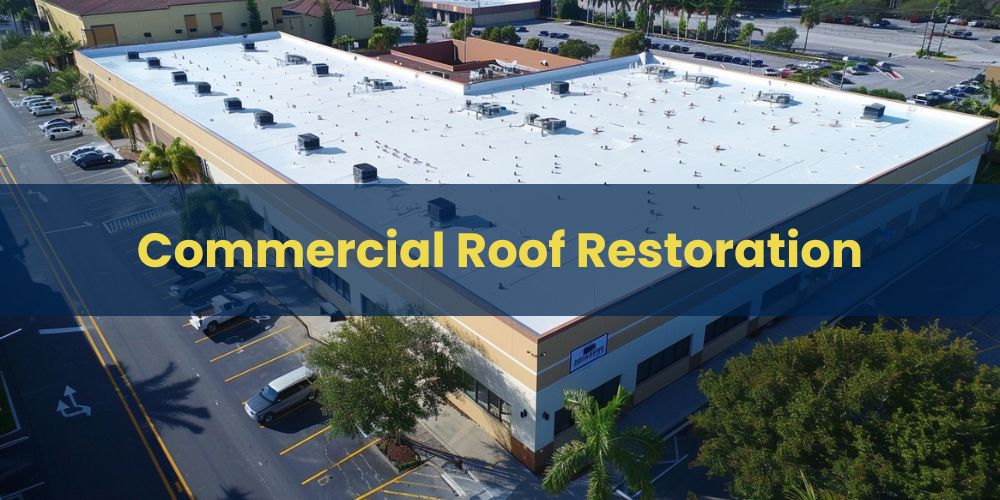
Commercial Roofing Pompano Beach provides commercial roof restoration for flat, low-slope, and sloped commercial buildings across Pompano Beach, Florida. Commercial roof restoration in Pompano Beach is performed under South Florida heat, Atlantic coastal humidity, salt-air exposure, storm-season rainfall, wind-driven moisture, coastal wind uplift, drainage-sensitive roof geometry, rooftop equipment density, and year-round service access demands that directly affect restoration viability, membrane recoverability, coating adhesion, seam reinforcement, flashing renewal, substrate stability, insulation protection, and long-term waterproofing performance across warehouses, retail plazas, office buildings, medical facilities, hospitality properties, food-service buildings, industrial units, service facilities, and multi-tenant commercial properties. Commercial roof restoration extends the service life of an existing roof assembly by correcting repairable defects, reinforcing seams, renewing flashings, treating penetrations, restoring surface protection, improving drainage performance, addressing moisture-limited areas, and applying compatible restoration systems before the roof reaches full replacement condition. In Pompano Beach conditions, restoration performance is determined by how accurately the existing roof type, moisture burden, membrane condition, coating compatibility, drainage behaviour, wind exposure, and remaining structural stability are connected into a recoverable long-term waterproofing strategy.
- South Florida heat and continuous UV exposure across Pompano Beach commercial roofs → accelerate membrane ageing, coating oxidation, sealant shrinkage, seam fatigue, adhesive decline, surface chalking, thermal movement, and brittleness across restorable roof assemblies → commercial roof restoration must verify that the existing membrane, seams, flashings, coatings, and substrate can still accept reinforcement, resurfacing, or coating without trapping active deterioration → restoration remains viable when heat-related ageing is correctable, but becomes unreliable when cracking, seam failure, membrane shrinkage, or surface degradation has passed the recoverable threshold.
- Atlantic coastal humidity, salt-air exposure, and wind-driven moisture near Pompano Beach → keep roof edges, fasteners, metal terminations, flashing interfaces, gutters, scuppers, insulation edges, roof-to-wall transitions, and penetration details exposed to corrosion-prone and moisture-heavy conditions → commercial roof restoration must identify and isolate saturated areas, stabilize corroded components, clean contaminated surfaces, reseal vulnerable transitions, and confirm adhesion readiness before restoration materials are installed → restoration fails when hidden moisture, salt residue, damp substrates, corroded fasteners, or unstable edge details remain beneath the renewed roof surface.
- Storm-season rainfall and drainage-sensitive roof geometry across Pompano Beach commercial buildings → place repeated water volume onto drains, scuppers, gutters, crickets, valleys, parapet edges, low points, patched areas, roof-to-wall transitions, and equipment-adjacent drainage paths → commercial roof restoration must correct ponding conditions, clear blocked outlets, reinforce water-loaded seams, rebuild drainage-adjacent flashings, and ensure the restored surface can resist standing-water exposure where unavoidable → restoration that ignores drainage defects remains exposed to hydrostatic pressure, coating softening, lap separation, membrane deformation, insulation saturation, deck deterioration, and recurring leak activation.
- Coastal wind uplift, rooftop equipment density, service traffic, and previous repair accumulation → concentrate restoration risk at roof edges, corners, HVAC curbs, exhaust fans, pipe penetrations, pitch pockets, access routes, walkway zones, equipment supports, fastener rows, patch clusters, and parapet interfaces → commercial roof restoration must rebuild high-movement details, reinforce penetrations, secure vulnerable edges, protect service-access areas, and verify compatibility between old repairs and new restoration materials → restoring only the field roof while leaving weak flashings, unstable penetrations, incompatible patches, or traffic-damaged zones unresolved allows localised defects to expand into multi-area roof failure.
Commercial Roofing Pompano Beach delivers commercial roof restoration as a system-level renewal service, assessing roof type, restoration eligibility, leak history, repair history, membrane condition, seam continuity, lap stability, coating compatibility, surface preparation needs, primer requirements, adhesion readiness, flashing integrity, edge metal condition, fastener security, corrosion patterns, wind uplift vulnerability, drainage behaviour, ponding exposure, gutter and scupper performance, rooftop penetration detailing, HVAC curb interfaces, pitch pocket condition, equipment support zones, service-traffic damage, substrate moisture, insulation saturation, deck condition, recoverable defects, saturated-area limits, prior repair compatibility, operational disruption risk, and remaining roof service life before defining the correct commercial roof restoration scope, reinforced repair package, seam treatment, flashing renewal, drainage correction, coating system, maintenance plan, partial replacement, or full commercial roof replacement strategy.
What Commercial Roof Restoration Conditions Does Commercial Roofing Pompano Beach Evaluate?
Commercial Roofing Pompano Beach evaluates commercial roof restoration conditions across flat, low-slope, and sloped buildings where the core question is not whether the roof can be coated, patched, or cleaned, but whether the existing assembly still has enough stable material, dry substrate, functional drainage, and detail continuity to justify restoration instead of replacement. In Pompano Beach, restoration decisions are shaped by South Florida solar load, Atlantic coastal humidity, salt-air contamination, storm-season water volume, wind-driven moisture, rooftop equipment density, and service-access wear. These conditions determine whether a roof remains recoverable, whether limited replacement is needed before restoration, or whether the assembly has already crossed into full commercial roof replacement territory.
The restoration conditions evaluated by Commercial Roofing Pompano Beach include:
- Recoverable membrane ageing → the roof surface shows UV wear, coating loss, minor cracking, chalking, granule displacement, oxidation, or surface fatigue, but the membrane or panel field still retains enough structural continuity to accept reinforcement or resurfacing → Pompano Beach heat and solar exposure accelerate surface degradation before every roof reaches structural failure → restoration remains appropriate when the ageing layer can be cleaned, primed, reinforced, and protected without sealing active failure beneath the new surface.
- Controlled seam and lap deterioration → seams, laps, welds, bonded joints, panel overlaps, modified bitumen edges, or coating transitions show early movement, minor separation, edge wear, or water-entry risk without widespread loss of continuity → storm rainfall, coastal humidity, and thermal movement repeatedly stress roof junctions across Pompano Beach commercial properties → restoration can proceed when these connection points can be reinforced first, but field coating alone becomes insufficient when seam failure has become the primary leak pathway.
- Repairable flashing and penetration stress → HVAC curbs, exhaust fans, pipe penetrations, pitch pockets, parapet transitions, roof hatches, skylights, vents, and equipment supports show ageing sealants, loose boots, open corners, puncture exposure, or movement-related failure that can still be rebuilt as part of the restoration scope → rooftop equipment density and wind-driven rain make these details high-risk interfaces in Pompano Beach → restoration is only viable when penetration work is treated as a detail rebuild, not as an afterthought beneath a surface coating.
- Moisture-limited roof areas → inspection identifies isolated damp sections, small wet insulation pockets, localised deck staining, or contained leak pathways, but not widespread saturation across the roof assembly → Atlantic humidity and repeated stormwater exposure can hide moisture beneath membranes, coatings, asphaltic layers, and panel transitions → restoration can still be suitable when wet materials are removed or isolated first, but it becomes unreliable when moisture migration is broad enough to trap water under the renewed system.
- Correctable drainage weakness → drains, scuppers, gutters, valleys, crickets, parapet-edge flow paths, or low points show blockage, poor discharge, debris retention, or ponding behaviour that can be corrected before restoration materials are installed → Pompano Beach storm-season rainfall places heavy water volume onto low-slope roof areas → restoration requires drainage correction where water retention is the failure driver, because a restored surface will still fail if hydrostatic pressure continues to sit over seams, laps, flashings, or coating films.
- Coating-compatible substrate condition → the existing roof surface can accept primer, reinforcement, acrylic, silicone, polyurethane, elastomeric coating, or another compatible restoration system after cleaning and preparation → salt-air residue, old coatings, mastics, oils, grease, chalking, rust, and trapped contaminants can prevent adhesion across Pompano Beach roof surfaces → restoration depends on matching the coating chemistry to the roof substrate, not simply applying a liquid membrane over whatever material is already present.
- Restorable edge and perimeter condition → edge metals, termination bars, fasteners, gutters, parapet transitions, wall flashings, clips, and perimeter securement remain stable enough to be repaired, tightened, sealed, reinforced, or integrated into the restoration system → coastal uplift pressure and salt-air exposure make perimeter zones one of the highest-risk areas in Pompano Beach → restoration is appropriate only when roof edges can resist wind load and water entry after renewal, not when the perimeter remains mechanically unstable.
- Prior repair compatibility → old patches, mastics, coating overlaps, welded repairs, repair plates, sealant beads, and previous leak corrections are reviewed to determine whether they can be integrated, removed, or rebuilt before restoration → older repair materials often age differently from the surrounding roof under heat, humidity, stormwater, and service traffic → restoration succeeds when repair transitions are made compatible with the renewed system, but fails when incompatible patch edges remain hidden beneath the restoration layer.
Commercial Roofing Pompano Beach determines restoration viability by separating recoverable roof conditions from replacement-level failure states. The evaluation considers membrane continuity, seam strength, flashing rebuild potential, drainage correction, coating compatibility, edge stability, isolated moisture removal, prior repair integration, rooftop equipment stress, corrosion exposure, service-traffic wear, and remaining roof service life. This allows commercial roof restoration to be used only where it can extend performance under Pompano Beach conditions, while roofs with widespread saturation, unstable attachment, failed perimeter details, incompatible substrates, or system-wide waterproofing loss are directed toward partial replacement or full commercial roof replacement instead.
Have a question about a commercial roofing project?
How Does Commercial Roofing Pompano Beach Decide Whether a Roof Is Restorable?
Commercial Roofing Pompano Beach decides whether a commercial roof is restorable by testing whether the existing roof assembly still has enough dry, stable, compatible, and continuous material to support renewal instead of full replacement. Restoration is appropriate when the roof can be cleaned, repaired, reinforced, primed, coated, flashed, and maintained without sealing active failure beneath the renewed surface. On Pompano Beach commercial buildings, South Florida heat, Atlantic coastal humidity, salt-air exposure, storm-season rainfall, wind-driven moisture, coastal wind uplift, drainage-sensitive roof geometry, rooftop equipment density, and year-round service access all affect whether membranes, coatings, seams, laps, flashings, fasteners, penetrations, substrates, and prior repair areas can still be restored into a durable waterproofing system.
The restoration viability checks used by Commercial Roofing Pompano Beach include:
- The roof surface remains recoverable. Membranes, coatings, panels, modified bitumen surfaces, built-up roofing layers, or other commercial roof surfaces may be restorable when ageing is visible but not structurally terminal → Pompano Beach solar load, heat cycling, salt-air residue, and stormwater exposure can create chalking, oxidation, minor cracking, coating wear, surface fatigue, and reflectivity loss before the roof is beyond recovery → restoration remains viable when the surface can be cleaned, repaired, primed, reinforced, and protected without hiding deeper failure → Commercial Roofing Pompano Beach separates restorable surface ageing from replacement-level membrane breakdown.
- Moisture is limited rather than widespread. A commercial roof can remain restorable when damp areas, wet insulation pockets, soft substrate zones, deck staining, or leak pathways are isolated and removable → Atlantic humidity and repeated Pompano Beach rainfall can keep moisture active beneath membranes, coatings, asphaltic layers, panels, and prior repairs → restoration becomes risky when moisture has spread laterally through insulation, cover board, deck interfaces, wall transitions, or multiple roof zones → Commercial Roofing Pompano Beach determines whether wet materials can be removed before restoration or whether partial replacement or full commercial roof replacement is required.
- Seams, laps, and joints can be reinforced before coating or renewal. A roof may be restorable when open laps, weak seams, split joints, failed welds, fabric lift, cracked mastics, modified bitumen edges, metal panel laps, or coating transitions can be repaired before the restoration system is installed → Pompano Beach heat movement, ponding pressure, storm rainfall, and wind-driven moisture repeatedly stress roof connection lines → restoration fails when field coating is applied over unstable seams that continue to move or admit water → Commercial Roofing Pompano Beach confirms that seam reinforcement can restore waterproofing continuity before approving restoration.
- Flashings and penetrations can be rebuilt into the restored system. HVAC curbs, exhaust fans, pipe penetrations, pitch pockets, vents, roof hatches, skylights, parapet transitions, roof-to-wall joints, and equipment supports must be capable of repair and integration → Pompano Beach rooftop equipment density, service traffic, vibration, heat expansion, curb-side runoff, and wind-driven rain concentrate restoration risk around fixed roof interruptions → restoration remains viable when boots, curb corners, pitch pockets, flashing collars, termination points, and adjacent roof areas can be rebuilt as one water-shedding system → Commercial Roofing Pompano Beach rejects restoration when penetration zones are saturated, unstable, crowded, contaminated, or repeatedly failing beyond local correction.
- Drainage behaviour can be corrected before restoration materials are installed. Restoration can succeed when drains, scuppers, gutters, valleys, crickets, low points, parapet-edge flow paths, and equipment-adjacent drainage routes can be cleared, corrected, reinforced, or redesigned within the restoration scope → Pompano Beach storm-season rainfall and low-slope roof geometry can keep water over seams, coatings, flashings, laps, prior patches, and weak membrane areas → restored surfaces may soften, blister, split, or leak again if ponding pressure remains unresolved → Commercial Roofing Pompano Beach confirms water movement before treating the roof as restorable.
- The substrate can accept primer, reinforcement, and coating. Restoration depends on adhesion readiness, not just visible roof condition → salt-air contamination, chalking, grease, old mastics, loose coatings, oxidation, dirt loading, trapped moisture, and food-service exhaust residue can prevent restoration materials from bonding on Pompano Beach commercial roofs → the roof is restorable when the substrate can be cleaned, dried, prepared, primed, reinforced, and matched to a compatible acrylic, silicone, polyurethane, elastomeric, asphaltic, metal-roof, or other restoration system → Commercial Roofing Pompano Beach tests whether coating compatibility is real before recommending restoration.
- Edges, fasteners, and perimeter details remain mechanically stable. Restoration is viable only when edge metals, coping caps, termination bars, fasteners, washers, clips, gutters, scuppers, parapet returns, roof-to-wall metals, and perimeter restraints can be secured before renewal → coastal uplift pressure, Atlantic humidity, salt-air exposure, and storm winds near Pompano Beach can weaken perimeter components before the roof field appears fully failed → restoration becomes unreliable when fastener corrosion, edge lift, metal displacement, loose terminations, or perimeter movement cannot be stabilised locally → Commercial Roofing Pompano Beach confirms edge security before restoring the roof surface.
- Prior repairs can be integrated or removed. Old patches, mastics, coating overlaps, welded repairs, sealant beads, repair plates, reinforced fabrics, incompatible membranes, and repeated leak corrections must be compatible with the restoration system or removed before renewal → South Florida heat, salt-air moisture, rooftop traffic, and stormwater exposure can make prior repairs age differently from the original roof → patch-edge lift, coating mismatch, trapped moisture, cracked mastics, adhesive failure, and delamination can cause restoration failure if covered over → Commercial Roofing Pompano Beach evaluates whether previous repair zones can be rebuilt into the restoration package or whether they make the roof non-restorable.
- The roof still has enough service life to justify restoration. Restoration makes sense when the renewed system can provide meaningful additional service life without concealing replacement-level failure → Pompano Beach’s humid, coastal, storm-exposed environment quickly exposes weak restoration decisions where roofs have widespread saturation, unstable attachment, severe corrosion, repeated leaks, poor drainage, incompatible layers, or exhausted materials → restoration becomes poor value when it only delays an unavoidable replacement → Commercial Roofing Pompano Beach weighs restoration cost, roof condition, replacement risk, maintenance needs, and expected service-life gain before approving restoration.
Commercial Roofing Pompano Beach decides that a roof is restorable when the existing assembly remains dry enough, stable enough, compatible enough, and continuous enough to accept repair, reinforcement, flashing renewal, drainage correction, surface preparation, and a compatible restoration system. Restoration is rejected when moisture spread, unstable seams, failed flashings, poor adhesion, perimeter movement, incompatible repairs, drainage failure, or exhausted service life would cause the renewed roof surface to fail under Pompano Beach’s humid, coastal, storm-exposed commercial roofing conditions.
Have a question about a commercial roofing project?
Which Preparation Details Control Coating Adhesion, Seam Reinforcement, and Flashing Renewal?
Commercial Roofing Pompano Beach controls commercial roof restoration performance by preparing the roof surface, seams, flashings, penetrations, edges, and prior repair areas before any restoration coating or renewed waterproofing layer is installed. Preparation is the difference between a restoration system that bonds into the existing roof assembly and one that peels, blisters, splits, traps moisture, or fails around movement points. On Pompano Beach commercial buildings, South Florida heat, Atlantic coastal humidity, salt-air exposure, storm-season rainfall, wind-driven moisture, coastal wind uplift, drainage-sensitive roof geometry, rooftop equipment density, food-service exhaust residue, and year-round service access can all affect coating adhesion, seam reinforcement, flashing renewal, substrate readiness, and long-term restoration durability.
The preparation details that control restoration performance include:
- Surface cleaning before adhesion work. Dirt, chalking, salt residue, biological growth, grease, old coating dust, loose granules, oxidation, and rooftop service debris can prevent restoration materials from bonding → Pompano Beach coastal humidity, salt-air exposure, food-service exhaust, stormwater splashback, and rooftop equipment traffic can leave contamination across membranes, coatings, metal panels, asphaltic surfaces, and prior repair zones → coating adhesion improves only when the surface is cleaned back to a stable, bondable substrate → Commercial Roofing Pompano Beach prepares the roof surface before primer, reinforcement, or coating is applied.
- Moisture review before the roof is sealed. Commercial roof restoration should not trap wet insulation, damp cover board, soft substrate, deck staining, trapped vapour, or hidden saturation beneath a renewed coating system → Atlantic humidity and repeated Pompano Beach rainfall can keep moisture active below membranes, asphaltic layers, coating films, panels, and old patches after the surface appears dry → coating over concealed moisture can cause blistering, odour, delamination, recurring leaks, and premature restoration failure → Commercial Roofing Pompano Beach identifies moisture-affected areas before deciding whether drying, removal, partial replacement, or restoration preparation is required.
- Primer and substrate compatibility checks. Acrylic, silicone, polyurethane, elastomeric, asphaltic, metal roof, and coating-compatible restoration systems require different preparation and primer conditions → Pompano Beach heat, salt residue, old coatings, mastics, grease, oxidation, and prior repair materials can change how a roof surface accepts restoration products → adhesion failure can occur when the coating chemistry does not match the existing roof substrate → Commercial Roofing Pompano Beach verifies substrate compatibility before selecting primer, reinforcement fabric, coating type, or restoration method.
- Seam, lap, and joint preparation. Open laps, weak welds, split seams, adhesive splice movement, modified bitumen edges, metal panel laps, cracked mastics, fabric lift, and coating-reinforced joints must be corrected before the field roof is restored → South Florida heat movement, ponding pressure, storm rainfall, and wind-driven moisture in Pompano Beach repeatedly stress roof connection lines → coating over unstable seams can leave the main leak pathway active beneath the restored surface → Commercial Roofing Pompano Beach cleans, repairs, reinforces, and terminates seams before restoration coating is installed.
- Flashing renewal at fixed transitions. Parapet walls, roof-to-wall joints, counterflashings, base flashings, coping returns, termination bars, mastic edges, wall interfaces, curb transitions, and coated metal details need preparation before restoration can perform → Pompano Beach wind-driven rain, coastal uplift pressure, Atlantic humidity, salt-air exposure, and heat expansion concentrate stress where roof surfaces meet fixed vertical details → renewed coating cannot compensate for loose flashings, open corners, split plies, failed termination points, or wall-side water paths → Commercial Roofing Pompano Beach rebuilds and reinforces flashing transitions before tying them into the restoration system.
- Penetration and rooftop equipment detailing. HVAC curbs, exhaust fans, pipe penetrations, pitch pockets, vents, skylights, roof hatches, conduit supports, equipment platforms, and service lines must be prepared as restoration risk points → Pompano Beach rooftop equipment density, service traffic, vibration, curb-side runoff, heat movement, and wind-driven moisture place repeated stress around fixed openings → coating the surrounding field without rebuilding boots, curb corners, pitch pockets, collars, and termination details can leave equipment-zone failure active → Commercial Roofing Pompano Beach prepares penetration details so the restored roof surface ties into each rooftop interruption correctly.
- Fastener, edge, and perimeter stabilisation. Fasteners, washers, clips, plates, edge metals, coping caps, termination bars, gutters, scuppers, fascia lines, roof corners, membrane restraints, and panel ends must be secure before restoration materials are installed → Atlantic salt air, coastal humidity, storm uplift, and wind-driven rain in Pompano Beach can loosen perimeter components and corrode hardware beneath visible roof surfaces → coating over unstable edge details can allow movement, lift, cracking, and water entry to continue → Commercial Roofing Pompano Beach stabilises perimeter and attachment components before restoration begins.
- Drainage preparation around water-loaded areas. Drains, scuppers, gutters, downspouts, valleys, crickets, ponding depressions, low points, parapet-edge water paths, and equipment-adjacent drainage routes must be cleared and corrected before coating or restoration work → Pompano Beach storm-season rainfall can keep water over seams, laps, coatings, flashings, patches, and low-slope roof areas long enough to soften or separate restoration materials → restored roof areas fail early when ponding pressure is left unresolved → Commercial Roofing Pompano Beach prepares drainage details so the restored roof can shed water rather than hold it against renewed surfaces.
- Prior repair and patch transition preparation. Old patches, mastics, coating overlaps, welded repairs, sealant beads, repair plates, reinforced fabrics, fastener treatments, and recurring leak locations must be evaluated before restoration covers them → South Florida heat, salt-air moisture, stormwater exposure, and rooftop traffic can make prior repairs age differently from the original roof surface → patch-edge lift, coating mismatch, trapped moisture, adhesive failure, cracked mastics, and delamination can undermine the restoration layer → Commercial Roofing Pompano Beach removes, rebuilds, or integrates previous repair areas before coating renewal begins.
- Final adhesion-readiness and detail integration. A commercial roof is ready for restoration only when the surface is clean, dry, stable, compatible, reinforced, and integrated around seams, flashings, penetrations, edges, drainage points, and prior repairs → Pompano Beach heat, humidity, wind-driven rain, salt-air exposure, rooftop service traffic, and stormwater loading will quickly expose weak preparation work → restoration performance depends on whether the renewed coating system bonds into a prepared roof assembly rather than covering unresolved defects → Commercial Roofing Pompano Beach verifies adhesion readiness before applying the final restoration system.
Commercial Roofing Pompano Beach prepares commercial roof restoration by controlling surface cleanliness, moisture risk, primer compatibility, seam reinforcement, flashing renewal, penetration detailing, perimeter stability, drainage correction, prior repair integration, and final adhesion readiness. This preparation ensures the restoration system can bond, move, shed water, resist coastal exposure, and extend roof service life under Pompano Beach’s humid, storm-exposed commercial roofing conditions.
Have a question about a commercial roofing project?
Where Must Drainage, Moisture, and Rooftop Equipment Risks Be Corrected Before Restoration?
Commercial Roofing Pompano Beach corrects drainage, moisture, and rooftop equipment risks before restoration because these conditions can cause a renewed roof surface to fail even when the coating, primer, seam reinforcement, or flashing work is otherwise suitable. Restoration should not cover water-retention patterns, concealed saturation, unstable equipment interfaces, clogged discharge routes, damp substrate, or high-traffic service zones without correcting the underlying risk first. On Pompano Beach commercial buildings, South Florida heat, Atlantic coastal humidity, salt-air exposure, storm-season rainfall, wind-driven moisture, coastal wind uplift, low-slope drainage behaviour, rooftop equipment density, food-service exhaust, and year-round service access can turn these risk zones into blistering, coating delamination, recurring leaks, seam stress, substrate deterioration, and premature restoration failure.
The drainage, moisture, and rooftop equipment risks corrected before restoration include:
- Drainage outlets and discharge paths. Drains, scuppers, gutters, downspouts, conductor heads, strainers, overflow routes, parapet openings, valleys, and water-release paths must be cleared, repaired, resized, or rebuilt before restoration → Pompano Beach storm-season rainfall can overload blocked or restricted discharge points and push standing water back across low-slope commercial roof surfaces → water-retention pressure can soften coatings, stress seams, separate laps, reactivate leaks, and saturate insulation beneath a restored roof surface → Commercial Roofing Pompano Beach corrects discharge restrictions before restoring the roof assembly.
- Ponding zones and low-slope depressions. Low points, settlement depressions, weak crickets, sagging insulation, drain-side bowls, equipment-adjacent water pockets, and parapet-edge ponding areas must be reviewed before coating or restoration work → Pompano Beach rainfall volume, wind-displaced debris, salt residue, and limited slope can keep water over seams, flashings, prior patches, and coating films for extended periods → restoration can fail early when ponding remains concentrated over reinforced areas or adhesion-sensitive coatings → Commercial Roofing Pompano Beach determines whether tapered correction, cricket work, reinforced low-point detailing, partial replacement, or drainage redesign is needed before restoration.
- Hidden moisture below the roof surface. Wet insulation, damp cover board, soft substrate, deck staining, trapped vapour, odour, blistering, wall moisture, and recurring interior marks must be identified before the renewed surface is installed → Atlantic humidity and repeated Pompano Beach stormwater exposure can keep concealed moisture active beneath membranes, coatings, panels, asphaltic layers, and old repair zones → sealing over hidden moisture can cause blistering, delamination, substrate decay, corrosion, and repeated leak symptoms after restoration → Commercial Roofing Pompano Beach removes, dries, isolates, or partially replaces moisture-affected areas before approving restoration.
- Drainage-adjacent seams, laps, and flashings. Seams, laps, flashings, coating edges, modified bitumen overlaps, metal panel joints, prior repair boundaries, and reinforced details near water-loaded areas must be stabilised before restoration → Pompano Beach storm rainfall and low-slope drainage behaviour can repeatedly press water against vulnerable connection lines → coating over weak seams near drains or ponding areas can leave the primary failure path active beneath the restored surface → Commercial Roofing Pompano Beach repairs and reinforces drainage-adjacent details before coating or restoration materials are applied.
- HVAC curbs and equipment bases. HVAC curbs, exhaust fans, equipment platforms, rooftop units, curb corners, service panels, and base flashings must be rebuilt or stabilised before restoration → Pompano Beach rooftop equipment density concentrates vibration, heat movement, curb-side runoff, service traffic, and wind-driven moisture around fixed roof interruptions → restored field surfaces can fail if curb transitions, open corners, old sealant lines, or equipment-side drainage paths remain unresolved → Commercial Roofing Pompano Beach integrates equipment bases into the restoration system rather than coating around unstable details.
- Pipe penetrations, pitch pockets, vents, and service lines. Pipe boots, pitch pockets, vents, conduit supports, skylights, roof hatches, service lines, collars, flashing sleeves, and penetration clusters must be corrected before restoration → Pompano Beach heat, storm rainfall, coastal humidity, and service access can crack boots, loosen pitch pockets, open sealant beads, and create moisture paths around small fixed openings → restoration coating cannot compensate for penetration details that still admit water or move independently from the roof field → Commercial Roofing Pompano Beach rebuilds penetration interfaces before tying them into the renewed roof surface.
- Service-traffic and access-route wear zones. Walkways, roof hatches, ladders, HVAC access paths, equipment approaches, food-service exhaust zones, service platforms, and maintenance routes must be protected before restoration is completed → Pompano Beach commercial roofs often receive year-round rooftop access from HVAC technicians, food-service maintenance, property staff, and other trades → foot traffic can puncture membranes, compress coatings, scuff restored surfaces, damage seams, and disturb flashing details after renewal → Commercial Roofing Pompano Beach adds access protection, walk pads, reinforced coating areas, or service-route planning where restoration would otherwise be exposed to repeat traffic damage.
- Food-service exhaust and contamination areas. Grease discharge, exhaust residue, oils, cleaning chemicals, dirt loading, and rooftop contaminants around restaurants, hospitality properties, service facilities, and food-service tenants must be cleaned and controlled before restoration → Pompano Beach heat and humidity can make contaminants spread, soften existing coatings, reduce primer adhesion, and interfere with restoration chemistry → coating over contaminated surfaces can cause peeling, fisheyes, delamination, and early adhesion failure → Commercial Roofing Pompano Beach prepares contamination-prone zones before selecting the restoration coating system.
- Perimeter drainage and wind-driven moisture zones. Roof edges, corners, parapet returns, coping lines, gutter interfaces, edge metals, fascia lines, and termination areas must be stable before restoration → coastal wind uplift and wind-driven rain in Pompano Beach can push moisture beneath loosened edges while pulling against restored coating and flashing transitions → restoration can fail if perimeter drainage, edge securement, or wind-loaded water paths remain unresolved → Commercial Roofing Pompano Beach corrects perimeter moisture and securement risks before renewing the roof surface.
- Prior repair zones affected by drainage or equipment stress. Old patches, mastics, coating overlaps, welded repairs, sealant beads, reinforced fabrics, repair plates, and recurring leak locations near drains, scuppers, curbs, walkways, and equipment zones must be reviewed before restoration → Pompano Beach stormwater loading, heat movement, salt-air moisture, and rooftop traffic can make old repair materials lift, crack, trap moisture, or age differently from the surrounding roof → covering failed repair boundaries can transfer the same weakness into the restored system → Commercial Roofing Pompano Beach removes, rebuilds, or integrates prior repairs before restoration begins.
Commercial Roofing Pompano Beach corrects drainage, moisture, and rooftop equipment risks before restoration by treating water movement, concealed saturation, service access, contamination, perimeter exposure, and prior repair stress as restoration-readiness conditions. This ensures the restored roof is not simply coated over unresolved failure paths, but renewed as a prepared, drainable, dry, reinforced, and serviceable commercial roof system suited to Pompano Beach’s humid, coastal, storm-exposed conditions.
When Is Restoration Better Than Repair, Coating Alone, or Full Replacement?
Commercial Roofing Pompano Beach recommends commercial roof restoration when the roof has moved beyond isolated repair but has not yet reached full replacement condition. Restoration is the correct middle path when the existing assembly is still dry enough, stable enough, compatible enough, and continuous enough to renew, but surface coating alone would not address seam movement, flashing weakness, drainage stress, moisture-limited areas, rooftop equipment interfaces, prior repair edges, or substrate preparation. On Pompano Beach commercial buildings, South Florida heat, Atlantic coastal humidity, salt-air exposure, storm-season rainfall, wind-driven moisture, coastal wind uplift, drainage-sensitive roof geometry, rooftop equipment density, and year-round service access can make the difference between a roof that should be repaired locally, restored systemically, coated after preparation, or replaced completely.
The decision points that make restoration stronger than repair, coating alone, or full replacement include:
- Restoration is better than repair when deterioration is connected across several roof details. A single puncture, loose fastener, small seam gap, or isolated flashing defect may be suitable for repair → Pompano Beach heat movement, stormwater loading, rooftop traffic, and wind-driven moisture can create related wear across seams, flashings, coating areas, patch edges, and penetrations → repeated small repairs may leave the wider ageing pattern unresolved → Commercial Roofing Pompano Beach uses restoration when the roof needs system-level renewal rather than one more local correction.
- Restoration is better than coating alone when the roof needs preparation before renewal. Coating alone may be suitable only when the roof is already clean, dry, stable, detailed, compatible, and adhesion-ready → salt-air residue, chalking, old mastics, ponding marks, weak seams, loose flashings, cracked sealants, and prior repair edges can prevent a coating from performing in Pompano Beach conditions → applying coating without reinforcement can conceal active failure paths beneath the renewed surface → Commercial Roofing Pompano Beach uses restoration when coating must be paired with surface preparation, seam reinforcement, flashing renewal, and detail rebuilding.
- Restoration is better than replacement when the roof is still recoverable. Full replacement may be unnecessary when the membrane, substrate, insulation, deck, perimeter, attachment, and drainage conditions remain stable enough to support renewal → Pompano Beach heat, humidity, salt-air exposure, storm rainfall, and rooftop equipment stress can age a roof before it becomes structurally failed → replacing a recoverable roof can create unnecessary cost and disruption → Commercial Roofing Pompano Beach uses restoration when the existing roof can still be renewed into a durable waterproofing system.
- Restoration is better when seam and lap deterioration can still be reinforced. Open laps, early seam movement, minor weld weakness, split splice lines, coating-reinforced joint wear, or modified bitumen edge stress may not require replacement if the surrounding material remains stable → Pompano Beach thermal movement, ponding exposure, and storm rainfall can turn untreated seams into recurring leak paths → restoration reinforces vulnerable connection lines before they become system-wide failure → Commercial Roofing Pompano Beach treats restorable seam deterioration as a restoration candidate rather than a replacement trigger.
- Restoration is better when flashings and penetrations can be rebuilt into the system. HVAC curbs, pipe penetrations, pitch pockets, exhaust fans, vents, roof hatches, parapet transitions, and roof-to-wall joints often fail before the entire roof field is lost → rooftop equipment density and wind-driven rain in Pompano Beach concentrate stress around fixed interruptions → restoration remains viable when these details can be rebuilt, reinforced, and tied into the restored surface → Commercial Roofing Pompano Beach uses restoration when detail renewal can extend the roof’s service life without full replacement.
- Restoration is better when moisture is isolated and removable. A roof with small wet insulation pockets, localised deck staining, limited damp substrate, or contained leak pathways may still be restorable → Atlantic humidity and repeated Pompano Beach rainfall can hide moisture beneath membranes, coatings, panels, and asphaltic layers → restoration fails when widespread saturation is sealed under the new system → Commercial Roofing Pompano Beach supports restoration only when moisture-affected areas can be removed, dried, isolated, or partially replaced first.
- Restoration is better when drainage problems are correctable. Ponding near drains, clogged scuppers, weak crickets, gutter restrictions, low points, and parapet-edge water paths can push a roof toward replacement if left unresolved → Pompano Beach storm-season rainfall places repeated water volume on low-slope commercial roofs → restoration can work when water movement can be corrected before renewal → Commercial Roofing Pompano Beach uses restoration when drainage correction and reinforced low-point detailing can protect the renewed system.
- Restoration is better when prior repairs can be integrated instead of removed through full tear-off. Old patches, coating overlaps, mastics, welded repairs, sealant beads, repair plates, and recurring leak corrections can either support or undermine restoration → South Florida heat, salt-air moisture, stormwater, and service traffic can make old repair materials age differently from the original roof → restoration remains viable when prior repair areas can be removed, rebuilt, reinforced, or tied into the renewed system → Commercial Roofing Pompano Beach avoids restoration when incompatible repairs make the roof behave as disconnected layers.
- Restoration is better when it delivers meaningful service-life extension. Restoration should not be used just to delay unavoidable replacement → Pompano Beach’s humid, coastal, storm-exposed environment quickly exposes roofs with exhausted materials, unstable edges, widespread saturation, failed seams, poor drainage, severe corrosion, or incompatible layers → restoration is justified when the renewed system can add durable, maintainable service life → Commercial Roofing Pompano Beach recommends restoration only when it provides a stronger long-term outcome than repeated repair, coating alone, or premature replacement.
Commercial Roofing Pompano Beach treats restoration as the correct middle strategy when the roof is too deteriorated for isolated repair, too detail-sensitive for coating alone, but still too recoverable for full replacement. Restoration becomes the strongest option when the roof can be cleaned, repaired, reinforced, flashed, drained, prepared, coated, documented, and maintained as a renewed commercial roofing system under Pompano Beach’s humid, coastal, storm-exposed conditions.
When Should a Pompano Beach Commercial Property Request Commercial Roof Restoration?
A Pompano Beach commercial property should request commercial roof restoration when the roof is showing broad but recoverable deterioration rather than isolated damage or full replacement-level failure. Restoration should be considered when membranes, coatings, seams, laps, flashings, penetrations, fasteners, edge details, prior repairs, and drainage areas show ageing, chalking, minor cracking, coating loss, seam movement, flashing wear, localised moisture, ponding stress, salt-air contamination, rooftop equipment wear, or repeated maintenance findings that need system-level renewal. Under South Florida heat, Atlantic coastal humidity, salt-air exposure, storm-season rainfall, wind-driven moisture, coastal wind uplift, rooftop equipment density, year-round service access, and low-slope drainage behaviour, these conditions can move a roof beyond simple repair while still leaving enough stable, dry, compatible material to support restoration instead of full commercial roof replacement.
Commercial Roofing Pompano Beach uses commercial roof restoration to extend roof service life when the existing assembly can still be cleaned, repaired, reinforced, flashed, drained, prepared, coated, documented, and maintained as a renewed waterproofing system. Restoration is strongest when surface ageing is recoverable, seams can be reinforced, flashings and penetrations can be rebuilt, drainage defects can be corrected, moisture is isolated and removable, prior repairs can be integrated, coating adhesion can be confirmed, and the roof still has enough structural stability to justify renewal. Full replacement becomes stronger when saturation is widespread, attachment is unstable, perimeter details are failing, drainage defects cannot be corrected, corrosion has compromised components, repair layers are incompatible, or the existing roof can no longer perform reliably under Pompano Beach’s humid, coastal, storm-exposed commercial roofing conditions.