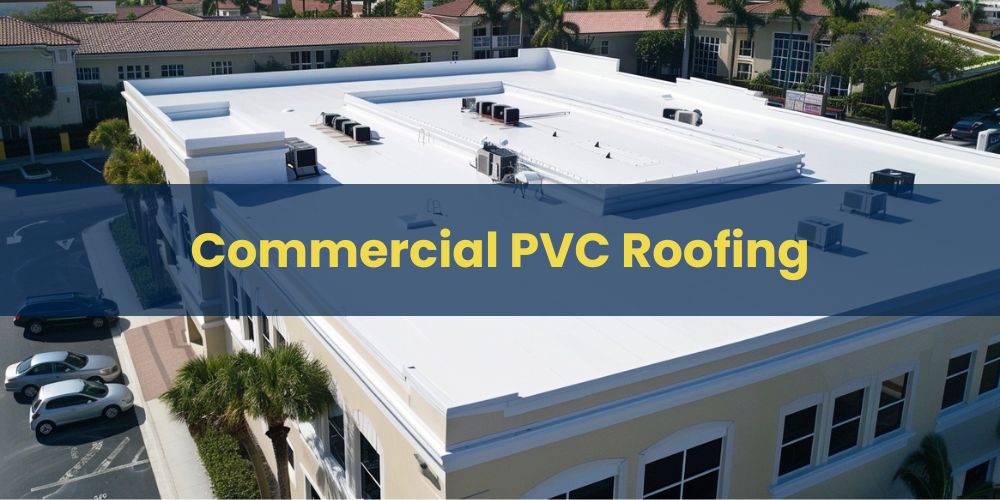
Commercial Roofing Pompano Beach provides commercial PVC roofing repair, replacement, restoration, and maintenance for flat and low-slope commercial buildings across Pompano Beach, Florida. Commercial PVC roofing systems in Pompano Beach operate under South Florida solar intensity, Atlantic coastal humidity, salt-air exposure, storm-season rainfall, wind uplift pressure, rooftop equipment density, and drainage-sensitive roof conditions that directly affect membrane flexibility, heat-welded seam integrity, flashing continuity, attachment stability, chemical resistance, and long-term waterproofing performance across warehouses, retail plazas, office buildings, medical facilities, hospitality properties, food-service buildings, industrial units, and multi-tenant commercial properties. Commercial PVC roofing systems use a single-ply polyvinyl chloride membrane with heat-welded seams, reinforced scrim, flashing membranes, coated metal details, termination bars, pipe boots, curb flashing, drainage outlets, and perimeter securement to create a continuous waterproofing assembly over large commercial roof spans. In Pompano Beach conditions, system performance is determined by how the PVC membrane, welded laps, reinforced membrane core, flashing interfaces, coated metal transitions, rooftop penetrations, attachment method, insulation substrate, and drainage paths respond to UV-driven ageing, coastal moisture exposure, stormwater loading, wind-related uplift forces, grease or chemical discharge, and repeated rooftop service activity.
- South Florida solar intensity and heat-driven roof movement in Pompano Beach → repeatedly expose PVC membrane fields, welded laps, reinforced scrim, flashing membranes, and perimeter terminations to thermal cycling across large low-slope roof areas → membrane flexibility, weld continuity, coated metal transitions, and attachment points absorb repeated expansion, contraction, tensile stress, and shear stress → plasticiser loss, surface brittleness, weld-line fatigue, membrane splitting, edge stress, and reduced waterproofing continuity increase across exposed roof zones.
- Atlantic coastal humidity and salt-air exposure near Pompano Beach → keep coated metal details, termination bars, fasteners, edge metals, roof-to-wall transitions, flashing interfaces, insulation edges, and penetration assemblies exposed to moisture-heavy environmental conditions → metal interfaces corrode, fastener stability weakens, transition details lose compression, and welded or flashed junctions become more vulnerable to movement and water entry → perimeter leakage, concealed moisture migration, seam instability, substrate saturation, and recurring interior water intrusion develop beneath or around the PVC roofing assembly.
- Storm-season rainfall and drainage-sensitive commercial roof geometry across Pompano Beach → place sudden water volume onto drains, scuppers, gutters, crickets, low points, parapet edges, roof-to-wall transitions, and equipment-adjacent drainage paths → blocked outlets, insufficient slope, wind-displaced debris, or undersized discharge routes allow ponding water to remain against welded seams, membrane patches, penetration flashings, coated metal transitions, and field membrane areas → sustained water pressure accelerates weld stress, membrane deformation, insulation saturation, substrate deterioration, and repeated leak activation.
- Coastal wind uplift, rooftop equipment density, food-service exhaust, and service penetrations → concentrate mechanical, chemical, and movement stress at roof edges, corners, HVAC curbs, exhaust fans, grease discharge zones, pipe penetrations, vents, access points, equipment supports, walkway routes, and membrane attachment zones → PVC flashing, welded patches, coated metal details, termination bars, reinforced membrane, fasteners, and bonded transition areas move or degrade differently from the surrounding field membrane → lifted edges, punctures, open welds, flashing separation, chemical softening, and localised water entry points expand into multi-area roof failure when not corrected at system level.
Commercial Roofing Pompano Beach delivers commercial PVC roofing as a system-level service, assessing membrane flexibility, plasticiser loss, reinforced scrim stability, heat-welded seam continuity, lap weld strength, flashing integrity, coated metal condition, termination bar security, perimeter edge securement, attachment method, rooftop penetration detailing, pipe boot condition, HVAC curb interfaces, grease or chemical exposure, drainage behaviour, ponding exposure, substrate moisture, insulation saturation, deck condition, wind uplift vulnerability, service-traffic damage, storm impact, prior repair compatibility, and remaining membrane service life before defining the correct commercial PVC roof repair, restoration, maintenance, coating, partial replacement, or full commercial PVC roof replacement strategy.
What Commercial PVC Roofing Systems Does Commercial Roofing Pompano Beach Service?
Commercial Roofing Pompano Beach services commercial PVC roofing systems across flat and low-slope commercial buildings where performance depends on membrane flexibility, heat-welded seam strength, reinforced scrim stability, attachment method, flashing continuity, chemical resistance, perimeter securement, drainage behaviour, and substrate condition under Pompano Beach’s South Florida solar intensity, Atlantic coastal humidity, salt-air exposure, storm-season rainfall, wind uplift pressure, rooftop equipment density, food-service exhaust exposure, and moisture-sensitive roof geometry. Commercial PVC roofing systems are not treated as identical thermoplastic membrane installations. Each PVC configuration creates a different relationship between weld performance, membrane reinforcement, attachment load, rooftop penetrations, chemical exposure, drainage stress, and remaining service life, which directly affects leak recurrence, restoration eligibility, partial replacement risk, and full commercial PVC roof replacement timing.
The commercial PVC roofing system configurations serviced by Commercial Roofing Pompano Beach include:
- Mechanically attached PVC roofing systems → PVC membrane is secured through fasteners, plates, attachment rows, perimeter restraints, and roof deck connections across large flat and low-slope commercial roof areas → Pompano Beach wind uplift pressure, storm exposure, heat-driven membrane movement, and repeated roof loading transfer force into fastening points, reinforced scrim, welded laps, and edge securement zones → fastener movement, plate displacement, membrane flutter, seam tension, edge lift, and attachment-line distortion develop over time → repair must stabilize mechanical securement before sealing defects because unresolved movement can reopen heat-welded seams, perimeter details, and water-entry paths.
- Fully adhered PVC roofing systems → PVC membrane is bonded to insulation, cover board, or prepared substrate using compatible adhesive across broad commercial roof fields → South Florida heat, coastal humidity, substrate moisture, adhesive cure conditions, and thermal cycling determine whether the membrane remains uniformly bonded beneath the waterproofing surface → bond-line weakening, membrane lifting, surface bubbling, adhesive fatigue, and concealed moisture pockets develop where adhesion becomes inconsistent → targeted repair remains viable when adhesion loss is isolated, but restoration or replacement becomes more likely when bond failure spreads across multiple roof zones.
- Heat-welded PVC seam systems with large membrane fields → reinforced PVC sheets are joined through hot-air welded laps designed to create continuous waterproofing across warehouses, retail plazas, service buildings, industrial units, and multi-tenant commercial properties → Pompano Beach solar intensity, thermal movement, stormwater loading, and service traffic place repeated tensile and shear stress on welded laps, T-joints, patches, and membrane transitions → weld-line fatigue, probe-open laps, seam fishmouths, membrane splitting, scrim stress, and localised water entry develop along high-load seam areas → durable repair requires testing weld continuity and reinforcement stability rather than treating every leak as a surface-level puncture.
- PVC roofing systems with high rooftop equipment and penetration density → HVAC curbs, exhaust fans, vents, pipe penetrations, service lines, access points, equipment supports, walkway zones, and roof-mounted interfaces interrupt the PVC membrane field at repeated high-stress locations → coastal wind-driven rain, heat movement, equipment vibration, and rooftop service activity concentrate stress at pipe boots, curb flashing, welded patches, coated metal transitions, termination bars, and penetration details → flashing separation, open welds, puncture damage, compression loss, coated metal corrosion, and transition-point leakage develop around equipment zones → lasting repair requires rebuilding the complete penetration or equipment interface rather than sealing only the visible water-entry symptom.
- PVC roofs exposed to food-service exhaust, grease discharge, or chemical contact → restaurants, hospitality properties, food-service buildings, mechanical exhaust zones, and service areas can expose PVC membrane surfaces, welded patches, flashings, drains, and equipment-adjacent roof areas to grease, oils, cleaning chemicals, or discharge residues → chemical exposure, heat, residue accumulation, and maintenance traffic change how the membrane surface, welds, coatings, sealants, and drainage areas age compared with clean field membrane zones → membrane softening, surface contamination, weld stress, adhesion loss, puncture vulnerability, and recurring leaks become more likely near exhaust and service areas → repair planning must identify chemical exposure as a distinct failure driver before coating, patching, restoration, or replacement is selected.
- PVC roofs exposed to ponding water, blocked drainage, or low-slope discharge limits → flat and low-slope commercial roof areas in Pompano Beach rely on drains, scuppers, gutters, crickets, low-point relief, parapet-edge flow paths, and equipment-adjacent drainage routes to move storm-season rainfall away from the PVC membrane surface → blocked outlets, undersized drainage routes, wind-displaced debris, insufficient slope, settlement depressions, or clogged scuppers allow standing water to remain against welded seams, patches, penetrations, coated metal details, and field membrane areas → sustained water pressure accelerates weld stress, membrane deformation, insulation saturation, substrate deterioration, and repeated leak activation → drainage correction becomes a prerequisite for reliable PVC roof repair or restoration when ponding pressure is driving recurring failure.
- Ageing, brittle, coated, or previously repaired PVC roofing systems → older PVC membranes, plasticiser loss, repeated patches, aged welded repairs, incompatible coatings, brittle flashings, open laps, contaminated service zones, and stressed perimeter terminations create uneven waterproofing behaviour across the roof assembly → South Florida solar exposure, Atlantic humidity, wind uplift, stormwater loading, and service access cause original membrane areas, repair zones, welded seams, coated sections, and flashing interfaces to age, move, and resist water differently → surface brittleness, membrane cracking, weld failure, coating delamination, repair-boundary leakage, edge stress, and multi-area leak recurrence become more likely → targeted patching becomes less reliable, while restoration, partial replacement, or full commercial PVC roof replacement becomes more appropriate when system continuity can no longer be restored.
Commercial Roofing Pompano Beach evaluates each commercial PVC roofing system based on roof configuration, attachment method, membrane flexibility, plasticiser loss, reinforced scrim stability, heat-welded seam continuity, lap weld strength, T-joint condition, patch compatibility, flashing integrity, coated metal condition, termination bar security, perimeter edge restraint, rooftop penetration density, pipe boot condition, curb flashing stability, HVAC interface stress, grease or chemical exposure, drainage behaviour, ponding exposure, substrate moisture, insulation saturation, deck condition, coastal humidity exposure, salt-air impact on metal components, wind uplift vulnerability, service-traffic damage, storm impact, prior repair compatibility, restoration viability, partial replacement risk, and remaining membrane service life. This ensures that commercial PVC roof repair, maintenance, restoration, coating, partial replacement, or full commercial PVC roof replacement decisions are aligned with how the PVC roofing system actually performs under Pompano Beach conditions, rather than applying one generic solution across different PVC roof assemblies.
Have a question about a commercial roofing project?
How Does Commercial Roofing Pompano Beach Evaluate Commercial PVC Roofing Systems?
Commercial Roofing Pompano Beach evaluates commercial PVC roofing systems by tracing how a thermoplastic waterproofing assembly performs under Pompano Beach’s coastal operating conditions. PVC is not assessed only by whether the membrane is leaking. Commercial Roofing Pompano Beach examines whether the heat-welded seams still act as one continuous waterproofing layer, whether the reinforced membrane remains flexible, whether rooftop chemicals or grease have changed the membrane surface, whether coated metal and termination details are resisting coastal exposure, and whether stormwater is draining before it overloads seams, flashings, and penetrations. In Pompano Beach, South Florida solar intensity, Atlantic humidity, salt-air exposure, storm-season rainfall, rooftop equipment density, food-service exhaust, coastal wind uplift, and low-slope drainage limits all determine whether a PVC roof should be repaired, restored, maintained, partially replaced, or fully replaced.
The commercial PVC roofing conditions evaluated by Commercial Roofing Pompano Beach include:
- Welded seam continuity. Commercial Roofing Pompano Beach evaluates heat-welded laps, T-joints, field seams, welded patches, curb transitions, coated metal tie-ins, and membrane terminations to confirm whether the PVC roof is still performing as a single continuous waterproofing sheet. Pompano Beach solar heat and stormwater loading repeatedly stress welded connections across large flat and low-slope commercial roofs. Probe-open laps, fishmouths, weld-line fatigue, seam tension, membrane splitting, and localised water entry indicate that the failure is not just a surface defect but a breakdown in the welded waterproofing network.
- Membrane flexibility and plasticiser ageing. Commercial Roofing Pompano Beach checks whether the PVC membrane still retains enough flexibility to tolerate heat-driven movement across warehouses, retail plazas, hospitality buildings, food-service properties, industrial units, and multi-tenant commercial roofs. South Florida solar exposure can accelerate plasticiser loss and surface hardening, especially across exposed field membrane areas and high-reflectance roof zones. Surface brittleness, cracking, splitting, shrinkage stress, scrim telegraphing, and weld-edge strain show whether targeted repair remains viable or whether wider restoration or replacement planning is needed.
- Attachment behaviour under coastal uplift. Commercial Roofing Pompano Beach reviews fasteners, plates, induction-welded zones, adhered areas, perimeter restraints, edge securement, attachment rows, and roof deck connections to determine how the PVC system is resisting wind load. Pompano Beach coastal wind pressure and storm exposure can move the membrane before obvious leaks appear. Membrane flutter, plate movement, fastener loosening, attachment-line distortion, edge lift, and seam stress show whether the roof has a mechanical stability problem that must be corrected before any PVC repair can remain watertight.
- Coated metal and salt-air interface performance. Commercial Roofing Pompano Beach evaluates coated metal edges, termination bars, scuppers, gutters, counterflashings, fasteners, roof-to-wall transitions, and metal-to-PVC weld interfaces because these components behave differently from the membrane field. Atlantic humidity and salt-air exposure near Pompano Beach can weaken metal interfaces, reduce compression, corrode exposed hardware, and disturb transition details. Perimeter leakage, coated metal deterioration, fastener instability, flashing movement, and water entry at metal junctions show whether the PVC roof failure is coming from the edge system rather than the membrane sheet itself.
- Rooftop contaminant and food-service exposure. Commercial Roofing Pompano Beach treats restaurant exhaust, grease discharge, cleaning chemicals, oils, residue buildup, and mechanical service zones as separate PVC performance variables. Food-service buildings, hospitality properties, retail plazas, and mixed-use commercial spaces in Pompano Beach can expose PVC membranes, welded patches, drains, flashings, walkway zones, and equipment-adjacent roof areas to contaminants that age differently from clean rainwater exposure. Surface softening, residue staining, puncture vulnerability, weld stress, adhesion loss, and recurring leaks near exhaust zones indicate that chemical exposure must be addressed before patching, coating, restoration, or replacement is selected.
- Penetration and rooftop equipment interruption. Commercial Roofing Pompano Beach inspects HVAC curbs, exhaust fans, vents, pipe penetrations, conduit supports, service lines, access points, walkway zones, equipment platforms, and roof-mounted interfaces because these details interrupt the welded PVC field. Pompano Beach wind-driven rain, equipment vibration, service traffic, and heat movement concentrate stress around pipe boots, curb flashing, welded corners, termination bars, coated metal transitions, and reinforced patches. Open welds, punctures, compression loss, lifted flashing, curb-side leakage, and transition-point failure show when the equipment detail must be rebuilt rather than surface sealed.
- Stormwater concentration and low-slope drainage stress. Commercial Roofing Pompano Beach studies drains, scuppers, gutters, crickets, low points, parapet-edge flow paths, equipment-adjacent drainage routes, and ponding-prone membrane areas to determine whether water is overloading the PVC system. Pompano Beach storm-season rainfall can keep water against welded seams, patches, coated metal details, penetrations, and field membrane areas when outlets are blocked or slope is limited. Weld stress, membrane deformation, insulation saturation, substrate deterioration, and repeated leak activation show that drainage correction may be required before PVC repair or restoration can perform reliably.
- Repair compatibility within the PVC assembly. Commercial Roofing Pompano Beach reviews older welded patches, incompatible coatings, contaminated repair zones, aged sealants, open laps, brittle flashings, prior leak repairs, and repair-boundary transitions to determine whether previous work still belongs inside the PVC system. South Florida heat, Atlantic humidity, stormwater exposure, food-service contaminants, and rooftop traffic can make old repairs age differently from the original PVC membrane. Patch-edge leakage, coating delamination, failed welds, chemical softening, trapped moisture, and multi-area recurrence indicate that the problem may be repair incompatibility rather than a new isolated defect.
- Replacement threshold within ageing PVC roofs. Commercial Roofing Pompano Beach determines whether the PVC roof still has enough membrane flexibility, weld strength, attachment stability, drainage reliability, and flashing continuity to justify continued repair. A PVC roof remains repairable when defects are isolated, welds remain testable, attachment is stable, and moisture has not spread through the assembly. Partial replacement or full commercial PVC roof replacement becomes more appropriate when plasticiser loss is widespread, seams fail across multiple zones, fasteners or edges are unstable, ponding repeatedly reactivates leaks, chemical exposure has damaged the membrane, or prior repairs can no longer be integrated into one continuous waterproofing system.
Commercial Roofing Pompano Beach defines commercial PVC roofing evaluation by welded continuity, membrane chemistry, attachment response, coastal metal interfaces, rooftop contaminant exposure, penetration stress, drainage loading, repair compatibility, and replacement threshold. This allows Commercial Roofing Pompano Beach to separate PVC roof conditions that can be maintained or repaired from conditions that require reinforced repair, drainage correction, roof restoration, partial replacement, or full commercial PVC roof replacement under Pompano Beach’s coastal, humid, storm-exposed commercial roofing environment.
Have a question about a commercial roofing project?
Where Do PVC Roofs Usually Fail on Pompano Beach Commercial Buildings?
Commercial Roofing Pompano Beach identifies PVC roof failure by locating the points where thermoplastic membrane movement, weld stress, rooftop chemical exposure, drainage load, coated metal deterioration, and penetration detailing begin to interrupt the waterproofing assembly. On Pompano Beach commercial buildings, PVC roofs usually fail where South Florida solar intensity, Atlantic coastal humidity, salt-air exposure, storm-season rainfall, coastal uplift pressure, food-service exhaust, rooftop equipment density, service traffic, and low-slope drainage limits concentrate stress into heat-welded seams, T-joints, membrane fields, flashing transitions, coated metal interfaces, pipe boots, HVAC curbs, drains, scuppers, perimeter edges, and previous repair zones.
The most common PVC roof failure zones found by Commercial Roofing Pompano Beach include:
- Heat-welded seams, T-joints, and field laps. PVC roof seams usually fail where welded laps, T-joints, field seams, probe-open edges, welded patches, and membrane transitions carry repeated waterproofing load → Pompano Beach solar intensity, thermal movement, stormwater loading, and rooftop service traffic place tensile and shear stress along the welded seam network → weld-line fatigue, fishmouths, open laps, seam splitting, scrim stress, membrane distortion, and localised water entry develop when weld continuity is lost → Commercial Roofing Pompano Beach evaluates whether seam reinforcement, hot-air welding, patch replacement, drainage correction, partial replacement, or full commercial PVC roof replacement is required.
- PVC membrane fields affected by plasticiser loss. Broad PVC membrane fields fail when UV exposure, heat ageing, traffic wear, and chemical contact reduce flexibility across the exposed thermoplastic surface → South Florida solar exposure can accelerate plasticiser loss across warehouses, retail plazas, hospitality properties, food-service buildings, industrial units, and multi-tenant commercial roofs → surface brittleness, shrinkage stress, cracking, splitting, scrim telegraphing, puncture sensitivity, and weld-edge strain appear as the membrane loses movement tolerance → Commercial Roofing Pompano Beach determines whether the membrane remains repairable or whether ageing has moved the roof toward restoration, partial replacement, or full commercial PVC roof replacement.
- Coated metal transitions and perimeter termination points. PVC roofs commonly fail where coated metal edges, termination bars, counterflashings, scuppers, gutters, parapet returns, roof-to-wall transitions, and metal-to-membrane weld interfaces meet the flexible roof field → Atlantic coastal humidity and salt-air exposure near Pompano Beach corrode metal components, weaken fastener compression, and disturb transition stability → coated metal deterioration, loose termination bars, fastener instability, edge leakage, membrane pullback, flashing movement, and water entry at metal junctions develop when the edge system loses compression → Commercial Roofing Pompano Beach evaluates whether perimeter details can be re-secured, re-welded, rebuilt, or whether edge instability indicates wider PVC system failure.
- Pipe boots, vents, penetrations, and pitch pockets. PVC roof failures often begin where pipe penetrations, vents, pitch pockets, service lines, conduit supports, exhaust penetrations, and roof-mounted interfaces interrupt the membrane field → Pompano Beach wind-driven rain, heat movement, rooftop service access, pipe movement, and equipment vibration concentrate stress around welded boots, flashing collars, sealant pockets, reinforced patches, and membrane-to-penetration transitions → open welds, cracked boots, punctures, compression loss, pitch pocket failure, patch-edge leakage, and localised water entry develop around these fixed details → Commercial Roofing Pompano Beach determines whether penetration detailing can be rebuilt or whether repeated leak recurrence requires partial replacement around the service zone.
- HVAC curbs, exhaust fans, and equipment platforms. Equipment-heavy PVC roofs fail where HVAC curbs, exhaust fans, mechanical units, roof hatches, access paths, equipment supports, service platforms, and walkway routes create repeated movement and traffic stress → rooftop equipment density in Pompano Beach concentrates vibration, foot traffic, tool impact, wind-driven rain, heat expansion, and curb-side drainage pressure at welded corners and flashing transitions → lifted curb flashing, split welded corners, puncture damage, membrane abrasion, compression loss, curb-side leakage, and reinforced patch failure develop when equipment interfaces are not rebuilt as complete details → Commercial Roofing Pompano Beach evaluates whether equipment zones can be reinforced, re-flashed, re-welded, protected with walkway materials, or whether repeated equipment-area failure requires partial replacement.
- Food-service exhaust, grease discharge, and chemical exposure zones. PVC roofs fail differently near restaurants, hospitality kitchens, exhaust fans, grease discharge areas, chemical-cleaning zones, and mechanical service areas because contaminants change membrane behaviour → Pompano Beach food-service buildings and mixed-use commercial properties can expose PVC membrane, welded patches, drains, flashings, walkway routes, and equipment-adjacent roof areas to grease, oils, cleaning chemicals, residue buildup, heat, and service traffic → surface softening, residue staining, weld stress, adhesion loss, puncture sensitivity, coating incompatibility, and recurring leaks develop when chemical exposure is treated like ordinary rainwater ageing → Commercial Roofing Pompano Beach identifies contaminant-driven failure before recommending PVC patching, cleaning, coating, restoration, partial replacement, or full roof replacement.
- Drains, scuppers, gutters, crickets, and ponding-prone low points. PVC roofs commonly fail where water collects, slows, backs up, or repeatedly sits against welded seams and membrane details → Pompano Beach storm-season rainfall, wind-displaced debris, blocked outlets, undersized discharge routes, weak crickets, settlement depressions, and limited low-slope drainage can leave standing water around drains, scuppers, gutters, parapet edges, low points, and equipment-adjacent drainage paths → weld stress, membrane deformation, patch-edge leakage, insulation saturation, substrate deterioration, and repeated leak activation develop when drainage load is not corrected → Commercial Roofing Pompano Beach evaluates whether drainage correction is required before PVC repair, restoration, or partial replacement can perform reliably.
- Perimeter edges, corners, and uplift-loaded restraint zones. PVC roof edges fail where perimeter securement, fasteners, termination bars, edge metals, membrane restraints, parapet returns, corners, and roof-to-wall transitions absorb wind uplift and membrane movement → coastal wind pressure in Pompano Beach loads edges and corners before the central membrane field may show obvious damage → lifted edges, membrane flutter, fastener movement, termination looseness, open corners, edge pullback, flashing separation, and perimeter leakage develop when uplift restraint weakens → Commercial Roofing Pompano Beach determines whether edge securement can be corrected or whether perimeter instability has pushed the roof toward partial or full commercial PVC roof replacement.
- Insulation substrate and concealed moisture zones. PVC roof failures can become hidden when water enters through seams, penetrations, coated metal details, ponding zones, or old patches and then travels beneath the membrane → Atlantic humidity and storm-season rain in Pompano Beach can keep insulation, cover board, and deck layers wet even when the PVC surface appears intact → soft substrate, damp insulation, deck staining, recurring ceiling leaks, membrane depressions, odour, and displaced leak symptoms develop when moisture migrates laterally beneath the single-ply membrane → Commercial Roofing Pompano Beach evaluates whether moisture is isolated and removable or whether concealed saturation has created restoration, repair, or replacement limitations.
- Old welded patches, incompatible coatings, and repair-boundary transitions. Ageing PVC roofs often fail where previous repairs, welded patches, coating overlays, sealant beads, brittle flashings, contaminated service zones, open laps, and repair-boundary transitions no longer behave like the original membrane → South Florida heat, Atlantic humidity, food-service contaminants, stormwater exposure, rooftop traffic, and membrane ageing make old repair areas move, bond, weather, and shed water differently from the surrounding PVC field → patch-edge leakage, failed welds, coating delamination, chemical softening, trapped moisture, brittle repair seams, and multi-area leak recurrence develop when repair history disrupts waterproofing continuity → Commercial Roofing Pompano Beach evaluates whether old repairs can be removed, re-welded, integrated, or whether the roof has moved beyond reliable patching.
Commercial Roofing Pompano Beach evaluates PVC roof failure zones by connecting each defect location to the membrane chemistry, welded seam network, attachment condition, coated metal interface, rooftop contaminant exposure, drainage behaviour, Pompano Beach exposure pattern, and service decision it affects. Heat-welded seam failure, plasticiser-related membrane ageing, coated metal deterioration, penetration leaks, equipment-zone stress, chemical exposure damage, ponding-related deformation, perimeter uplift movement, concealed substrate moisture, and failed repair boundaries are treated as connected PVC roofing performance problems rather than isolated single-ply roof defects. This separates repairable PVC leak sources from reinforced repair candidates, drainage-correctable conditions, restoration-suitable areas, partial replacement zones, and full commercial PVC roof replacement conditions under Pompano Beach’s hot, humid, coastal, storm-exposed commercial roofing environment.
Have a question about a commercial roofing project?
When Is PVC Roof Repair Still a Sound Option on Pompano Beach Commercial Buildings?
Commercial Roofing Pompano Beach decides whether PVC roof repair is still viable by determining whether the existing thermoplastic roof assembly can regain watertight performance without replacing the full system. A repairable PVC roof still has testable heat-welded seams, flexible membrane fields, stable reinforced scrim, secure attachment, rebuildable flashing details, controlled chemical exposure, correctable drainage behaviour, limited substrate moisture, and compatible repair surfaces. On Pompano Beach commercial buildings, that decision is shaped by South Florida solar intensity, Atlantic coastal humidity, salt-air exposure, storm-season rainfall, coastal uplift pressure, rooftop equipment density, food-service exhaust, service traffic, and low-slope drainage stress.
Commercial Roofing Pompano Beach uses the following PVC roof repair-viability checks before recommending repair:
- Heat-welded seams remain testable and re-weldable. PVC roof repair remains viable when field seams, welded laps, T-joints, welded patches, curb transitions, coated metal tie-ins, and membrane terminations can still be probed, cleaned, prepared, and re-welded → Pompano Beach solar heat, stormwater loading, thermal movement, and service traffic may have stressed the welded seam network, but the surrounding membrane has not lost weldable surface quality → hot-air welding, seam reinforcement, patch replacement, T-joint correction, or local membrane repair can restore waterproofing continuity → full commercial PVC roof replacement becomes more likely when open welds repeat across multiple roof zones, seam edges are brittle, or weld repair no longer bonds reliably to the aged membrane.
- Membrane flexibility remains sufficient for local repair. Targeted PVC roof repair is still practical when the membrane can bend, move, and accept compatible welded repair material without cracking or splitting around the repair boundary → South Florida solar intensity can accelerate plasticiser loss across exposed roof fields, high-reflectance areas, roof edges, walk paths, and old patches → local cracking, punctures, minor shrinkage stress, or isolated brittleness can often be corrected when the surrounding membrane retains flexibility → replacement risk rises when plasticiser loss is widespread, scrim telegraphing is visible across the field, or the membrane fractures during preparation.
- Reinforced scrim and membrane core remain intact. PVC repair depends on whether the reinforced membrane core still supports welding, patching, movement, and waterproofing continuity → Pompano Beach heat movement, rooftop service traffic, chemical residue, wind uplift, and ponding pressure can stress the scrim beneath the visible membrane surface → isolated punctures, small splits, and local seam strain may remain repairable if reinforcement damage is limited → partial replacement or full commercial PVC roof replacement becomes more appropriate when scrim exposure, membrane tearing, field-wide splitting, or reinforcement fatigue prevents the roof from behaving as one continuous waterproofing sheet.
- Attachment movement can be stabilised before sealing. Mechanically attached PVC roofs remain repairable when fasteners, plates, attachment rows, perimeter restraints, edge securement, and deck connections can be tightened, replaced, reinforced, or corrected before seam work begins → coastal uplift pressure and storm exposure in Pompano Beach can create membrane flutter, plate movement, fastener loosening, attachment-line distortion, edge lift, and seam tension before obvious water entry appears → repair remains viable when the movement source can be controlled and the membrane can then be re-welded or patched → replacement becomes more likely when attachment failure is widespread, the deck connection is unreliable, or movement keeps reopening welded seams and perimeter details.
- Flashing and penetration details can be rebuilt as complete interfaces. PVC roof repair remains viable when pipe boots, vents, pitch pockets, HVAC curbs, exhaust fans, conduit supports, service lines, coated metal transitions, termination bars, and welded corners can be rebuilt rather than merely sealed over → Pompano Beach wind-driven rain, heat movement, equipment vibration, service traffic, and rooftop equipment density concentrate stress around fixed roof interruptions → open welds, cracked boots, lifted curb flashing, compression loss, punctures, and patch-edge leaks can be corrected when the surrounding membrane and metal details are stable → partial replacement becomes more likely when penetration clusters fail repeatedly or equipment-zone membrane is brittle, contaminated, or moisture-loaded.
- Food-service exhaust and chemical exposure are isolated. PVC repair can still work when grease, oil, cleaning chemical, residue, or exhaust-related contamination is limited to defined roof zones and can be cleaned, isolated, or removed before repair → Pompano Beach hospitality properties, restaurant spaces, mixed-use buildings, and food-service roofs can expose PVC membrane, welded patches, flashings, drains, and walkway routes to contaminants that change weldability and surface behaviour → repair remains viable when chemical softening, residue staining, adhesion loss, and puncture sensitivity are localised → replacement risk increases when chemical exposure has softened membrane fields, contaminated seams, weakened patches, or made repair material incompatible with the existing PVC surface.
- Drainage pressure can be corrected before repair is relied on. PVC roof repair remains viable when recurring water load is caused by correctable drainage conditions such as blocked drains, clogged scuppers, undersized discharge routes, debris-filled gutters, weak crickets, settlement depressions, or restricted equipment-adjacent flow paths → Pompano Beach storm-season rainfall can hold water against welded seams, coated metal details, patches, drains, low points, and penetration flashings long enough to reactivate leaks → drainage clearing, scupper correction, local tapered work, seam reinforcement, drain-side patching, or targeted membrane replacement can make repair reliable → replacement becomes more appropriate when ponding has caused repeated weld failure, insulation saturation, membrane deformation, substrate deterioration, or recurring leaks after drainage correction.
- Coated metal and perimeter details remain recoverable. PVC repair is still suitable when coated metal edges, termination bars, counterflashings, scuppers, gutters, parapet returns, roof-to-wall transitions, fasteners, and metal-to-membrane weld interfaces can be re-secured or rebuilt → Atlantic humidity and salt-air exposure near Pompano Beach can corrode metal interfaces, reduce compression, loosen hardware, and disturb edge stability → edge leakage, fastener instability, membrane pullback, coated metal deterioration, and flashing movement can often be corrected when deterioration is local → full replacement risk rises when perimeter failure is continuous, edge securement no longer holds, or metal-interface deterioration repeatedly opens the PVC waterproofing assembly.
- Substrate moisture remains limited and removable. PVC roof repair can still be justified when insulation saturation, damp cover board, deck staining, soft substrate, odour, or recurring interior leak evidence is confined near a confirmed entry point → Atlantic coastal humidity and Pompano Beach storm rainfall can keep moisture active beneath the single-ply membrane even after the surface appears dry → saturated materials can be removed locally, the repair boundary can be dried, and the leak source can be re-welded, patched, or rebuilt → partial replacement or full commercial PVC roof replacement becomes more likely when moisture has migrated laterally, compromised insulation broadly, or would be trapped beneath repair, coating, or restoration work.
- Previous PVC repairs remain compatible or removable. Repair remains viable when old welded patches, incompatible coatings, brittle flashings, sealant beads, contaminated service zones, aged repair seams, and repair-boundary transitions are isolated enough to remove, re-weld, replace, or integrate into the existing membrane system → South Florida heat, Atlantic humidity, food-service contaminants, stormwater exposure, rooftop traffic, and membrane ageing can make older repairs move, weather, and shed water differently from the original PVC field → patch-edge leakage, failed welds, coating delamination, chemical softening, brittle repair seams, and trapped moisture can be corrected when the surrounding surface remains weldable and dry → replacement becomes more appropriate when repair history is widespread, incompatible, contaminated, or no longer capable of restoring one continuous thermoplastic waterproofing assembly.
Commercial Roofing Pompano Beach recommends PVC roof repair when the failure remains local, heat-welded seams remain re-weldable, membrane flexibility is sufficient, reinforced scrim remains intact, attachment movement can be stabilised, flashing and penetration details can be rebuilt, chemical exposure is isolated, drainage can be corrected, substrate moisture is limited, and previous repairs can be made compatible with the existing roof system. Full commercial PVC roof replacement becomes more appropriate when plasticiser loss is widespread, weld failure repeats across multiple areas, attachment instability persists, perimeter details no longer hold, chemical contamination has changed membrane behaviour, ponding has damaged the assembly, moisture has migrated below the membrane, or repair boundaries can no longer bond into one continuous PVC waterproofing system under Pompano Beach’s hot, humid, coastal, storm-exposed commercial roofing conditions.
When Is PVC Roof Restoration Suitable and When Is Replacement the Better Decision?
Commercial Roofing Pompano Beach assesses PVC roof restoration or replacement suitability by determining whether the existing thermoplastic roof assembly still has enough recoverable performance to justify extending its service life. PVC restoration is appropriate only when the membrane remains flexible enough to accept preparation, heat-welded seams can still be tested and reinforced, rooftop penetrations can be rebuilt, drainage behaviour can be corrected, coated metal interfaces remain recoverable, and substrate moisture has not spread beneath the roof system. Full commercial PVC roof replacement becomes the better decision when plasticiser loss, seam failure, attachment movement, chemical contamination, ponding damage, perimeter instability, or wet insulation has moved beyond isolated correction under Pompano Beach’s South Florida solar intensity, Atlantic coastal humidity, salt-air exposure, storm-season rainfall, coastal uplift pressure, food-service exhaust exposure, rooftop equipment density, and low-slope drainage stress.
Commercial Roofing Pompano Beach uses the following suitability checks before recommending PVC roof restoration or replacement:
- Membrane flexibility and plasticiser condition. PVC roof restoration remains suitable when the membrane can still flex, relax, and accept compatible preparation without cracking, splitting, or exposing the reinforced scrim → South Florida solar intensity in Pompano Beach can accelerate plasticiser loss across exposed field membrane areas, parapet edges, walk paths, equipment zones, and older repair boundaries → restoration remains viable when brittleness is limited and the membrane surface can still support cleaning, detail repair, seam reinforcement, and compatible system work → full commercial PVC roof replacement becomes more appropriate when plasticiser loss is widespread, the membrane fractures during preparation, scrim telegraphing appears across the field, or surface ageing has removed the roof’s movement tolerance.
- Heat-welded seam recoverability. PVC restoration depends on whether field seams, T-joints, welded laps, membrane patches, curb transitions, coated metal tie-ins, and perimeter welds can still be probed, cleaned, re-welded, reinforced, or replaced locally → Pompano Beach solar heat, stormwater loading, thermal movement, and rooftop service traffic place repeated tensile and shear stress on the welded seam network → restoration remains suitable when seam failure is isolated, weld edges remain sound, and reinforcement can be integrated into the existing membrane → replacement becomes the stronger decision when open welds repeat across multiple roof areas, seam edges are brittle, heat-weld repairs fail to bond, or the roof can no longer behave as one continuous thermoplastic waterproofing sheet.
- Attachment and uplift stability. Mechanically attached and adhered PVC systems must remain stable enough to resist wind load before restoration can be trusted → coastal uplift pressure, storm exposure, and heat-driven movement in Pompano Beach can loosen fasteners, shift plates, distort attachment rows, weaken adhered areas, stress reinforced scrim, and pull against perimeter restraints → restoration remains viable when movement can be stabilised through fastening correction, edge securement, adhered-zone repair, or local membrane replacement → full replacement risk increases when membrane flutter, plate movement, fastener loosening, edge lift, attachment-line distortion, or deck connection weakness is widespread or keeps reopening seams and flashing details.
- Flashing, pipe boot, and equipment-detail rebuildability. PVC roof restoration can only succeed when pipe boots, vents, pitch pockets, HVAC curbs, exhaust fans, service lines, conduit supports, coated metal transitions, termination bars, and welded corners can be rebuilt as complete waterproofing interfaces → Pompano Beach wind-driven rain, rooftop equipment vibration, service traffic, heat movement, and dense mechanical layouts concentrate stress around fixed roof interruptions → restoration remains suitable when open welds, lifted flashing, cracked boots, punctures, compression loss, and curb-side leaks can be rebuilt into the restored system → replacement or partial replacement becomes more appropriate when penetration clusters fail repeatedly, equipment-zone membrane is brittle or contaminated, or surrounding substrate moisture prevents reliable detailing.
- Coated metal and perimeter interface condition. PVC roof restoration requires recoverable coated metal edges, termination bars, counterflashings, scuppers, gutters, parapet returns, roof-to-wall transitions, fasteners, edge metals, and metal-to-membrane weld interfaces → Atlantic coastal humidity and salt-air exposure near Pompano Beach can corrode metal components, loosen compression points, weaken fastener stability, and disturb edge-zone waterproofing → restoration remains suitable when perimeter details can be re-secured, cleaned, treated, re-welded, or rebuilt locally → replacement becomes more likely when edge failure is continuous, coated metal deterioration repeatedly opens the membrane system, perimeter securement no longer holds, or roof-edge instability has spread across multiple sides of the building.
- Food-service exhaust and chemical exposure control. PVC restoration suitability depends on whether grease, oil, cleaning chemicals, exhaust residue, discharge staining, or rooftop contaminant exposure is isolated and removable → Pompano Beach food-service buildings, hospitality properties, restaurant spaces, and mixed-use commercial facilities can expose PVC membrane fields, welded patches, drains, flashings, and walkway zones to contaminants that alter surface behaviour and weldability → restoration remains viable when contaminated areas can be cleaned, isolated, removed, patched, or protected before the roof is renewed → replacement becomes more appropriate when chemical exposure has softened broad membrane areas, contaminated seams, weakened existing patches, created coating incompatibility, or made the PVC surface unreliable for long-term bonding.
- Drainage correction and ponding tolerance. PVC restoration should not be recommended unless stormwater can move away from welded seams, drains, scuppers, gutters, crickets, parapet edges, low points, equipment-adjacent flow paths, and patch boundaries → Pompano Beach storm-season rainfall, wind-displaced debris, blocked outlets, undersized drainage routes, and low-slope roof geometry can leave standing water against vulnerable thermoplastic details → restoration remains suitable when drainage restrictions can be cleared, corrected, tapered, reinforced, or paired with targeted membrane work → replacement risk increases when ponding has caused repeated weld stress, membrane deformation, insulation saturation, substrate deterioration, or leak recurrence after prior drainage-related repairs.
- Substrate moisture and insulation condition. PVC roof restoration requires a dry or locally recoverable substrate beneath the single-ply membrane → Atlantic humidity and Pompano Beach storm rainfall can keep insulation, cover board, and deck layers wet after water enters through open welds, penetrations, edge details, ponding zones, or failed patches → restoration remains suitable when moisture is isolated, saturated material can be removed, and the repair boundary can be dried before the roof is renewed → partial replacement or full commercial PVC roof replacement becomes more appropriate when moisture has migrated laterally, insulation is broadly saturated, deck staining is present, soft substrate areas are widespread, or restoration would trap water beneath the membrane.
- Repair-history and coating compatibility. Previously repaired PVC roofs must be checked for old welded patches, incompatible coatings, brittle flashings, sealant beads, contaminated repair zones, open laps, failed repair seams, and repair-boundary transitions before restoration is approved → South Florida heat, Atlantic humidity, food-service contaminants, stormwater exposure, rooftop traffic, and membrane ageing can make older repairs weather differently from the original PVC field → restoration remains suitable when old repairs are isolated, dry, weldable, removable, or compatible with the renewed roof system → replacement becomes more appropriate when repair history is widespread, contaminated, delaminated, brittle, moisture-trapping, or no longer capable of forming one continuous thermoplastic waterproofing assembly.
- Remaining service-life justification. Commercial Roofing Pompano Beach assesses whether PVC restoration will create meaningful additional roof life or merely delay replacement on a roof that has crossed its service threshold → Pompano Beach’s hot, humid, coastal, storm-exposed conditions increase the risk of renewing a roof with brittle membrane fields, repeated weld failure, unstable attachment, contaminated service zones, wet insulation, poor drainage, or failing perimeter details → restoration is justified when defects are controlled, membrane flexibility remains usable, welds remain recoverable, moisture is limited, and rooftop details can be rebuilt into a reliable system → full commercial PVC roof replacement becomes the stronger decision when the roof can no longer be restored as a continuous waterproofing assembly.
Commercial Roofing Pompano Beach separates PVC roof restoration candidates from replacement-level roofs by connecting membrane condition, weld recoverability, attachment stability, flashing rebuildability, coated metal performance, chemical exposure, drainage behaviour, substrate moisture, repair compatibility, and remaining service life into one decision. Restoration is suitable when the PVC roof can still be cleaned, re-welded, reinforced, drained, detailed, and maintained as a continuous thermoplastic waterproofing system. Full commercial PVC roof replacement is more appropriate when ageing, contamination, moisture, weld failure, uplift movement, ponding damage, or incompatible repairs prevent the existing system from performing reliably under Pompano Beach’s coastal commercial roofing conditions.
When Should a Pompano Beach Commercial Property Request a PVC Roofing Assessment?
A Pompano Beach commercial property should request a PVC roofing assessment when roof symptoms begin pointing to changes in heat-welded seam continuity, membrane flexibility, reinforced scrim stability, attachment security, flashing performance, coated metal compression, drainage behaviour, chemical exposure, substrate dryness, or repair compatibility. Probe-open laps, fishmouths, brittle membrane areas, surface cracking, scrim telegraphing, lifted edges, membrane flutter, loose termination bars, cracked pipe boots, curb-side leaks, grease-stained roof zones, chemical-softened membrane areas, ponding near drains or scuppers, recurring ceiling stains, damp insulation indicators, or failed welded patches can indicate that South Florida solar intensity, Atlantic coastal humidity, salt-air exposure, storm-season rainfall, coastal uplift pressure, food-service exhaust, rooftop equipment density, service traffic, or low-slope drainage stress is affecting the PVC roof as a thermoplastic waterproofing assembly rather than as an isolated leak.
Commercial Roofing Pompano Beach uses a commercial PVC roofing assessment to determine whether the roof can still be repaired, maintained, restored, partially replaced, or should move toward full commercial PVC roof replacement. Targeted PVC roof repair may remain appropriate when heat-welded seams are still re-weldable, membrane flexibility remains usable, reinforced scrim is intact, attachment movement can be stabilised, flashing and penetration details can be rebuilt, chemical exposure is isolated, drainage can be corrected, substrate moisture is limited, and previous repairs can be made compatible with the existing membrane. PVC roof restoration may be suitable when the roof can still be cleaned, re-welded, reinforced, drained, detailed, and maintained as one continuous waterproofing system. Full replacement becomes more likely when plasticiser loss is widespread, weld failure repeats across multiple areas, perimeter securement no longer holds, chemical contamination has changed membrane behaviour, ponding has damaged the assembly, moisture has migrated below the membrane, or old repair boundaries can no longer bond into a reliable PVC roofing system under Pompano Beach’s humid, coastal, storm-exposed commercial roofing conditions.