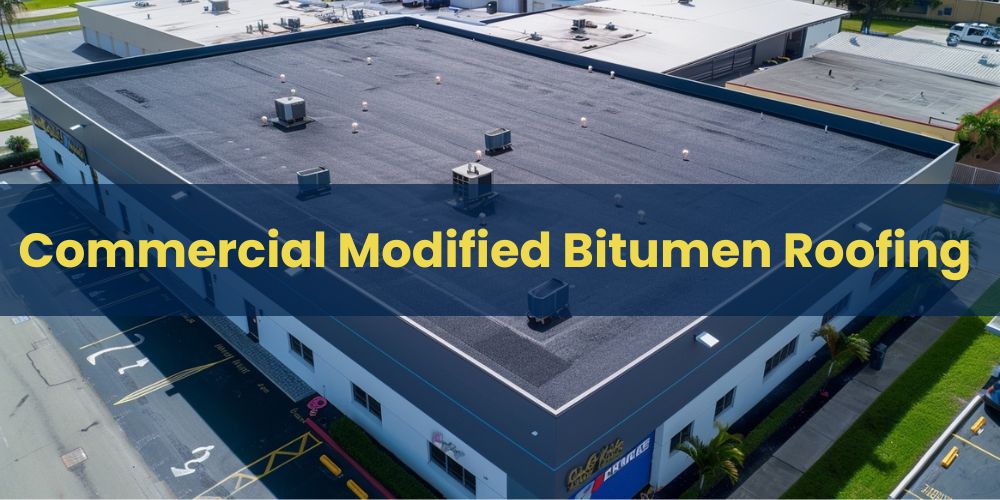
Commercial Roofing Pompano Beach provides commercial modified bitumen roofing repair, replacement, restoration, and maintenance for flat and low-slope commercial buildings across Pompano Beach, Florida. Commercial modified bitumen roofing systems in Pompano Beach operate under Atlantic coastal humidity, South Florida solar heat, storm-season rainfall, wind uplift pressure, rooftop service traffic, and drainage-sensitive roof conditions that directly affect membrane reinforcement stability, asphaltic waterproofing performance, lap adhesion, surfacing durability, flashing continuity, and long-term leak resistance across warehouses, retail plazas, office buildings, medical facilities, hospitality properties, service buildings, industrial units, and multi-tenant commercial properties. Commercial modified bitumen roofing systems use asphalt-based membranes reinforced with polyester, fiberglass, or composite carriers, installed in torch-applied, cold-applied, self-adhered, or hot-asphalt configurations to create a layered waterproofing assembly over commercial roof decks. In Pompano Beach conditions, system performance is determined by how the modified bitumen membrane, cap sheet, base sheet, lap seams, adhesives, asphalt modifiers, granule surfacing, flashing details, insulation substrate, drainage routes, and perimeter terminations respond to coastal moisture, heat-driven softening, UV exposure, stormwater loading, wind stress, and repeated maintenance access.
- South Florida solar heat and high roof-surface temperatures in Pompano Beach → repeatedly soften, expand, and contract asphalt-modified membrane layers across flat and low-slope commercial roof areas → cap sheets, base sheets, lap seams, asphalt modifiers, cold-applied adhesives, and flashing transitions absorb cyclical thermal stress → blistering, ridging, lap movement, adhesive fatigue, granule displacement, and asphaltic surface ageing increase across exposed roof zones.
- Atlantic coastal humidity and moisture-heavy air conditions near Pompano Beach → keep lap edges, flashing interfaces, roof-to-wall transitions, insulation facers, penetrations, and perimeter details exposed to prolonged moisture contact → weakened bond lines, damp substrate areas, deteriorated mastic, and compromised flashing terminations lose stable waterproofing continuity → concealed moisture migration, membrane blister formation, lap-edge instability, and recurring interior water intrusion develop beneath or around the modified bitumen assembly.
- Storm-season rainfall and drainage-sensitive commercial roof geometry across Pompano Beach → place sudden water volume onto drains, scuppers, gutters, crickets, valleys, low points, parapet edges, and roof-to-wall transition areas → blocked outlets, insufficient slope, displaced debris, or aged drainage paths allow ponding water to remain against lap seams, patches, penetrations, flashing details, and asphaltic membrane surfaces → sustained water pressure accelerates lap separation, membrane deformation, surfacing erosion, insulation saturation, substrate deterioration, and repeated leak activation.
- Coastal wind uplift, rooftop equipment zones, service penetrations, and maintenance traffic → concentrate mechanical stress at perimeter edges, corners, parapet interfaces, HVAC curbs, pipe penetrations, pitch pockets, access points, walkway routes, and equipment support areas → modified bitumen flashing plies, membrane laps, reinforced carriers, termination bars, mastics, coatings, and patch materials move differently from the surrounding field membrane → cracks, punctures, open laps, flashing splits, surface scuffs, and localised water entry points expand into multi-area roof failure when not corrected at system level.
Commercial Roofing Pompano Beach delivers commercial modified bitumen roofing as a system-level service, assessing cap sheet condition, base sheet stability, membrane reinforcement, asphalt modifier performance, lap seam adhesion, granule retention, blistering patterns, ridging, cracking, puncture damage, flashing continuity, mastic condition, termination security, roof-to-wall transitions, rooftop penetration detailing, HVAC curb interfaces, drainage behaviour, ponding exposure, substrate moisture, insulation saturation, deck condition, wind uplift vulnerability, service-traffic damage, coating compatibility, and prior repair compatibility before defining the correct commercial modified bitumen roof repair, restoration, maintenance, coating, overlay, partial replacement, or full commercial modified bitumen roof replacement strategy.
What Modified Bitumen Roof Assemblies Does Commercial Roofing Pompano Beach Service?
Commercial Roofing Pompano Beach services modified bitumen roof assemblies by identifying how each asphalt-based membrane build-up was installed, reinforced, surfaced, bonded, repaired, drained, and exposed to Pompano Beach conditions. A torch-applied modified bitumen roof, cold-applied modified bitumen roof, self-adhered modified bitumen roof, hot-asphalt applied roof, granulated cap sheet system, smooth-surface membrane, coated modified bitumen roof, patched roof, or overlay candidate does not behave as one uniform flat roof. Each assembly has a different relationship between cap sheet condition, base sheet stability, reinforcement carrier, asphalt modifier performance, lap seam adhesion, interply bond strength, granule surfacing, flashing ply continuity, drainage behaviour, substrate moisture, and roof repair viability under South Florida solar heat, Atlantic coastal humidity, storm-season rainfall, wind uplift pressure, rooftop equipment traffic, and low-slope ponding exposure.
The modified bitumen roof assemblies serviced by Commercial Roofing Pompano Beach include:
- Torch-applied modified bitumen roof assemblies. Torch-applied modified bitumen systems rely on controlled heat bonding between cap sheets, base sheets, lap seams, flashing plies, asphalt bleed-out lines, and reinforced membrane carriers → Pompano Beach solar heat, coastal humidity, stormwater loading, and roof movement repeatedly stress heat-fused laps and asphaltic surfaces → fishmouths, lap voids, overheated seams, blistering, ridging, granule displacement, flashing splits, and inconsistent bleed-out can develop when torch bonds lose continuity → Commercial Roofing Pompano Beach evaluates torch-applied assemblies for lap integrity, heat-weld quality, cap sheet condition, reinforcement stability, flashing tie-ins, moisture intrusion, repair suitability, restoration viability, overlay risk, and full commercial modified bitumen roof replacement threshold.
- Cold-applied modified bitumen roof assemblies. Cold-applied modified bitumen systems depend on adhesive spread, cure quality, substrate preparation, insulation or cover board condition, sheet alignment, lap bonding, and stable contact between membrane layers → Atlantic coastal humidity, damp substrates, roof-surface contamination, storm-season moisture, and low-slope drainage pressure can interfere with adhesive curing or long-term bond strength → adhesive fatigue, bond-line separation, membrane slippage, wrinkling, lap-edge instability, concealed moisture pockets, and recurring leak paths can develop when the adhesive plane is compromised → Commercial Roofing Pompano Beach evaluates cold-applied assemblies for adhesive performance, substrate dryness, cap sheet adhesion, base sheet stability, lap continuity, moisture migration, coating compatibility, restoration suitability, and replacement risk.
- Self-adhered modified bitumen roof assemblies. Self-adhered modified bitumen systems use factory-applied adhesive layers, release-film installation, primer preparation, pressure bonding, lap adhesion, flashing membranes, and approved substrate contact to create the roof assembly without torching or hot asphalt → South Florida heat, primer inconsistency, substrate dust, coastal moisture, incomplete pressure application, and stormwater exposure can weaken the adhesive contact plane → edge lift, lap peel, incomplete bond, bubbling, fishmouths, surface wrinkling, and moisture entry at poorly bonded seams can develop when adhesion is not uniform → Commercial Roofing Pompano Beach evaluates self-adhered assemblies for primer coverage, adhesive contact, lap peel resistance, substrate compatibility, flashing bond, drainage exposure, repair viability, restoration potential, and partial replacement threshold.
- Hot-asphalt applied modified bitumen roof assemblies. Hot-asphalt applied modified bitumen systems rely on asphalt coverage, ply alignment, membrane embedment, interply adhesion, base sheet stability, insulation support, and deck contact across a layered commercial roof build-up → Pompano Beach heat cycling, rooftop maintenance traffic, coastal moisture, ageing asphalt layers, and repeated rainfall can weaken the relationship between cap sheet, base sheet, asphalt layer, insulation, and deck surface → asphalt displacement, slippage, blistering, ridging, interply separation, lap instability, and concealed moisture migration can develop beneath a surface that may still appear serviceable → Commercial Roofing Pompano Beach evaluates hot-asphalt assemblies for asphalt coverage, ply bond strength, cap sheet movement, base sheet attachment, interply moisture, substrate stability, overlay suitability, restoration viability, and full replacement timing.
- Granulated cap sheet modified bitumen roof assemblies. Granulated cap sheet systems use mineral granules as UV protection, traffic resistance, weathering armour, and surface protection for the asphaltic membrane below → South Florida solar load, Atlantic humidity, salt-air residue, stormwater runoff, ponding zones, foot traffic, and rooftop equipment access gradually displace, embed, loosen, or wash granules from vulnerable roof areas → exposed asphalt, surface checking, granule loss, erosion channels, patch-edge abrasion, dark wear paths, cracking, and accelerated membrane ageing can develop when surfacing protection is reduced → Commercial Roofing Pompano Beach evaluates granulated cap sheet assemblies for granule retention, exposed asphalt, UV ageing, surfacing erosion, cap sheet cracking, repair preparation, coating readiness, restoration suitability, overlay compatibility, and replacement risk.
- Smooth-surface modified bitumen roof assemblies. Smooth-surface modified bitumen roofs rely on asphaltic surface condition, coating compatibility, reflectivity strategy, membrane reinforcement, lap adhesion, flashing continuity, and drainage control because the exposed membrane surface has less mineral surfacing protection than granulated cap sheet systems → Pompano Beach solar heat, ponding exposure, coating ageing, roof traffic, and moisture-heavy air can accelerate surface oxidation, softening, cracking, and coating dependency → asphalt bleed, surface checking, coating delamination, membrane scuffing, lap stress, and heat-related deformation can develop when the exposed asphaltic surface is not protected correctly → Commercial Roofing Pompano Beach evaluates smooth-surface assemblies for coating need, asphalt condition, reinforcement stability, lap performance, flashing condition, ponding tolerance, restoration preparation, and replacement threshold.
- Coated or previously restored modified bitumen roof assemblies. Coated modified bitumen roofs depend on surface preparation, coating adhesion, primer compatibility, seam reinforcement, flashing treatment, dry film thickness, previous repair quality, and moisture control beneath the restored surface → Pompano Beach heat, Atlantic humidity, stormwater runoff, salt-air contamination, rooftop traffic, and ponding exposure can make coatings, mastics, patches, and original asphalt membrane areas age at different rates → peeling, blistering, coating lift, patch-edge leaks, trapped moisture, crack recurrence, lap movement, and surface incompatibility can develop when the restored layer no longer moves with the underlying modified bitumen assembly → Commercial Roofing Pompano Beach evaluates coated assemblies for coating adhesion, moisture entrapment, repair-material compatibility, seam reinforcement, substrate condition, recoating suitability, restoration viability, overlay risk, and replacement timing.
- Patched, ageing, or repeatedly repaired modified bitumen roof assemblies. Older modified bitumen roofs often contain multiple generations of patches, mastics, torch repairs, cold-applied repairs, reinforced fabrics, coating overlays, cracked asphalt surfaces, open laps, deteriorated flashing plies, and repair-boundary transitions → South Florida heat, coastal humidity, wind-driven rain, rooftop service traffic, and drainage-sensitive low-slope areas cause original membrane fields, patches, laps, mastics, coating zones, and flashing details to age and move differently → patch-edge lift, mastic cracking, coating delamination, blister recurrence, lap separation, punctures, surface scuffing, and multi-area leak activation can develop when repair history disrupts system continuity → Commercial Roofing Pompano Beach evaluates ageing and repeatedly repaired assemblies for patch compatibility, mastic condition, lap continuity, asphalt stability, flashing rebuildability, trapped moisture, restoration eligibility, overlay suitability, partial replacement risk, and full commercial modified bitumen roof replacement threshold.
Commercial Roofing Pompano Beach classifies modified bitumen roof assemblies by installation method, reinforcement behaviour, asphaltic surface condition, lap construction, interply bond strength, surfacing protection, flashing continuity, drainage response, repair history, overlay suitability, and replacement threshold. This ensures torch-applied, cold-applied, self-adhered, hot-asphalt applied, granulated cap sheet, smooth-surface, coated, restored, patched, and ageing modified bitumen roofs are evaluated according to how they actually perform under Pompano Beach’s hot, humid, coastal, storm-exposed commercial roofing conditions rather than being treated as one generic asphalt membrane system.
Have a question about a commercial roofing project?
How Does Commercial Roofing Pompano Beach Evaluate Layered Asphaltic Roof Performance?
Commercial Roofing Pompano Beach evaluates layered asphaltic roof performance by treating commercial modified bitumen roofing as a multi-ply waterproofing assembly with distinct surface, bond, reinforcement, moisture, drainage, and detail zones. On Pompano Beach commercial buildings, modified bitumen performance is shaped by how the cap sheet, base sheet, asphalt matrix, reinforcement carrier, lap seams, interply bond, granule surface, mastics, flashing plies, coatings, insulation substrate, and roof deck respond to South Florida solar heat, Atlantic coastal humidity, storm-season rainfall, wind-driven moisture, coastal uplift pressure, rooftop equipment traffic, and low-slope ponding exposure. The purpose of evaluation is to determine whether the roof still has recoverable asphaltic continuity or whether heat movement, moisture migration, lap failure, surfacing depletion, flashing breakdown, or repair incompatibility has pushed the assembly toward overlay, partial replacement, or full commercial modified bitumen roof replacement.
The layered asphaltic roof performance factors evaluated by Commercial Roofing Pompano Beach include:
- Asphalt matrix movement and heat stability. Modified bitumen membranes depend on a stable asphalt matrix that can tolerate heat softening, cooling cycles, rooftop traffic, and low-slope movement without losing dimensional control → Pompano Beach solar heat repeatedly warms exposed cap sheets, asphalt modifiers, reinforced carriers, lap edges, and flashing transitions → asphalt bleed, ridging, slippage, wrinkling, surface deformation, stress cracking, and heat-softened membrane movement can develop when the asphaltic layer no longer holds its intended position → Commercial Roofing Pompano Beach uses asphalt movement patterns to separate isolated repair conditions from broader restoration, overlay, partial replacement, or full commercial modified bitumen roof replacement risk.
- Cap sheet distress and surface waterproofing continuity. The cap sheet is the exposed weathering layer that protects the lower modified bitumen assembly from UV exposure, rainfall, foot traffic, and mechanical damage → South Florida heat, Atlantic humidity, stormwater runoff, and maintenance access can weaken cap sheet surfaces around drains, walkways, parapet edges, rooftop units, and low-slope ponding areas → surface checking, cracking, scuffing, asphalt exposure, granule displacement, punctures, patch-edge wear, and cap sheet fatigue can reduce waterproofing continuity → Commercial Roofing Pompano Beach evaluates whether cap sheet distress can be repaired or coated, or whether the exposed surface indicates deeper assembly deterioration.
- Base sheet attachment and ply-stack support. Modified bitumen roof performance depends on the base sheet, interply asphalt, adhesive layer, insulation facer, cover board, and deck surface remaining stable beneath the visible membrane → Pompano Beach humidity, damp substrate conditions, repeated rainfall, heat cycling, and ageing asphalt layers can weaken the lower roof stack before the cap sheet fully fails → soft areas, membrane slippage, blistering, raised sections, base sheet separation, substrate staining, and recurring leak corridors can appear when lower-layer support is compromised → Commercial Roofing Pompano Beach evaluates the ply stack to determine whether surface repair is enough or whether moisture removal, overlay preparation, partial replacement, or full replacement is required.
- Lap seam geometry and asphalt bleed-out behaviour. Side laps, end laps, bleed-out lines, patched overlaps, fishmouths, seam edges, and flashing tie-ins form the modified bitumen lap network that controls water entry between membrane sheets → Pompano Beach storm-season rainfall, wind-driven moisture, slow drainage, and ponding near drains, crickets, parapet walls, and rooftop equipment keep water against lap edges for extended periods → open laps, seam voids, lap curling, mastic breakdown, inconsistent bleed-out, capillary water movement, and stained overlap lines can develop when lap geometry loses contact or flow control → Commercial Roofing Pompano Beach evaluates lap seam behaviour to decide whether seam reinforcement, targeted repair, coating preparation, overlay, or replacement is the correct service path.
- Interply bond strength and shear resistance. A layered asphaltic roof must maintain bond strength between cap sheet, base sheet, asphalt layers, adhesive planes, insulation, cover board, and deck support → South Florida heat, trapped moisture, rooftop service traffic, and repeated expansion can create shear movement between layers rather than visible surface damage alone → interply separation, membrane slippage, asphalt displacement, blister formation, ridging, wrinkles, and unstable surface movement can indicate that the roof is separating inside the assembly → Commercial Roofing Pompano Beach evaluates whether the bond failure is isolated enough for repair or whether the assembly is no longer suitable for coating, restoration, or overlay.
- Granule surfacing, UV armour, and surface depletion. Granulated modified bitumen roofs rely on mineral surfacing to shield asphalt from South Florida UV exposure, rain wash, salt-air residue, foot traffic, and rooftop equipment movement → Pompano Beach solar load, stormwater flow, drain-side turbulence, walkway use, and service-zone activity can loosen, embed, wash away, or displace granules across high-stress roof areas → exposed asphalt, dark wear paths, erosion channels, surface checking, brittle patches, cracking, and accelerated ageing can develop where UV armour is depleted → Commercial Roofing Pompano Beach evaluates granule loss as a performance signal that affects repair preparation, coating suitability, restoration timing, overlay eligibility, and replacement risk.
- Application-method failure signatures. Torch-applied, cold-applied, self-adhered, hot-asphalt applied, coated, repaired, and overlaid modified bitumen roofs each reveal different failure signatures → torch-applied systems may show fishmouths, overheated laps, voids, or inconsistent bleed-out; cold-applied systems may show adhesive fatigue, cure-related weakness, or sheet slippage; self-adhered systems may show edge lift, incomplete pressure bond, or primer failure; hot-asphalt systems may show interply movement, asphalt displacement, or blistering → misreading the installation method can lead to the wrong repair or restoration decision → Commercial Roofing Pompano Beach identifies the application signature before selecting patching, seam reinforcement, coating, restoration, overlay, partial replacement, or full commercial modified bitumen roof replacement.
- Ply-stack moisture and trapped water behaviour. Modified bitumen assemblies can hold water between membrane layers, insulation, cover board, and deck surfaces after moisture enters through laps, punctures, flashings, ponding zones, or failed patches → Atlantic coastal humidity and Pompano Beach storm rainfall can keep trapped moisture active even when the roof surface appears dry → blisters, raised membrane areas, damp insulation, soft substrate zones, deck staining, odour, heat-expanded moisture pockets, and recurring interior leak paths can develop beneath the cap sheet → Commercial Roofing Pompano Beach evaluates whether moisture is isolated and removable or whether hidden saturation has compromised restoration, coating, overlay, or replacement suitability.
- Flashing ply continuity and vertical transition durability. Parapet walls, roof-to-wall transitions, HVAC curbs, pipe penetrations, pitch pockets, counterflashing, termination bars, equipment bases, and mastic edges are high-stress interruption points in a modified bitumen roof → wind-driven rain, coastal uplift pressure, rooftop equipment vibration, service traffic, heat movement, and stormwater flow concentrate stress at these vertical and equipment-adjacent details → split flashing plies, dried mastics, loose terminations, cracked pitch pockets, open corners, curb-side leakage, and membrane separation can develop when detail continuity fails → Commercial Roofing Pompano Beach evaluates whether these details can be rebuilt or whether repeated flashing failure signals wider assembly breakdown.
- Drainage memory and ponding imprint. Modified bitumen roofs often record drainage history through ponding rings, sediment marks, algae staining, low-point discoloration, softened asphaltic zones, drain-side erosion, scupper-adjacent wear, and repeated patch failure near water-holding areas → Pompano Beach storm-season rainfall and low-slope roof geometry can hold water against cap sheets, lap seams, flashing plies, patches, and drain perimeters longer than the assembly can tolerate → surfacing erosion, lap stress, blistering, asphalt softening, insulation saturation, and repeated leak activation can develop when water loading is not corrected → Commercial Roofing Pompano Beach uses drainage memory to determine whether repair, coating, restoration, or overlay can succeed without drainage correction.
- Mastic ageing and repair-boundary compatibility. Older modified bitumen roofs often contain mastics, torch patches, cold-applied repairs, reinforced fabrics, coating overlays, sealant beads, asphalt repair compounds, and repeated leak repairs that no longer behave like the original cap sheet → Pompano Beach heat, coastal humidity, stormwater exposure, rooftop service traffic, and asphalt movement can cause repair materials to soften, crack, lift, delaminate, trap moisture, or separate from the surrounding roof → patch-edge leaks, mastic cracking, coating incompatibility, blister recurrence, old repair lift, and multi-area leak activation can develop when repair history disrupts system continuity → Commercial Roofing Pompano Beach determines whether prior repairs can be made compatible or whether the roof has moved beyond reliable patching.
- Overlay eligibility and replacement threshold. Modified bitumen roofing may remain suitable for restoration or overlay when the membrane field is stable, laps are reinforceable, moisture is isolated, surfacing loss is controlled, flashings can be rebuilt, drainage can be corrected, and the substrate can support another recoverable layer → Pompano Beach heat, humidity, ponding exposure, coastal uplift, and rooftop traffic increase the risk of overlaying unstable plies, trapped moisture, or weak insulation → widespread blistering, repeated lap failure, unstable interply bond, exposed reinforcement, saturated insulation, deteriorated flashing details, or incompatible repair history can make overlay unsuitable → Commercial Roofing Pompano Beach evaluates overlay eligibility before recommending repair, coating, restoration, overlay, partial replacement, or full commercial modified bitumen roof replacement.
Commercial Roofing Pompano Beach evaluates layered asphaltic roof performance by connecting each modified bitumen condition to the part of the assembly it affects, the Pompano Beach exposure that accelerates it, and the service decision it influences. Asphalt matrix movement, cap sheet distress, base sheet support, lap seam geometry, interply bond strength, granule surfacing, application-method signatures, trapped moisture, flashing ply continuity, drainage memory, mastic ageing, and overlay eligibility are assessed as connected performance signals rather than isolated surface defects. This creates a clear distinction between repairable modified bitumen defects, restorable asphaltic assemblies, coating-preparation candidates, overlay-suitable roofs, partial replacement zones, and full commercial modified bitumen roof replacement scenarios under Pompano Beach’s hot, humid, coastal, storm-exposed commercial roofing conditions.
Have a question about a commercial roofing project?
Where Do Modified Bitumen Roofs Usually Fail on Pompano Beach Commercial Buildings?
Commercial Roofing Pompano Beach identifies modified bitumen roof failure by locating the zones where asphaltic membrane stress, lap seam weakness, surfacing loss, moisture retention, flashing movement, and repair-history incompatibility first interrupt the layered waterproofing assembly. On Pompano Beach commercial buildings, modified bitumen roofs usually fail where South Florida solar heat, Atlantic coastal humidity, storm-season rainfall, wind-driven moisture, coastal uplift pressure, rooftop equipment traffic, and low-slope ponding exposure concentrate stress into cap sheets, base sheets, lap seams, mastics, flashing plies, drains, penetrations, parapet transitions, and patched roof areas.
The most common modified bitumen roof failure zones found by Commercial Roofing Pompano Beach include:
- Lap seams and bleed-out lines. Side laps, end laps, bleed-out lines, fishmouths, patched overlaps, and seam edges are primary failure zones because they control how modified bitumen sheets remain bonded as one waterproofing layer → Pompano Beach storm-season rainfall, slow drainage, wind-driven moisture, and ponding near drains, crickets, parapets, and equipment zones keep water against lap edges for extended periods → open laps, seam voids, lap curling, mastic breakdown, capillary water movement, stained overlap lines, and recurring seam-side leaks develop when asphaltic seam continuity is lost → Commercial Roofing Pompano Beach evaluates whether lap failure can be cleaned, reinforced, sealed, patched, or whether repeated seam failure indicates restoration, overlay, partial replacement, or full commercial modified bitumen roof replacement risk.
- Cap sheet surfaces exposed to heat and traffic. The cap sheet fails first where South Florida solar heat, rooftop service traffic, stormwater runoff, and equipment access wear down the exposed asphaltic weathering layer → drains, walkways, parapet edges, rooftop units, access paths, patch boundaries, and low-slope ponding areas receive repeated surface stress → surface checking, asphalt exposure, granule displacement, punctures, scuffing, cracks, dark wear paths, and cap sheet fatigue reduce waterproofing continuity → Commercial Roofing Pompano Beach determines whether the cap sheet can be repaired, coated, restored, overlaid, or whether visible surface distress reflects deeper modified bitumen assembly deterioration.
- Base sheet support and hidden ply separation zones. Modified bitumen roofs can fail beneath the visible cap sheet where the base sheet, interply asphalt, adhesive layer, insulation facer, cover board, or deck support loses stability → Atlantic coastal humidity, damp substrate conditions, repeated rainfall, ageing asphalt layers, and trapped vapour can weaken lower-ply support before the surface fully opens → soft areas, raised membrane sections, blistering, base sheet separation, membrane slippage, substrate staining, and recurring leak corridors appear when failure spreads inside the layered assembly → Commercial Roofing Pompano Beach evaluates whether hidden ply separation is isolated enough for repair or whether moisture removal, overlay rejection, partial replacement, or full replacement is required.
- Granulated surfacing and UV armour loss zones. Granulated modified bitumen roofs fail faster where mineral surfacing no longer protects the asphalt layer from UV exposure, rain wash, salt-air residue, and rooftop movement → Pompano Beach solar load, stormwater flow, foot traffic, drain-side turbulence, and equipment-zone activity loosen, embed, wash away, or displace granules in high-stress areas → exposed asphalt, brittle patches, erosion channels, dark wear paths, surface checking, cracking, and accelerated ageing develop where UV armour is depleted → Commercial Roofing Pompano Beach evaluates surfacing loss as a repair, coating, restoration, overlay, or replacement signal rather than as a cosmetic roof condition.
- Blistered and moisture-loaded membrane areas. Modified bitumen blistering often marks locations where trapped moisture, vapour pressure, interply separation, or heat expansion is active below the roof surface → Pompano Beach humidity, repeated storm rainfall, ponding exposure, and solar heat can keep moisture inside the asphaltic assembly and expand it beneath the cap sheet → blisters, raised membrane pockets, soft substrate zones, damp insulation, split blister crowns, odour, deck staining, and recurring interior leak paths develop when moisture remains trapped → Commercial Roofing Pompano Beach assesses whether blistered areas can be opened, dried, repaired, and reinforced or whether hidden saturation has compromised restoration, coating, overlay, or replacement suitability.
- Flashing plies at parapets and roof-to-wall transitions. Parapet walls, roof-to-wall transitions, counterflashing, termination bars, mastic edges, wall interfaces, and vertical modified bitumen plies fail where field membrane movement meets fixed building details → wind-driven rain, coastal uplift pressure, South Florida heat movement, and stormwater flow concentrate stress along vertical transitions on Pompano Beach commercial buildings → split flashing plies, dried mastics, loose terminations, open corners, wall-side leaks, cracked counterflashing, and membrane separation develop when transition continuity breaks down → Commercial Roofing Pompano Beach evaluates whether flashing details can be rebuilt or whether repeated vertical transition failure shows broader roof-system deterioration.
- HVAC curbs, pipe penetrations, and pitch pockets. Rooftop equipment zones interrupt the modified bitumen field with fixed penetrations that move differently from the surrounding asphaltic membrane → HVAC vibration, service traffic, wind-driven rain, heat movement, pipe movement, equipment supports, and maintenance access concentrate stress at curb corners, pipe boots, pitch pockets, mastic seals, flashing plies, and membrane patches → cracked pitch pockets, split curb flashings, punctures, dried mastics, open corners, patch-edge leaks, and localised water entry develop around equipment interfaces → Commercial Roofing Pompano Beach determines whether penetration details can be rebuilt with compatible modified bitumen materials or whether repeated equipment-zone leaks require partial replacement.
- Drain perimeters, scuppers, gutters, and low-point areas. Modified bitumen roofs commonly fail where stormwater collects, slows, backs up, or repeatedly passes across low-slope drainage details → Pompano Beach storm-season rainfall, debris movement, blocked outlets, weak crickets, sediment buildup, and undersized drainage routes hold water near drains, scuppers, gutters, valleys, parapet edges, and low points → ponding rings, algae staining, sediment marks, drain-side erosion, softened asphalt, lap stress, blistering, insulation saturation, and repeated leak activation develop when drainage memory is ignored → Commercial Roofing Pompano Beach evaluates drainage zones to determine whether repair can succeed only after water movement is corrected.
- Old patches, mastics, coatings, and repair boundaries. Ageing modified bitumen roofs often fail around previous repairs because mastics, torch patches, cold-applied patches, coating overlays, reinforced fabrics, asphalt compounds, and sealant beads may no longer move or weather like the original cap sheet → Pompano Beach heat, Atlantic humidity, stormwater exposure, rooftop service traffic, and asphalt movement make old repair materials soften, crack, lift, delaminate, trap moisture, or separate from the surrounding membrane → patch-edge leaks, mastic cracking, coating incompatibility, blister recurrence, old repair lift, and multi-area leak activation develop when repair history becomes part of the failure pattern → Commercial Roofing Pompano Beach evaluates whether old repairs can be removed, rebuilt, integrated, or whether overlapping repair history has pushed the roof beyond reliable patching.
- Perimeter edges, corners, and wind-uplift transition areas. Modified bitumen roof edges fail where perimeter securement, flashing plies, termination bars, edge metals, parapet returns, and corner details absorb wind load and membrane movement → coastal uplift pressure, wind-driven moisture, salt-air exposure, storm movement, and roof-edge drainage stress in Pompano Beach pull against perimeter details before the central field membrane may show severe damage → loose terminations, lifted edge details, cracked mastics, open corners, flashing separation, edge-side leaks, and perimeter membrane stress develop when roof-edge continuity weakens → Commercial Roofing Pompano Beach evaluates whether edge repairs, termination correction, flashing rebuilds, or partial replacement are required before local perimeter failure expands into wider roof-system failure.
Commercial Roofing Pompano Beach evaluates modified bitumen roof failure zones by connecting each visible defect to the assembly layer, detail condition, drainage behaviour, Pompano Beach exposure pattern, and service decision it affects. Lap seam failure, cap sheet distress, base sheet separation, granule loss, blistering, flashing-ply breakdown, penetration leaks, drainage-zone deterioration, failed patch boundaries, and perimeter edge stress are treated as connected modified bitumen performance problems rather than isolated flat roof defects. This separates repairable leak sources from restoration candidates, overlay-suitable assemblies, partial replacement zones, and full commercial modified bitumen roof replacement conditions under Pompano Beach’s hot, humid, coastal, storm-exposed commercial roofing environment.
Have a question about a commercial roofing project?
How Does Commercial Roofing Pompano Beach Decide Whether Modified Bitumen Roof Repair Is Still Viable?
Commercial Roofing Pompano Beach decides whether modified bitumen roof repair is still viable by testing whether the existing layered asphaltic assembly can be returned to watertight performance without replacing the full roof system. Modified bitumen repair remains practical when the cap sheet is still stable, the base sheet remains supported, lap seams can be reinforced, moisture is isolated, flashing plies can be rebuilt, drainage issues can be corrected, and prior repairs can be made compatible with the surrounding membrane. On Pompano Beach commercial buildings, this repair decision is shaped by South Florida solar heat, Atlantic coastal humidity, storm-season rainfall, wind-driven moisture, coastal uplift pressure, rooftop equipment traffic, and low-slope ponding exposure.
Commercial Roofing Pompano Beach uses the following repair-viability checks before recommending modified bitumen roof repair:
- Cap sheet stability and asphaltic surface control. Modified bitumen roof repair remains viable when the cap sheet still holds a stable waterproofing surface despite isolated cracking, scuffing, granule displacement, asphalt exposure, patch-edge wear, or local surface checking → Pompano Beach solar heat and rooftop service traffic may have stressed the exposed asphaltic layer, but the membrane field has not lost broad dimensional control → local patching, reinforced repair, coating preparation, or surface correction can restore the damaged area → full commercial modified bitumen roof replacement becomes more likely when cap sheet fatigue spreads across large roof areas, reinforcement becomes exposed, or asphaltic surface breakdown can no longer be isolated.
- Base sheet support and lower-ply stability. Repair is still practical when the base sheet, interply bond, insulation facer, cover board, and deck support remain firm below the visible defect → Atlantic coastal humidity, damp substrate conditions, and repeated storm rainfall can weaken lower roof layers before the surface fully opens → isolated blistering, small soft spots, or local raised membrane areas may be opened, dried, reinforced, and repaired if the surrounding assembly remains stable → replacement risk increases when base sheet separation, widespread interply movement, substrate staining, or recurring leak corridors show that failure has spread below the cap sheet.
- Lap seam bond and bleed-out continuity. Modified bitumen repair remains viable when side laps, end laps, bleed-out lines, fishmouths, seam edges, patched overlaps, and flashing tie-ins can still be cleaned, dried, bonded, and reinforced → Pompano Beach storm-season rainfall, wind-driven moisture, ponding exposure, and slow drainage can hold water against lap edges and weaken asphaltic seam continuity → seam reinforcement, mastic renewal, compatible asphaltic repair material, reinforced fabric, or local membrane replacement can restore lap performance when failure is limited → full replacement becomes more appropriate when lap failure repeats across multiple roof runs, capillary leakage has spread beneath the membrane, or seam repair no longer holds under recurring stormwater load.
- Moisture isolation and dry repair boundary. Targeted repair is appropriate when trapped moisture, damp insulation, raised membrane, blistering, or soft substrate is confined to a small area near a confirmed entry point → Pompano Beach humidity and repeated rainfall can keep water active inside modified bitumen assemblies even after the surface appears dry → saturated material can be removed, the repair boundary can be dried, and the entry point can be sealed with compatible modified bitumen materials → partial replacement or full commercial modified bitumen roof replacement becomes more likely when moisture has travelled laterally through insulation, reached the deck, or would be sealed beneath a patch, coating, restoration system, or overlay.
- Asphalt matrix movement and heat deformation. Repair remains viable when ridging, wrinkling, asphalt bleed, slippage, softening, or heat-related membrane movement is confined to a defined area rather than appearing across the roof field → South Florida roof temperatures repeatedly soften and re-stiffen modified bitumen membranes, especially around exposed low-slope spans, equipment zones, parapet edges, and drain-side areas → local membrane correction, reinforcement, seam repair, or limited replacement can stabilise the affected zone when the surrounding asphalt matrix remains controlled → replacement becomes more likely when heat deformation is widespread, recurring, or tied to unstable interply bonding beneath the surface.
- Granule retention and surface protection. Modified bitumen repair can still succeed when granule loss, dark wear paths, exposed asphalt, erosion marks, or smooth-surface ageing is limited to drains, walkways, patch boundaries, parapet edges, or equipment-service routes → South Florida UV exposure, stormwater runoff, rooftop traffic, and salt-air residue can reduce surfacing protection and expose the asphaltic layer below → surfacing repair, cleaning, priming, compatible patching, or coating preparation can extend service life when the reinforcement carrier remains protected → replacement risk increases when granule depletion is field-wide, exposed asphalt is brittle or softened across broad areas, or reinforcement deterioration is visible.
- Flashing ply rebuildability at vertical details. Repair remains viable when leaks are concentrated at parapet walls, roof-to-wall transitions, HVAC curbs, pipe penetrations, pitch pockets, equipment bases, counterflashing, termination bars, or mastic edges, and the surrounding field membrane remains stable → wind-driven rain, coastal uplift pressure, heat movement, equipment vibration, and service traffic in Pompano Beach can split flashing plies, dry mastics, open corners, loosen terminations, and crack pitch pockets → flashing reconstruction, reinforced ply repair, mastic renewal, curb-side detailing, or counterflashing correction can restore waterproofing continuity → replacement becomes more appropriate when flashing failures repeat across many penetrations or the field membrane around the details can no longer accept reliable repair.
- Drainage correction and ponding-load control. Modified bitumen roof repair remains viable when water retention is caused by correctable drainage conditions such as blocked drains, clogged scuppers, debris-filled gutters, weak crickets, sediment buildup, minor low points, or restricted discharge paths → Pompano Beach storm rainfall can hold water against lap seams, patches, flashing plies, drain perimeters, and low-slope roof areas long enough to reactivate leaks → drainage clearing, scupper correction, cricket repair, drain-side reinforcement, lap sealing, and local membrane repair can reduce recurring water load → replacement becomes more likely when ponding has softened asphaltic surfaces, saturated insulation, distorted the membrane, damaged the substrate, or reopened previous repairs after drainage correction.
- Patch history and repair-material compatibility. Repair is still justified when old mastics, torch patches, cold-applied repairs, coating overlays, reinforced fabrics, asphalt compounds, or sealant beads are isolated enough to remove, rebuild, or integrate with the existing modified bitumen assembly → Pompano Beach heat, coastal humidity, stormwater exposure, and rooftop service traffic can make older repairs age differently from the original cap sheet → patch-edge lift, mastic cracking, coating incompatibility, blister recurrence, delamination, and repair-boundary leakage can be corrected when the surrounding membrane is clean, dry, bondable, and stable → replacement risk rises when repair history is widespread, overlapping, moisture-trapping, or no longer capable of restoring continuous asphaltic waterproofing.
- Restoration or overlay preparation value. Modified bitumen repair remains viable when it improves the roof’s suitability for future restoration, coating, or overlay by stabilising seams, flashings, ponding zones, surface wear, and isolated moisture conditions → Pompano Beach heat, humidity, storm rainfall, coastal uplift, and rooftop traffic increase the risk of renewing an unstable modified bitumen assembly → local repair can be used as a preparation step when the roof has stable plies, dry substrate, reinforceable laps, rebuildable details, and controlled drainage → full commercial modified bitumen roof replacement becomes the stronger decision when repair would only cover a roof that is already blistered, saturated, poorly bonded, severely cracked, or incompatible with restoration or overlay.
Commercial Roofing Pompano Beach recommends modified bitumen roof repair when the defect remains local, the cap sheet is stable, the base sheet remains supported, lap seams can be reinforced, moisture is isolated, asphalt movement is controlled, flashing plies can be rebuilt, drainage can be corrected, and prior repairs can be made compatible with the existing roof assembly. Full commercial modified bitumen roof replacement becomes more appropriate when cap sheet failure, unstable lower plies, repeated lap leakage, trapped moisture, heat deformation, surfacing depletion, flashing breakdown, ponding damage, or incompatible patch history prevents the roof from functioning as a continuous layered asphaltic waterproofing system under Pompano Beach’s humid, coastal, storm-exposed commercial roofing conditions.
How Does Commercial Roofing Pompano Beach Assess Restoration, Coating, or Overlay Suitability?
Commercial Roofing Pompano Beach assesses restoration, coating, or overlay suitability by determining whether the existing modified bitumen roof still has enough stable asphaltic structure to support another service layer. Restoration, coating, and overlay are not selected because a roof surface looks worn or because replacement can be delayed. They are selected only when the cap sheet, base sheet, reinforcement carrier, lap seams, asphalt matrix, surfacing, flashing plies, substrate layers, drainage paths, and prior repairs can still function as a recoverable waterproofing assembly under Pompano Beach’s South Florida solar heat, Atlantic coastal humidity, storm-season rainfall, wind-driven moisture, coastal uplift pressure, rooftop equipment traffic, and low-slope ponding exposure.
Commercial Roofing Pompano Beach uses the following suitability checks before recommending modified bitumen restoration, coating, or overlay:
- Restoration suitability begins with asphaltic field stability. A modified bitumen roof can be considered for restoration when the main membrane field remains dimensionally stable, even if isolated cracking, surface checking, granule displacement, patch wear, or lap deterioration is present → Pompano Beach solar heat repeatedly softens and re-stiffens asphalt-modified membranes across exposed roof spans → restoration becomes viable when the asphalt matrix still holds position and defects can be reinforced, sealed, coated, or resurfaced → restoration becomes unsuitable when ridging, slippage, asphalt bleed, field-wide cracking, membrane deformation, or recurring blistering shows that the roof is losing asphaltic control across the assembly.
- Coating suitability depends on a bondable cap sheet surface. Commercial modified bitumen coating can perform only when the cap sheet surface can be cleaned, dried, primed, reinforced, and bonded without trapping active failure below the coating film → South Florida UV exposure, salt-air residue, rooftop traffic, stormwater runoff, and ponding zones can leave granule loss, exposed asphalt, chalking, scuffing, oxidised surfaces, coating residue, and patch-edge contamination across the membrane → coating remains suitable when surface ageing is controlled and the roof can accept primer, seam reinforcement, flashing treatment, and specified film build → coating becomes risky when the surface is too brittle, wet, contaminated, cracked, or unstable to support adhesion.
- Overlay suitability requires a dry and load-supporting roof stack. A modified bitumen overlay is only considered when the existing cap sheet, base sheet, insulation, cover board, and roof deck can support another recoverable layer without sealing moisture or instability inside the assembly → Atlantic humidity and Pompano Beach storm rainfall can keep moisture active beneath modified bitumen long after the surface appears dry → overlay may remain viable when moisture is isolated, substrate support is sound, insulation is stable, and the existing membrane can be prepared as a reliable base → overlay becomes inappropriate when wet insulation, soft substrate, deck staining, widespread blistering, interply separation, or lateral moisture migration indicates hidden assembly failure.
- Lap seam condition controls whether preparation can succeed. Side laps, end laps, bleed-out lines, fishmouths, patched overlaps, seam edges, and flashing tie-ins must be reinforceable before restoration, coating, or overlay can be considered → Pompano Beach storm-season rainfall, slow drainage, wind-driven moisture, and ponding exposure keep water against lap edges and test asphaltic seam continuity → suitability remains strong when open laps are isolated, seams can be cleaned, reinforced, sealed, and integrated into the new service layer → suitability declines when repeated lap failure, seam voids, capillary leakage, mastic breakdown, or water-stained overlap lines show that the lap network is no longer dependable.
- Interply bond strength determines whether the roof can be renewed or must be opened. Modified bitumen restoration or overlay depends on stable contact between cap sheet, base sheet, asphalt layers, adhesive planes, insulation facer, cover board, and deck support → Pompano Beach heat cycling, trapped vapour, rooftop service traffic, and coastal moisture can create shear movement between plies rather than visible surface damage alone → restoration or overlay remains possible when interply separation is local and the surrounding assembly remains firm → partial replacement or full commercial modified bitumen roof replacement becomes more appropriate when membrane slippage, broad blistering, asphalt displacement, ridging, or unstable surface movement shows loss of internal bond strength.
- Granule retention affects coating and restoration timing. Granulated cap sheet roofs remain better restoration candidates when mineral surfacing still protects most of the asphalt layer and surfacing loss is concentrated at drains, walk paths, patch boundaries, parapet edges, or equipment zones → South Florida solar load, Atlantic humidity, stormwater runoff, and rooftop maintenance access gradually loosen, embed, or wash granules from high-stress areas → coating or restoration remains viable when exposed asphalt is limited and preparation can restore surface protection → replacement risk increases when granule depletion exposes broad asphalt areas, reveals reinforcement, accelerates cracking, or leaves the roof without UV-resistant surface armour.
- Flashing and vertical detail rebuildability must be proven before coating over the field. Parapet walls, roof-to-wall transitions, HVAC curbs, pipe penetrations, pitch pockets, counterflashing, termination bars, mastic edges, and equipment bases must be capable of being rebuilt into the restored assembly → wind-driven rain, coastal uplift pressure, rooftop equipment vibration, heat movement, and service traffic in Pompano Beach concentrate stress at these vertical details → restoration remains suitable when split flashing plies, dried mastics, open corners, loose terminations, and curb-side defects can be corrected before the surface system is applied → restoration becomes unreliable when repeated transition failure shows that the roof details can no longer support continuous waterproofing.
- Drainage correction is required before any renewed surface can perform. Restoration, coating, or overlay can only succeed when drains, scuppers, gutters, crickets, valleys, low points, parapet-edge flow paths, and roof-to-wall drainage routes can move stormwater away from vulnerable modified bitumen details → Pompano Beach storm-season rainfall can leave ponding rings, sediment marks, algae staining, softened asphalt, drain-side erosion, and scupper-adjacent wear across low-slope roof areas → suitability remains strong when drainage restrictions can be cleared, corrected, or reinforced around water-loaded zones → suitability weakens when ponding has already caused surfacing erosion, lap stress, blistering, insulation saturation, asphalt softening, or repeated leak activation.
- Repair-history compatibility decides whether old work can be integrated or removed. Existing mastics, torch patches, cold-applied repairs, coating overlays, reinforced fabrics, sealant beads, asphalt compounds, and repeated leak repairs must either bond with the new service layer or be removed before restoration proceeds → Pompano Beach heat, coastal humidity, stormwater exposure, rooftop access, and asphalt movement make old repair materials age differently from the original cap sheet → coating or restoration remains suitable when repair boundaries are isolated, dry, bondable, and compatible with the selected system → suitability fails when patch-edge lift, mastic cracking, coating incompatibility, trapped moisture, blister recurrence, or overlapping repairs prevent the roof from behaving as one continuous modified bitumen assembly.
- Service-life justification separates useful restoration from delayed replacement. Commercial Roofing Pompano Beach assesses whether restoration, coating, or overlay will create a meaningful service-life extension or only hide a roof that has already crossed the replacement threshold → Pompano Beach’s hot, humid, coastal, storm-exposed conditions increase the consequences of renewing a roof with unstable plies, wet insulation, failed laps, poor drainage, or incompatible repairs → restoration, coating, or overlay is justified when defects are controlled, substrate moisture is limited, surface preparation is achievable, and the renewed assembly can remain watertight → full commercial modified bitumen roof replacement becomes the stronger decision when the existing roof can no longer support a reliable restored or overlaid system.
Commercial Roofing Pompano Beach assesses modified bitumen restoration, coating, and overlay suitability by connecting the proposed service method to the condition of the existing asphaltic assembly. Asphalt field stability, cap sheet bondability, substrate dryness, lap seam continuity, interply bond strength, granule retention, flashing rebuildability, drainage correction, repair-history compatibility, and service-life justification are reviewed before a recommendation is made. This separates Pompano Beach commercial modified bitumen roofs that can be restored, coated, or overlaid from roofs that require moisture removal, partial replacement, or full commercial modified bitumen roof replacement.
When Should a Pompano Beach Commercial Property Request a Modified Bitumen Roofing Assessment?
A Pompano Beach commercial property should request a modified bitumen roofing assessment when roof symptoms begin pointing to changes in asphaltic membrane stability, lap seam continuity, cap sheet protection, flashing ply performance, drainage behaviour, substrate dryness, or repair compatibility. Blistering, ridging, open laps, fishmouths, granule loss, exposed asphalt, cracked mastics, split flashing plies, ponding rings, drain-side erosion, patch-edge lift, recurring ceiling stains, damp insulation indicators, or repeated leak repairs can indicate that South Florida solar heat, Atlantic coastal humidity, storm-season rainfall, wind-driven moisture, rooftop service traffic, coastal uplift pressure, or low-slope ponding exposure is affecting the modified bitumen roof as a layered asphaltic waterproofing assembly rather than as an isolated surface defect.
Commercial Roofing Pompano Beach uses a commercial modified bitumen roofing assessment to determine whether the roof can still be repaired, maintained, coated, restored, overlaid, partially replaced, or should move toward full commercial modified bitumen roof replacement. Targeted modified bitumen roof repair may remain appropriate when the cap sheet is stable, lap seams are reinforceable, moisture is isolated, asphalt movement is controlled, flashing plies can be rebuilt, drainage can be corrected, and prior repairs are compatible with the existing membrane. Restoration, coating, or overlay may be suitable when the assembly has dry substrate support, stable interply bonding, controlled surfacing loss, rebuildable details, and enough remaining service life to support a renewed waterproofing layer. Full replacement becomes more likely when widespread blistering, repeated lap failure, saturated insulation, unstable lower plies, severe surfacing depletion, persistent ponding damage, failed flashings, or incompatible repair history prevents the roof from functioning as a continuous modified bitumen roofing system under Pompano Beach’s humid, coastal, storm-exposed commercial roofing conditions.