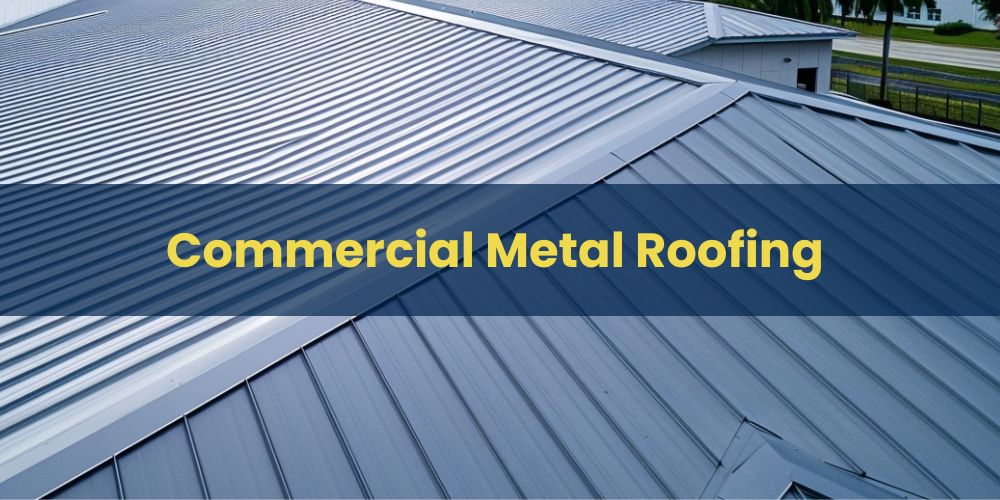
Commercial Roofing Pompano Beach provides commercial metal roofing repair, replacement, restoration, and maintenance for flat, low-slope, and sloped commercial buildings across Pompano Beach, Florida. Commercial metal roofing systems in Pompano Beach operate under Atlantic coastal humidity, salt-air exposure, South Florida heat, storm-season rainfall, wind uplift pressure, and drainage-sensitive roof conditions that directly affect panel stability, coating performance, fastener integrity, seam continuity, flashing durability, and long-term weatherproofing performance across warehouses, retail plazas, office buildings, industrial units, service facilities, and multi-tenant commercial properties. Commercial metal roofing systems use metal panels, seams, fasteners, clips, sealants, coatings, flashing, edge details, penetrations, gutters, and drainage components to create a durable exterior roof assembly over commercial structures. In Pompano Beach conditions, system performance is determined by how the metal panels, protective finishes, fastener systems, standing seams, lap joints, penetrations, perimeter edges, drainage paths, and substrate connections respond to coastal corrosion pressure, thermal expansion, stormwater movement, wind uplift forces, and repeated rooftop service activity.
- Atlantic coastal humidity and salt-air exposure in Pompano Beach → keep metal panels, exposed fasteners, edge metals, gutters, flashing, clips, penetrations, and cut edges exposed to corrosion-prone moisture conditions → protective coatings, sealant joints, fastener washers, and metal terminations experience accelerated environmental stress → rust formation, cut-edge corrosion, fastener deterioration, coating breakdown, and localised weatherproofing loss increase across exposed roof zones.
- South Florida heat and daily thermal movement across commercial metal roofs → repeatedly expand and contract metal panels, standing seams, lap joints, clips, fastener rows, and flashing transitions → movement stress transfers into panel connections, sealant lines, penetrations, and perimeter details → seam fatigue, fastener back-out, sealant splitting, panel distortion, and flashing separation develop when movement is not controlled at system level.
- Storm-season rainfall and drainage-sensitive roof geometry across Pompano Beach commercial buildings → place sudden water volume onto valleys, gutters, downspouts, scuppers, low-slope panel areas, end laps, and roof-to-wall transition zones → blocked drainage paths, insufficient slope, debris accumulation, or undersized water discharge routes allow water to collect against seams, fasteners, flashings, and panel overlaps → ponding pressure, capillary water movement, corrosion acceleration, substrate moisture, and recurring leak activation develop across vulnerable metal roof areas.
- Coastal wind uplift, perimeter edge exposure, rooftop equipment, and service penetrations → concentrate mechanical stress at roof edges, corners, ridge zones, eaves, curbs, vents, pipe penetrations, equipment supports, access routes, and panel attachment points → metal panels, fasteners, clips, sealants, flashing assemblies, and roof-mounted interfaces move differently under wind load and service activity → lifted panels, loosened fasteners, open laps, displaced flashing, punctures, and localised water entry points expand into multi-point roof failure when not corrected at system level.
Commercial Roofing Pompano Beach delivers commercial metal roofing as a system-level service, assessing panel condition, coating integrity, corrosion patterns, cut-edge exposure, fastener security, washer condition, seam continuity, standing seam performance, lap joint stability, sealant condition, flashing durability, edge metal securement, gutter and drainage behaviour, penetration detailing, rooftop equipment interfaces, substrate moisture, wind uplift vulnerability, storm damage, service-traffic impact, and prior repair compatibility before defining the correct commercial metal roof repair, restoration, maintenance, coating, partial replacement, or full commercial metal roof replacement strategy.
How Does Commercial Roofing Pompano Beach Read Commercial Metal Roof Failure Patterns?
Commercial Roofing Pompano Beach evaluates commercial metal roofing by reading the roof as a connected weather-shedding and mechanically restrained panel system, not as a generic roof surface. On Pompano Beach commercial buildings, metal roof performance depends on how panels, ribs, standing seams, exposed fasteners, concealed clips, washers, sealants, cut edges, coatings, gutters, flashings, penetrations, and perimeter metals respond to Atlantic humidity, salt-air exposure, South Florida heat, coastal uplift pressure, storm-season rainfall, and repeated service access. Commercial Roofing Pompano Beach determines whether the metal roof can be repaired, sealed, coated, restored, partially replaced, or fully replaced by identifying where the panel system is losing corrosion resistance, attachment strength, water-shedding control, or movement tolerance.
The commercial metal roof failure patterns evaluated by Commercial Roofing Pompano Beach include:
- Panel geometry and water-shedding behaviour. Commercial Roofing Pompano Beach reviews standing seams, ribs, corrugations, R-panels, valleys, end laps, side laps, ridge transitions, eaves, gutters, downspouts, and low-slope panel runs to determine whether the roof is still moving water away from the building correctly. Pompano Beach storm rainfall and wind-driven debris can slow drainage across panel laps, valleys, gutters, and discharge points. Water staining, capillary draw, lap leakage, ponding at low-slope transitions, and gutter backflow show when the failure is connected to roof geometry rather than a single damaged panel.
- Fastener-line fatigue. Commercial Roofing Pompano Beach examines exposed screws, concealed clips, plates, washers, fastener rows, panel attachment points, screw holes, and deck connections because metal roofs often begin failing where the panel is restrained. South Florida heat repeatedly expands and contracts metal panels, while coastal wind pressure pulls against fastener lines and edge zones. Backed-out screws, cracked washers, hole elongation, clip movement, fastener rust, panel chatter, and attachment-line leakage indicate that the roof is losing mechanical control before wider water entry appears.
- Salt-air corrosion mapping. Commercial Roofing Pompano Beach maps corrosion at cut edges, scratches, panel laps, exposed fasteners, gutters, scuppers, edge metals, flashing returns, trim pieces, and roof-mounted interfaces. Atlantic humidity and salt-air exposure near Pompano Beach can turn minor coating breaks into rust creep, staining, metal thinning, and water-entry points. Corrosion is assessed by location, spread, depth, and connection to drainage paths because rust at a cut edge, washer, lap seam, or gutter line carries different repair, coating, or replacement implications.
- Coating and finish breakdown. Commercial Roofing Pompano Beach evaluates factory finishes, field-applied coatings, chalking, oxidation, peeling, blistering, fading, surface scratches, exposed primer, and bare metal zones to determine whether the protective layer is still defending the panel system. Pompano Beach solar exposure, salt residue, roof traffic, stormwater runoff, and airborne contaminants can degrade coatings unevenly across slopes, parapet edges, gutters, equipment zones, and sun-exposed panel fields. Coating failure becomes a replacement risk when corrosion has moved beyond surface treatment and into panel integrity.
- Thermal movement distortion. Commercial Roofing Pompano Beach studies oil-canning, panel bowing, seam creep, clip drag, lap shift, ridge movement, flashing separation, and trim displacement as signs of heat-driven metal movement. Metal expands and contracts sharply under South Florida roof temperatures, especially across long panel runs and broad commercial spans. Distortion is not treated as a visual issue alone. It can indicate that panels, clips, seams, or fasteners are binding, shifting, or transferring stress into water-shedding joints.
- Standing seam lock integrity. Commercial Roofing Pompano Beach checks raised seam locks, seam caps, hidden clips, panel ribs, ridge interfaces, eave details, and perimeter terminations on standing seam metal roofs. Coastal uplift pressure in Pompano Beach can load raised seams and concealed clips before surface damage becomes obvious. Seam disengagement, clip fatigue, panel drift, edge movement, and water entry at seam intersections show when the standing seam system is losing both weatherproofing and restraint.
- Exposed fastener roof vulnerability. Commercial Roofing Pompano Beach evaluates neoprene washers, screw heads, lap fasteners, rib fasteners, panel overlaps, sealant lines, and fastener patterns on exposed fastener metal roofs. These roofs depend on thousands of small compression points remaining watertight. Pompano Beach heat, salt-air exposure, rainfall cycling, and panel movement can crack washers, loosen screws, stretch holes, and create rust halos around fastener heads. Repair must address the fastening system, not only seal over leak points.
- Rooftop equipment interruption. Commercial Roofing Pompano Beach inspects HVAC curbs, exhaust vents, pipe penetrations, skylights, service lines, equipment supports, access routes, and maintenance paths where panel continuity is interrupted. Equipment zones on Pompano Beach commercial roofs concentrate vibration, foot traffic, wind-driven rain, sealant ageing, flashing movement, and panel puncture risk. Leaks around rooftop equipment are evaluated as interface failures involving metal panels, flashing boots, curb corners, fasteners, sealants, and surrounding drainage paths.
- Edge-zone and uplift exposure. Commercial Roofing Pompano Beach reviews roof edges, corners, eaves, rakes, fascias, ridge ends, parapet interfaces, gutter attachments, trim pieces, and perimeter fasteners because coastal wind pressure concentrates at these zones. Lifted panels, loose trim, displaced edge metal, fastener movement, flashing separation, and perimeter leakage can signal wind-uplift vulnerability even when the center of the roof still appears stable. Edge-zone findings determine whether repair, reinforcement, partial replacement, or full metal roof replacement is required.
- Repair-metal compatibility. Commercial Roofing Pompano Beach examines patch plates, replacement panels, sealant repairs, coating overlays, fastener replacements, flashing additions, and mismatched metals to determine whether previous repairs are helping or accelerating failure. In Pompano Beach, salt-air exposure, heat movement, and stormwater runoff can make incompatible metals, sealants, coatings, and repair plates age at different rates from the original roof. Galvanic staining, patch-edge leaks, coating lift, sealant failure, and corrosion around repair boundaries indicate that the repair itself has become part of the metal roof failure pattern.
Commercial Roofing Pompano Beach defines commercial metal roof evaluation through panel geometry, fastening behaviour, corrosion mapping, coating durability, thermal movement, seam lock integrity, exposed fastener condition, rooftop equipment interruption, edge-zone uplift exposure, and repair-metal compatibility. This allows Commercial Roofing Pompano Beach to distinguish metal roof conditions that can be repaired, sealed, coated, or restored from conditions that require panel replacement, perimeter reinforcement, drainage correction, partial replacement, or full commercial metal roof replacement under Pompano Beach’s coastal, humid, storm-exposed roofing environment.
Have a question about a commercial roofing project?
Where Do Commercial Metal Roofs Usually Fail on Pompano Beach Buildings?
Commercial Roofing Pompano Beach identifies commercial metal roof failure by locating the roof zones where panel movement, salt-air corrosion, fastener fatigue, coating wear, drainage resistance, and coastal uplift pressure begin to break the weather-shedding system. On Pompano Beach commercial buildings, metal roofs rarely fail from one isolated panel defect. Atlantic humidity, salt-air exposure, South Florida heat, storm-season rainfall, wind-driven debris, rooftop equipment traffic, and low-slope transition areas create failure points at seams, laps, fasteners, cut edges, gutters, flashings, penetrations, and perimeter details. The most important failures are the ones that interrupt panel continuity, loosen mechanical restraint, expose bare metal, trap stormwater, or allow water to move beneath the metal roof surface.
The most common commercial metal roof failure zones found by Commercial Roofing Pompano Beach include:
- Cut edges and exposed metal terminations. Salt-air exposure and Atlantic coastal humidity keep cut panel edges, trim returns, flashing edges, gutter edges, scupper metals, and exposed terminations in a corrosion-prone state → protective finishes thin or break at vulnerable edges where factory coating coverage is weakest → rust creep, edge staining, metal thinning, and coating lift begin at the exposed boundary → weatherproofing performance declines because corrosion can move from a small cut edge into a wider panel, flashing, or drainage component.
- Exposed fastener rows and washer seals. South Florida heat expands and contracts metal panels while coastal wind pressure pulls against screw lines, washers, plates, and panel attachment points → neoprene washers compress, crack, harden, or lose sealing pressure as fasteners loosen or holes elongate → rust halos, backed-out screws, washer splitting, attachment-line leakage, and panel chatter develop around fastener rows → leak risk increases because the roof depends on thousands of small compression points remaining watertight.
- Standing seam locks and concealed clip paths. Coastal uplift pressure loads raised seams, hidden clips, seam caps, panel ribs, ridge interfaces, eave details, and perimeter terminations before obvious surface damage appears → clips fatigue, seam locks distort, panel ribs drift, and edge restraints shift under repeated wind and thermal movement → seam disengagement, concealed clip movement, edge lift, and water entry at seam intersections develop → standing seam performance declines because the roof loses both water-shedding continuity and mechanical restraint.
- Panel laps, end laps, and side laps. Storm-season rainfall, wind-driven moisture, salt residue, and low-slope roof geometry keep water moving slowly across overlapping panel joints → capillary action draws moisture into end laps, side laps, rib overlaps, and panel transitions when sealants or closure details weaken → lap leakage, rust staining, sealant split, open overlaps, and concealed substrate moisture develop beneath the panel joint → failure spreads because lap defects allow water to bypass the visible roof surface while the panel field may still appear intact.
- Gutters, downspouts, valleys, and scupper discharge zones. Pompano Beach storm rainfall places sudden water volume into gutters, valleys, scuppers, downspouts, roof-to-wall drainage routes, and low-slope panel discharge areas → wind-displaced debris, salt residue, undersized discharge routes, or blocked outlets slow water release and hold moisture against metal components → gutter corrosion, valley staining, backflow, panel-edge rust, ponding at low-slope transitions, and recurring leak activation develop → drainage-zone failure becomes a metal roof problem because trapped water accelerates corrosion and forces moisture into seams, laps, and flashings.
- Rooftop equipment curbs and penetration flashings. HVAC curbs, exhaust vents, pipe penetrations, skylights, service lines, equipment supports, roof hatches, and access routes interrupt the metal panel field with fixed details that move differently from the surrounding panels → equipment vibration, service traffic, heat expansion, and wind-driven rain concentrate stress at flashing boots, curb corners, sealant joints, fastener rows, and transition metals → sealant splitting, flashing lift, punctures, fastener loosening, curb-side leakage, and panel-to-flashing separation develop → water entry increases because the roof fails at the interface between rigid equipment details and moving metal panels.
- Coating breakdown on sun-loaded panel fields. South Florida solar exposure, salt-air residue, stormwater runoff, roof traffic, and airborne contaminants wear protective coatings unevenly across slopes, parapet edges, gutters, equipment zones, and exposed panel fields → factory finishes or field-applied coatings begin chalking, oxidising, peeling, blistering, fading, or exposing primer and bare metal → surface protection declines and corrosion risk increases at scratches, high-contact points, panel ribs, repair edges, and drainage paths → restoration remains possible when coating failure is surface-level, but replacement risk rises when corrosion moves into panel integrity.
- Thermal movement points across long panel runs. Metal panels expand sharply under Pompano Beach roof heat and contract as surface temperatures fall → long panel runs, broad commercial spans, ridge details, clips, fasteners, laps, and trim pieces absorb repeated movement stress → oil-canning, panel bowing, clip drag, seam creep, lap shift, flashing separation, and trim displacement appear as movement indicators → water-shedding performance declines when thermal distortion transfers stress into seams, laps, fasteners, or perimeter details instead of allowing controlled panel movement.
- Roof edges, corners, eaves, rakes, and perimeter trim. Coastal wind pressure concentrates at edges, corners, eaves, rakes, fascia lines, ridge ends, parapet returns, gutter attachments, and perimeter fasteners → uplift forces pull against panel edges, trim pieces, fastener lines, flashing metals, and roof-to-wall transitions → lifted panels, loose trim, displaced edge metal, fastener movement, flashing separation, open corners, and perimeter leakage develop → perimeter failure becomes serious because a local edge weakness can expand into wider panel displacement during storm exposure.
- Old patch plates, sealant repairs, and mismatched metals. Previous repairs using patch plates, sealant overlays, coating patches, replacement panels, added flashings, fastener replacements, or mismatched metals can age differently from the original metal roof → Pompano Beach heat, salt-air exposure, stormwater runoff, and roof movement expose differences in expansion, corrosion resistance, coating compatibility, and sealant durability → galvanic staining, patch-edge leaks, coating lift, sealant failure, fastener corrosion, and rust around repair boundaries develop → repair history becomes part of the failure pattern when old repair materials no longer move, drain, or weather like the original roof system.
Commercial Roofing Pompano Beach evaluates commercial metal roof failure by connecting each vulnerable roof zone with the local exposure conditions, mechanical stress, corrosion pathway, water-shedding breakdown, and repair or replacement decision it creates. This allows cut-edge corrosion, fastener fatigue, standing seam distortion, lap leakage, drainage-zone corrosion, rooftop equipment interface failure, coating breakdown, thermal movement distortion, perimeter uplift damage, and repair-metal incompatibility to be understood as connected metal roof performance problems under Pompano Beach’s humid, coastal, storm-exposed commercial roofing environment. The result is clearer separation between metal roof defects that can be repaired, sealed, coated, or restored and conditions that require panel replacement, perimeter reinforcement, drainage correction, partial replacement, or full commercial metal roof replacement.
Have a question about a commercial roofing project?
How Does Commercial Roofing Pompano Beach Decide Whether Metal Roof Repair Is Still Viable?
Commercial Roofing Pompano Beach decides whether commercial metal roof repair is still viable by determining whether the metal roof still has recoverable panel stability, controllable corrosion, serviceable fastener compression, rebuildable seam or lap details, correctable drainage behaviour, and secure perimeter restraint. A repairable metal roof can still shed water, resist wind uplift, hold fasteners, accept compatible sealants or coatings, and isolate defects to defined roof zones. A replacement-level metal roof has moved beyond isolated repair because corrosion, panel distortion, fastener fatigue, coating failure, lap leakage, substrate moisture, or edge instability has spread across the roof assembly. In Pompano Beach, that decision is shaped by Atlantic humidity, salt-air exposure, South Florida heat, storm-season rainfall, coastal uplift pressure, wind-driven debris, rooftop equipment traffic, and drainage-sensitive commercial roof geometry.
Commercial Roofing Pompano Beach uses the following metal roof repair-viability thresholds:
- Panel metal remains structurally sound → repair remains viable. Metal roof repair is still appropriate when panels show isolated dents, surface scratches, minor oxidation, localised coating wear, or limited weathering without widespread thinning, cracking, perforation, or structural weakness → Pompano Beach salt-air exposure and stormwater runoff may have started surface deterioration, but the panel still has enough metal integrity to hold repair materials, shed water, and remain mechanically stable → sealing, panel preparation, coating touch-up, fastener correction, or local panel repair can restore weatherproofing performance → replacement threshold: full commercial metal roof replacement becomes more likely when rust perforation, panel thinning, widespread corrosion, or repeated panel breakdown prevents the roof from retaining watertight and load-resistant performance.
- Corrosion is localised and treatable → repair or coating can still work. Cut-edge corrosion, rust staining, fastener rust, gutter-edge corrosion, lap staining, or coating breakdown remains limited to specific details or roof zones → Atlantic coastal humidity and salt-air exposure have attacked exposed metal surfaces, but corrosion has not spread deeply into panel laps, seams, flashing metals, gutters, or structural connections → cleaning, corrosion treatment, primer, compatible coating, edge sealing, or component replacement can stop the corrosion pathway → replacement threshold: replacement becomes more appropriate when corrosion creeps beneath coatings, perforates panels, weakens fastener holes, spreads across laps, or compromises gutters, edge metals, and flashing assemblies beyond stable repair.
- Fastener compression can be restored → repair remains technically reliable. Backed-out screws, cracked washers, elongated holes, rust halos, loose clips, or isolated attachment-line leaks can still be corrected when the surrounding panel and deck connection remain stable → South Florida heat expands and contracts panels while coastal wind pressure pulls against fastener rows, washers, plates, and concealed clips → fastener replacement, oversized fasteners, washer correction, clip repair, sealant reinforcement, and attachment-line tightening can restore compression and weatherproofing → replacement threshold: repair becomes unreliable when fastener holes are widely enlarged, deck attachment is weak, washers fail across broad roof areas, clips have shifted repeatedly, or panel movement keeps reopening the same attachment points.
- Seams, laps, and panel joints remain rebuildable → targeted repair is appropriate. Standing seams, side laps, end laps, R-panel overlaps, corrugated joints, rib transitions, ridge seams, and low-slope panel joints can be repaired when separation, sealant split, or capillary leakage is isolated → storm-season rainfall, wind-driven moisture, and slow drainage in Pompano Beach may be pushing water into vulnerable overlaps, but the surrounding panel geometry still sheds water correctly → seam cleaning, compatible sealant, lap reinforcement, closure correction, fastener replacement, and local flashing repair can restore joint continuity → replacement threshold: replacement risk increases when seam distortion, lap separation, panel misalignment, corrosion within overlaps, or capillary leakage repeats across multiple roof runs.
- Protective coating failure is surface-level → restoration remains possible. Factory finishes or field-applied coatings can still be restored when chalking, oxidation, fading, light peeling, scratches, or isolated bare-metal exposure remain shallow and the underlying panel has not lost integrity → Pompano Beach solar exposure, salt-air residue, roof traffic, and stormwater runoff may have weakened the finish, but the coating failure has not progressed into deep corrosion or panel perforation → surface preparation, primer, corrosion treatment, seam detailing, and commercial metal roof coating can extend service life → replacement threshold: coating or repair becomes insufficient when corrosion has moved beneath the finish, coating delamination is widespread, bare metal is exposed across large areas, or the panel surface can no longer provide a stable coating base.
- Thermal movement distortion is limited → repair can control the movement point. Oil-canning, panel bowing, seam creep, clip drag, lap shift, flashing separation, or trim displacement remains confined to limited panel runs or specific stress zones → South Florida roof heat has caused expansion and contraction, but the roof has not lost overall panel alignment or attachment geometry → clip adjustment, fastener correction, seam repair, flashing rebuilds, and local panel replacement can relieve movement stress → replacement threshold: replacement becomes more likely when panel distortion is widespread, clips are binding across large areas, seams disengage repeatedly, or movement stress has spread into multiple fastener rows, laps, and perimeter details.
- Drainage defects are correctable → repair can hold after water flow is restored. Metal roof repair remains viable when water retention is caused by clearable gutters, blocked downspouts, clogged scuppers, valley debris, minor low-slope ponding, or correctable discharge restrictions → Pompano Beach storm-season rainfall and wind-displaced debris may have held water against laps, fasteners, valleys, gutters, or roof-to-wall transitions, but moisture damage has not spread into the substrate or broad panel areas → drainage clearing, gutter repair, scupper correction, valley cleaning, lap sealing, and local corrosion treatment can stop repeated leak activation → replacement threshold: replacement becomes more appropriate when drainage failure has caused widespread corrosion, substrate moisture, repeated lap leakage, gutter collapse, panel-edge deterioration, or recurring leaks after previous drainage repairs.
- Rooftop equipment interfaces can be rebuilt → repair remains viable. Leaks around HVAC curbs, exhaust vents, pipe penetrations, skylights, service lines, roof hatches, equipment supports, and access paths can still be repaired when the surrounding panel field remains stable → rooftop equipment traffic, vibration, heat movement, and wind-driven rain in Pompano Beach may have damaged flashing boots, curb corners, sealants, fastener rows, transition metals, or panel-to-flashing details → detail rebuilding, flashing replacement, sealant correction, fastener repair, curb reinforcement, and local panel repair can restore the equipment interface → replacement threshold: repair becomes less viable when equipment-zone failures repeat across many penetrations, panels around curbs are corroded or distorted, service traffic has damaged multiple roof paths, or the surrounding roof can no longer support stable flashing work.
- Perimeter restraint can be re-secured → edge-focused repair is sufficient. Lifted panels, loose trim, displaced edge metal, fastener movement, flashing separation, open corners, or perimeter leakage can be repaired when edge instability remains limited to defined roof edges or corners → coastal uplift pressure and salt-air exposure in Pompano Beach have stressed the perimeter, but the roof has not lost continuous edge restraint around the building → fastener replacement, edge-metal re-securement, trim correction, flashing rebuilds, sealant reinforcement, and local panel work can restore uplift resistance → replacement threshold: partial or full commercial metal roof replacement becomes more likely when perimeter movement is continuous, edge panels are repeatedly lifted, fasteners no longer hold, storm exposure has displaced broad sections, or perimeter leakage continues after reinforced repair.
- Previous repairs remain compatible or removable → repair can still be justified. Patch plates, replacement panels, sealant repairs, coating overlays, fastener replacements, flashing additions, or mismatched metals can be corrected when failed materials are isolated and the original roof remains bondable, sealable, and mechanically stable → Pompano Beach salt-air exposure, stormwater runoff, heat movement, and rooftop traffic may have caused old repair materials to age differently from the original metal roof → patch-edge leaks, galvanic staining, coating lift, sealant failure, and corrosion around repair boundaries can be rebuilt with compatible materials → replacement threshold: replacement risk increases when old repairs overlap across large roof areas, incompatible metals accelerate corrosion, coatings no longer bond, repair plates trap moisture, or repeated repair failures show that the roof no longer behaves as one weather-shedding system.
Commercial Roofing Pompano Beach recommends commercial metal roof repair when panel integrity remains sound, corrosion is treatable, fastener compression can be restored, seams and laps remain rebuildable, coating failure is surface-level, drainage can be corrected, rooftop equipment interfaces can be rebuilt, perimeter restraint can be re-secured, and previous repairs can be made compatible with the existing roof assembly. Commercial metal roof replacement becomes the stronger decision when corrosion perforates panels, fastener systems no longer hold, seam distortion repeats across multiple roof runs, drainage failure has caused substrate moisture, coating systems no longer bond, perimeter movement is widespread, or prior repairs prevent the roof from functioning as a continuous weather-shedding system under Pompano Beach’s humid, coastal, storm-exposed conditions.
Have a question about a commercial roofing project?
What Makes Pompano Beach a High-Corrosion Environment for Commercial Metal Roofing?
Commercial Roofing Pompano Beach evaluates corrosion risk on commercial metal roofing by looking at how coastal exposure changes the behaviour of panels, fasteners, coatings, gutters, flashings, edge metals, cut edges, seams, laps, and rooftop equipment interfaces. Pompano Beach creates a high-corrosion environment because commercial metal roofs are exposed to Atlantic coastal humidity, salt-air residue, South Florida heat, storm-season rainfall, wind-driven moisture, and rooftop service activity at the same time. Corrosion does not usually begin as one dramatic failure. It often starts at small coating breaks, fastener heads, panel cuts, washer seals, lap edges, gutter seams, scupper outlets, or flashing returns before spreading into wider weatherproofing loss, fastener instability, drainage failure, and commercial metal roof replacement risk.
The main corrosion drivers affecting commercial metal roofing in Pompano Beach include:
- Salt-air residue at exposed metal edges. Salt-laden coastal air settles on cut panel edges, trim returns, flashing edges, gutter lips, scupper metals, ridge details, eaves, rakes, and exposed terminations → protective coating coverage is often thinner or more vulnerable at cut boundaries and formed edges → salt residue holds moisture against these exposed points and accelerates oxidation → rust creep, edge staining, coating lift, and metal thinning begin at the boundary → corrosion treatment or edge sealing remains viable when damage is shallow, while panel replacement becomes more likely when corrosion moves beneath the coating or into the metal section.
- Atlantic humidity around fasteners and washers. Moisture-heavy air keeps exposed screws, neoprene washers, fastener holes, plates, clips, and attachment rows in repeated contact with damp conditions → washers harden or crack as heat and moisture cycles age the seal, while fastener heads begin rusting where protective finishes break → compression is reduced at the attachment point → fastener back-out, rust halos, washer splitting, hole elongation, and attachment-line leakage develop → repair remains viable when fasteners can be replaced or re-sealed, while replacement risk rises when fastener holes are enlarged across broad roof zones or deck attachment becomes unreliable.
- Stormwater concentration at laps and drainage routes. Pompano Beach storm-season rainfall pushes high water volume across side laps, end laps, panel ribs, valleys, gutters, downspouts, scuppers, parapet-edge flow paths, and low-slope panel transitions → wind-displaced debris, salt residue, and blocked discharge routes slow water release and hold moisture against panel overlaps → capillary water movement pulls moisture into lap joints and hidden panel edges → lap staining, sealant breakdown, rust inside overlaps, substrate moisture, and recurring leak activation develop → corrosion becomes more difficult to stop when water is repeatedly trapped inside the joint rather than simply washing over the surface.
- South Florida heat accelerating coating breakdown. High roof-surface temperatures expand and contract metal panels while also ageing factory finishes, field-applied coatings, sealants, and repair coatings → coating films chalk, oxidise, blister, peel, fade, or lose adhesion more quickly where salt residue, roof traffic, stormwater runoff, and airborne contaminants collect → exposed primer or bare metal appears at scratches, ribs, repair edges, fastener rows, and sun-loaded panel fields → corrosion gains direct access to the metal surface → coating restoration remains suitable when the panel still has stable metal integrity, while replacement becomes more appropriate when coating failure has allowed deep corrosion or panel perforation.
- Wind-driven moisture at roof edges and corners. Coastal wind pushes rain and salt-laden moisture into eaves, rakes, fascias, ridge ends, parapet returns, edge metals, counterflashings, gutters, and corner details → moisture reaches concealed seams, trim overlaps, fastener heads, and flashing returns that may not be saturated during vertical rainfall → corrosion begins behind trim, beneath overlaps, or around perimeter fasteners → lifted trim, edge staining, loose flashing, rusted fasteners, open corners, and perimeter leakage develop → corrosion at the roof edge becomes serious because it weakens both weatherproofing and wind-uplift resistance.
- Galvanic reaction from mismatched repair metals. Previous repairs may introduce patch plates, replacement panels, fasteners, clips, flashing pieces, or trim metals that do not match the original roof assembly → Pompano Beach moisture, salt-air exposure, and stormwater runoff create the conductive conditions that allow incompatible metals to react with each other → staining, accelerated rust, coating lift, fastener deterioration, and patch-edge corrosion appear around repair boundaries → the repair itself becomes a corrosion source → Commercial Roofing Pompano Beach evaluates whether mismatched materials can be removed, isolated, coated, or replaced before corrosion spreads into the surrounding metal roof system.
- Rooftop equipment discharge and service-zone contamination. HVAC units, exhaust vents, food-service equipment, mechanical supports, access routes, and maintenance areas can expose metal panels, fasteners, sealants, coatings, and flashings to condensate, grease residue, cleaning chemicals, tool damage, and foot traffic → contaminants collect around curb corners, panel ribs, fastener rows, drainage paths, and equipment supports → coating surfaces soften, stain, scratch, or lose adhesion, while exposed metal begins corroding faster → leaks develop around equipment interfaces when corrosion combines with flashing movement and sealant fatigue → corrosion control must include equipment-zone cleaning, coating repair, fastener review, and flashing correction.
- Gutter, scupper, and downspout moisture retention. Drainage components stay wetter for longer than open panel fields because they carry repeated stormwater volume, debris, salt residue, and roof runoff → gutters, scuppers, downspouts, collector heads, valley outlets, and internal drainage transitions hold standing moisture at seams, corners, outlets, and fastener points → corrosion starts inside water-handling components before appearing on the visible roof field → gutter seam rust, scupper deterioration, downspout staining, overflow marks, panel-edge rust, and wall-side leakage develop → drainage corrosion can become a roof-system issue because failed water discharge routes push moisture back into panels, laps, flashings, and building transitions.
- Coating scratches from roof traffic and debris movement. Repeated rooftop service access, moving debris, wind-blown particles, tools, ladders, and equipment work can scratch protective finishes on panels, ribs, walk paths, curbs, and roof-access zones → once the coating is breached, Atlantic humidity and salt-air residue can keep the scratch active as a corrosion point → small scratches widen into rust tracks, coating blisters, and exposed metal patches → local repair remains viable when scratches are cleaned, treated, primed, and sealed early → corrosion spreads when service-route damage is left untreated across repeated access paths.
- Concealed corrosion beneath sealants, closures, and overlaps. Sealants, closure strips, lap details, trim overlaps, flashing returns, patch plates, and coating overlays can hide early corrosion from view → moisture trapped beneath these materials remains active in Pompano Beach’s humid, salt-exposed environment → corrosion develops behind the visible sealant or overlap before staining appears at the surface → hidden rust, lap-edge swelling, sealant lift, patch-edge leaks, and water entry emerge later as advanced symptoms → Commercial Roofing Pompano Beach treats concealed corrosion as a repair-threshold issue because the visible defect may understate the actual metal deterioration beneath the detail.
Commercial Roofing Pompano Beach defines Pompano Beach as a high-corrosion environment for commercial metal roofing because salt-air exposure, Atlantic humidity, stormwater concentration, South Florida heat, wind-driven moisture, rooftop equipment contamination, drainage retention, and service-traffic damage interact at the roof’s most vulnerable metal components. This allows corrosion at cut edges, fasteners, washers, laps, gutters, scuppers, flashings, coating breaks, equipment interfaces, repair boundaries, and concealed overlaps to be understood as connected metal roof performance risks rather than isolated rust marks. The result is clearer separation between treatable surface corrosion, coating-restoration candidates, fastener repair conditions, drainage-correctable corrosion, panel replacement zones, and full commercial metal roof replacement scenarios.
What Does Commercial Roofing Pompano Beach Inspect Before Metal Roof Restoration or Coating?
Commercial Roofing Pompano Beach inspects commercial metal roofs before restoration or coating by determining whether the existing panel system can still be renewed as a weather-shedding, corrosion-resistant, mechanically stable roof assembly. Metal roof coating is not approved just because the surface can receive a liquid-applied product. It is appropriate only when the panels, fasteners, seams, laps, coating base, flashings, gutters, edge metals, penetrations, drainage paths, and prior repairs can support a bonded restoration system under Pompano Beach’s Atlantic humidity, salt-air exposure, South Florida heat, storm-season rainfall, coastal uplift pressure, wind-driven moisture, rooftop equipment traffic, and drainage-sensitive commercial roof conditions.
The metal roof restoration and coating inspection performed by Commercial Roofing Pompano Beach includes:
- Panel integrity and metal thickness → restoration requires a stable metal substrate. Commercial Roofing Pompano Beach verifies whether metal panels still have enough structural integrity to support cleaning, priming, seam treatment, fastener correction, and coating application → salt-air exposure, stormwater runoff, and South Florida heat can turn minor oxidation into panel thinning, pitting, perforation, or weakened ribs → surface-level weathering can usually be prepared for restoration → widespread rust-through, panel softness, severe deformation, or loss of metal section indicates that coating would conceal failure rather than restore roof performance.
- Corrosion depth and spread → coating depends on whether rust can be stopped. Commercial Roofing Pompano Beach maps corrosion at cut edges, scratches, fastener heads, washers, lap joints, gutters, scuppers, flashing returns, trim pieces, and equipment interfaces before coating is considered → Atlantic humidity and salt-air residue near Pompano Beach can keep corrosion active below loose paint, sealant, old coatings, and panel overlaps → shallow rust may be cleaned, treated, primed, and coated → deep corrosion, rust creep beneath laps, fastener-hole deterioration, gutter metal loss, or panel perforation reduces restoration suitability and increases partial replacement or full metal roof replacement risk.
- Fastener and washer condition → coating cannot compensate for loose attachment. Commercial Roofing Pompano Beach tests exposed screws, neoprene washers, concealed clips, fastener rows, plates, attachment points, screw holes, and deck connections to confirm whether the roof is still mechanically secure → heat-driven panel movement and coastal wind pressure in Pompano Beach can loosen fasteners, crack washers, stretch holes, and reduce compression at attachment points → fasteners can be replaced, upsized, resealed, or reinforced before coating when the surrounding panel and deck remain stable → coating becomes unreliable when attachment failure is widespread or panel movement keeps reopening fastener lines.
- Seam, lap, and joint continuity → restoration must rebuild water-shedding paths first. Commercial Roofing Pompano Beach inspects standing seams, side laps, end laps, R-panel overlaps, corrugated joints, rib transitions, ridge seams, valleys, and low-slope panel joints before surface restoration begins → storm-season rainfall, wind-driven moisture, capillary action, and slow drainage can force water into panel overlaps where sealants or closures have weakened → open laps, split sealant, seam distortion, closure failure, and hidden moisture at joints must be corrected before coating → restoration remains viable when joints can be sealed and reinforced, but replacement risk rises when seam geometry is distorted or corrosion is active inside multiple overlaps.
- Existing coating and finish adhesion → new coating needs a bondable surface. Commercial Roofing Pompano Beach evaluates factory finishes, field-applied coatings, chalking, oxidation, peeling, blistering, fading, exposed primer, bare metal, and old coating layers before recommending recoating → Pompano Beach solar exposure, salt residue, stormwater runoff, and roof traffic can weaken the surface that a new coating must bond to → stable finishes can be cleaned, abraded, primed, and coated → recoating becomes risky when the existing finish is delaminating, contaminated, incompatible, or hiding corrosion below the visible surface.
- Drainage and water-retention behaviour → coating must not lock in ponding stress. Commercial Roofing Pompano Beach follows water movement across gutters, downspouts, scuppers, valleys, low-slope panel areas, parapet-edge routes, roof-to-wall transitions, and equipment-adjacent drainage paths → Pompano Beach storm rainfall can hold water against laps, fasteners, gutters, panel edges, and flashings when outlets are blocked or discharge routes are undersized → drainage correction, gutter repair, scupper cleaning, valley clearing, or lap reinforcement may be needed before coating → restoration becomes unreliable when trapped water has already caused corrosion, substrate moisture, or recurring lap leakage.
- Edge-zone and uplift restraint → restored metal roofing must remain mechanically secure. Commercial Roofing Pompano Beach reviews eaves, rakes, corners, ridge ends, fascia lines, parapet returns, edge metals, perimeter fasteners, gutter attachments, trim pieces, and roof-to-wall transitions for wind-uplift vulnerability → coastal uplift pressure in Pompano Beach can loosen perimeter metal before the central panel field appears damaged → lifted trim, displaced edge metal, loose fasteners, flashing separation, open corners, and perimeter leakage must be corrected before coating or restoration → unstable roof edges increase partial replacement or full commercial metal roof replacement risk.
- Rooftop equipment and penetration details → coating must integrate fixed interruptions. Commercial Roofing Pompano Beach inspects HVAC curbs, exhaust vents, pipe penetrations, skylights, service lines, roof hatches, equipment supports, access routes, flashing boots, curb corners, fastener rows, and sealant transitions before restoration → rooftop equipment on Pompano Beach commercial buildings concentrates vibration, foot traffic, wind-driven rain, sealant ageing, and panel puncture risk → failed sealants, loose flashings, punctures, curb-side leakage, or panel-to-flashing separation must be rebuilt before coating → restoration remains viable when equipment interfaces can be made continuous with the metal roof system.
- Repair-metal compatibility → prior repairs must not accelerate corrosion. Commercial Roofing Pompano Beach screens patch plates, replacement panels, sealant repairs, coating overlays, fastener replacements, flashing additions, and mismatched metals before restoration → salt-air exposure, heat movement, and stormwater runoff can cause incompatible metals, sealants, coatings, and repair plates to age differently from the original roof → galvanic staining, patch-edge leaks, coating lift, sealant failure, and corrosion around repair boundaries must be corrected or removed → coating becomes unreliable when old repairs are too numerous, incompatible, moisture-trapping, or structurally unstable.
- Restoration threshold classification → the roof must remain restorable as one metal assembly. Commercial Roofing Pompano Beach classifies the roof by panel integrity, corrosion depth, fastener compression, seam continuity, coating adhesion, drainage behaviour, edge restraint, equipment-interface stability, repair compatibility, substrate moisture risk, and realistic remaining service life → restoration or coating is appropriate when defects are isolated, corrosion is treatable, fasteners can be secured, seams can be sealed, drainage can be corrected, and the panel system can accept a bonded coating → restoration is not appropriate when rust-through, widespread fastener failure, distorted panel geometry, hidden corrosion, unstable edges, repeated lap leakage, or incompatible repairs prevent the metal roof from functioning as a continuous weather-shedding system.
Commercial Roofing Pompano Beach defines metal roof restoration and coating inspection by testing whether the existing panel assembly is still recoverable as a corrosion-resistant, water-shedding, mechanically restrained roof system. The inspection reviews panel integrity, corrosion depth, cut-edge condition, fastener compression, washer performance, seam and lap continuity, coating adhesion, drainage behaviour, perimeter restraint, rooftop equipment interfaces, repair-metal compatibility, substrate moisture risk, and remaining service life before restoration or coating is recommended. This separates commercial metal roofs that can be restored or coated under Pompano Beach’s humid, coastal, storm-exposed conditions from metal roofs that require panel replacement, drainage correction, perimeter reinforcement, partial replacement, or full commercial metal roof replacement.
When Should a Pompano Beach Property Request a Commercial Metal Roofing Assessment?
A Pompano Beach property should request a commercial metal roofing assessment when roof symptoms begin pointing to loss of panel control, corrosion resistance, fastener compression, seam continuity, coating protection, drainage reliability, or perimeter restraint. Rust staining at cut edges, backed-out screws, cracked washer seals, loose standing seam locks, lifted trim, coating chalking, gutter corrosion, lap leaks, wind-shifted panels, flashing separation, ponding near low-slope transitions, or recurring sealant repairs can indicate that Atlantic humidity, salt-air exposure, South Florida heat, storm-season rainfall, coastal uplift pressure, wind-driven debris, rooftop equipment traffic, or drainage restriction is affecting the metal roof as a connected weather-shedding system rather than as isolated surface damage.
Commercial Roofing Pompano Beach uses a commercial metal roofing assessment to determine whether the roof can still be repaired, sealed, coated, restored, partially replaced, or should move toward full commercial metal roof replacement. Targeted metal roof repair may remain appropriate when corrosion is shallow, panels remain structurally sound, fastener lines can be re-secured, seams and laps are rebuildable, coating failure is surface-level, drainage can be corrected, and perimeter details still resist uplift. Metal roof restoration or coating may be suitable when the panel system can accept surface preparation, primer, seam treatment, fastener correction, and corrosion control. Full replacement becomes more likely when rust has perforated panels, fastener holes no longer hold, seam geometry is distorted, coating systems no longer bond, moisture has reached substrate layers, edge movement is widespread, or prior repairs prevent the roof from functioning as a continuous commercial metal roofing system under Pompano Beach’s humid, coastal, storm-exposed conditions.