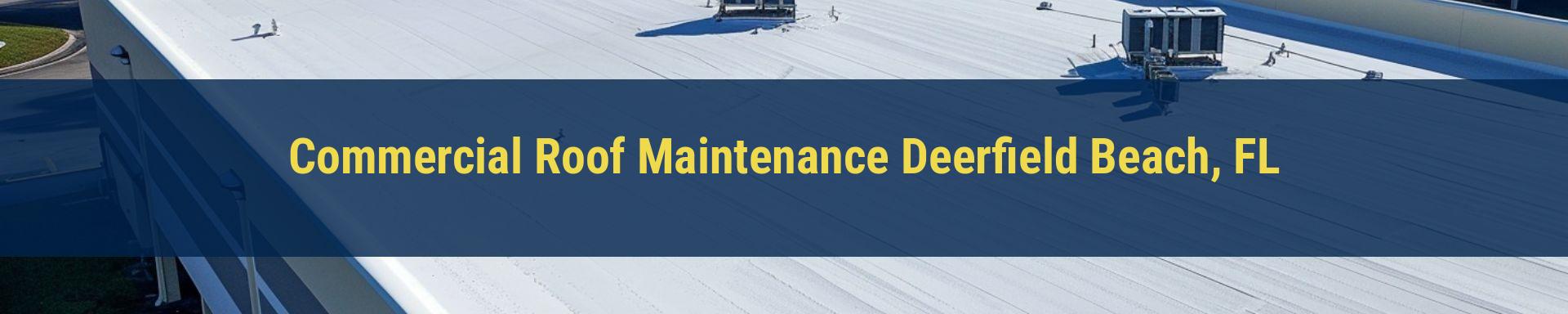
Commercial Roofing Pompano Beach delivers system-led commercial roof maintenance in Deerfield Beach, Florida by keeping coastal commercial roof assemblies inspected, cleaned, stabilized, and documented before salt-air exposure, rooftop service traffic, drainage restriction, membrane wear, flashing movement, or storm-season wind pressure turns manageable roof conditions into active leaks, wet insulation, tenant disruption, hospitality downtime, corrosion-driven repair work, warranty complications, or premature replacement pressure. Commercial Roofing Pompano Beach maintains commercial roofs on beachfront hospitality properties, Hillsboro Boulevard retail buildings, Federal Highway commercial sites, I-95 corridor service properties, office and medical buildings, warehouse units, light industrial facilities, restaurants, multifamily structures, mixed-use assets, civic buildings, and other flat or low-slope commercial roofs where Atlantic salt air, beachfront wind pressure, humid South Florida heat, hurricane-season uplift, wind-driven rain, rooftop HVAC traffic, sand and debris movement, drain restriction, seam stress, flashing fatigue, edge-metal corrosion, fastener movement, coating wear, and repeated service access can gradually weaken roof-system reliability.
The Deerfield Beach-specific maintenance outcomes below show how commercial roof maintenance is organized around Atlantic-facing roof exposure, Hillsboro Boulevard and Federal Highway commercial corridors, beachfront hospitality operations, I-95 service-building access, salt-exposed perimeter details, rooftop equipment traffic, debris-sensitive drainage routes, storm-season readiness, and documented lifecycle control across northern Broward coastal commercial roof assemblies.
- Salt-air perimeter monitoring for Deerfield Beach commercial roofs → coping, edge metal, gutter joints, scupper metal, fasteners, roof-edge terminations, equipment supports, exposed flashing metal, parapet caps, and corrosion-prone perimeter details are checked for movement, rust staining, coating loss, loosened attachment, sealant decline, and salt-related material stress → maintenance identifies corrosion-sensitive roof conditions before edge weakness, water entry, or wind-uplift vulnerability spreads into the wider roof assembly.
- Beachfront debris and drainage housekeeping → sand, leaves, windblown debris, loose materials, rooftop trash, clogged strainers, restricted drains, slow scuppers, blocked gutters, parapet-side water paths, equipment-shadowed runoff areas, and low-slope ponding marks are cleared and recorded after coastal wind, heavy rainfall, or routine roof use → maintenance keeps water moving off the roof before standing moisture causes membrane fatigue, wet insulation, interior staining, corrosion around metal details, or repeat leak behaviour.
- Hospitality, retail, and service-property roof condition reviews → hotel roof areas, restaurant exhaust zones, retail-unit roof sections, medical-office service routes, I-95 corridor service roofs, warehouse roof fields, rooftop access paths, tenant-facing areas, and equipment-adjacent membranes are inspected for punctures, surface wear, seam stress, coating decline, foot-traffic abrasion, and localized moisture symptoms → maintenance protects active commercial operations by identifying roof deterioration before it becomes guest disruption, tenant complaints, or emergency repair demand.
- Membrane and seam preservation under coastal weathering → TPO, PVC, EPDM, modified bitumen, built-up roofing, coated roof surfaces, welded laps, adhered seams, expansion points, patch edges, roof-edge terminations, walkway routes, and equipment-adjacent membrane fields are monitored for UV ageing, salt-air weathering, blistering, shrinkage, punctures, adhesion loss, seam creep, and humidity-driven fatigue → routine maintenance preserves waterproofing continuity while defects remain small enough to correct without major repair or replacement work.
- Rooftop equipment and service-route maintenance control → HVAC curbs, condenser zones, pipe supports, conduit runs, service platforms, walk pads, restaurant exhaust areas, vibration-prone penetrations, access paths, fasteners, coating wear zones, and membrane sections beside mechanical units are reviewed after service activity, storms, or repeated technician access → maintenance reduces roof damage caused by equipment vibration, displaced supports, rooftop traffic, service-route abrasion, and poorly controlled mechanical work.
- Flashing, penetration, and coastal transition checks → parapets, wall transitions, curbs, vents, skylight perimeters, service entries, HVAC penetrations, pipe penetrations, conduit penetrations, drains, scuppers, roof-to-wall details, restaurant exhaust transitions, hospitality access points, industrial service routes, and medical-office roof interfaces are reviewed where Atlantic wind, wind-driven rain, aging sealant, rooftop traffic, salt-air exposure, and uplift pressure can open water-entry paths → maintenance stabilizes the interface zones most likely to become Deerfield Beach commercial roof leak sources.
- Storm-season readiness for northern Broward coastal roofs → loose edge components, vulnerable flashings, open laps, blocked drains, weak scupper discharge, unsecured strainers, debris-loaded roof sections, ponding-prone fields, rooftop equipment interfaces, coating damage, fastener movement, and perimeter conditions are reviewed before and after hurricane-season weather → maintenance improves readiness for uplift pressure, wind-driven rain, salt-laden storm moisture, debris movement, heavy rainfall, and sudden leak escalation.
- Coating, fastener, and surface-protection maintenance → coating chalking, worn reflective surfaces, exposed seams, fastener back-out, coping movement, edge-metal displacement, gutter joints, scupper metal, restaurant exhaust-adjacent wear, equipment supports, walkway abrasion, and salt-exposed surface areas are checked for early deterioration → maintenance identifies protective work before coating decline, fastener movement, or metal-detail weakness compromises waterproofing continuity.
- Maintenance records and lifecycle planning for Deerfield Beach roof assets → inspection findings, photo evidence, cleaning records, drainage observations, salt-corrosion notes, membrane conditions, seam concerns, coating status, flashing review, equipment-zone findings, storm-readiness items, minor corrections, repair priorities, access notes, and lifecycle recommendations are documented for owners, property managers, facility teams, insurers, tenants, hospitality operators, restaurant owners, industrial occupants, medical-office managers, multifamily operators, retail managers, and capital-planning records → documented maintenance supports warranty review, insurance records, budgeting, repair timing, corrosion monitoring, storm preparation, and long-term commercial roof asset control.
What Commercial Roof Maintenance Services Do We Provide In Deerfield Beach, FL?
Commercial Roofing Pompano Beach delivers system-led commercial roof maintenance across Pompano Beach and the surrounding Broward County commercial roofing area by inspecting, cleaning, documenting, stabilizing, and preserving commercial roof systems before early deterioration becomes active leakage, saturated insulation, emergency repair, storm-damage escalation, warranty conflict, or premature roof replacement. Commercial Roofing Pompano Beach maintains flat and low-slope commercial roofs on retail centers, office properties, medical buildings, multifamily structures, hospitality assets, restaurants, service facilities, warehouse units, light industrial buildings, mixed-use properties, marina-adjacent buildings, Federal Highway commercial properties, Atlantic Boulevard business sites, Cypress Creek-area commercial assets, and surrounding commercial properties in Deerfield Beach, Lighthouse Point, Lauderdale-by-the-Sea, Fort Lauderdale, Oakland Park, Wilton Manors, Margate, Coconut Creek, Coral Springs, Tamarac, North Lauderdale, and Lauderdale Lakes.
Commercial roof maintenance in this Broward County service area is shaped by Atlantic salt air, Intracoastal and canal moisture, hurricane-season uplift, wind-driven rain, South Florida UV exposure, humid heat, rooftop mechanical density, drainage sensitivity, corrosion-prone metal details, and repeated service access. These conditions place continuous stress on membranes, seams, flashings, penetrations, drains, scuppers, coatings, edge metal, fasteners, and rooftop equipment interfaces, so maintenance must be built around verified roof performance rather than basic cleaning or visual checking alone.
- Roof condition inspection and leak-risk identification → membrane fields, seams, flashings, penetrations, drains, scuppers, gutters, edge metal, coatings, fasteners, rooftop equipment curbs, walk paths, corrosion-sensitive details, ceiling-stain indicators, tenant reports, and storm-exposed roof zones are reviewed together → maintenance identifies early roof-system risk before minor deterioration becomes active leakage, commercial roof leak detection, commercial roof leak repair, or broader commercial roof repair.
- Drainage cleaning and ponding control → roof drains, overflow drains, scuppers, gutters, downspouts, strainers, parapet-side water paths, equipment-shadowed runoff zones, ponding-prone roof sections, sand or salt residue, tree debris, and slow-discharge areas are cleared, checked, and documented → maintenance keeps Broward County rainfall moving off the roof before standing water accelerates membrane fatigue, wet insulation, interior staining, corrosion, or repeat leak behaviour.
- Membrane, seam, and roof-system surface preservation → TPO, PVC, EPDM, modified bitumen, built-up roofing, coated roof surfaces, welded laps, adhered seams, expansion joints, patch edges, roof-edge terminations, punctures, abrasions, blistering, shrinkage, coating wear, and UV-related ageing are monitored while the roof remains serviceable → maintenance preserves waterproofing continuity before small defects become repair, restoration, coating, or replacement-level failures.
- Flashing, penetration, edge, and rooftop equipment maintenance → parapet flashings, curb flashings, wall transitions, pipe penetrations, vents, skylights, service entries, HVAC curbs, conduit runs, exhaust points, drains, scuppers, edge metal, walk pads, pipe supports, service platforms, and vibration-prone equipment zones are checked where wind-driven rain, ageing sealant, rooftop traffic, salt-air exposure, and mechanical movement commonly create leak paths → maintenance stabilizes the interface details most likely to compromise commercial roof performance.
- Coating, metal-detail, and storm-readiness review → coating adhesion, chalking, cracking, thin areas, exposed seams, fastener back-out, panel movement, coping movement, corrosion-prone metal, loose flashing, blocked drains, unsecured strainers, rooftop equipment security, uplift-sensitive edges, and post-storm roof conditions are reviewed before and after severe weather → maintenance supports commercial roof coatings, commercial metal roofing, storm damage commercial roof repair planning, and hurricane-season roof readiness.
- Maintenance documentation and lifecycle planning → inspection findings, photo evidence, completed maintenance items, drainage performance, membrane wear, seam status, flashing condition, equipment-zone stress, corrosion observations, coating condition, storm-readiness items, repair priorities, restoration opportunities, and replacement risk are documented for owners, property managers, facility teams, insurers, tenants, and capital-planning records → documented maintenance shows whether the roof can remain under maintenance, needs targeted repair or leak detection, is suitable for restoration or coatings, or has reached replacement planning.
For commercial properties throughout the Pompano Beach and Broward County service area, the goal of maintenance is to keep the roof serviceable for as long as the assembly remains viable while avoiding unnecessary emergency repair, premature restoration, unsupported coating decisions, or avoidable replacement. Commercial Roofing Pompano Beach evaluates each maintained roof through building use, roof-system type, drainage behaviour, rooftop equipment layout, storm exposure, coastal corrosion risk, occupancy requirements, warranty conditions, and long-term lifecycle value.
Have a question about a commercial roof maintenance project?
What Early Roof Conditions Put Deerfield Beach Commercial Properties On A Maintenance Schedule?
Deerfield Beach commercial roofs should be placed on a scheduled maintenance program when early roof-system conditions show that the assembly is still serviceable but beginning to experience coastal stress, drainage sensitivity, rooftop equipment wear, membrane movement, flashing fatigue, or storm-season exposure. This applies to commercial properties near Federal Highway, Hillsboro Boulevard, East Hillsboro Boulevard, Dixie Highway, Powerline Road, beachside hospitality buildings, retail plazas, restaurants, office properties, medical buildings, multifamily communities, service facilities, light industrial units, marina-adjacent assets, mixed-use properties, and other flat or low-slope commercial roofs affected by Atlantic salt air, Intracoastal and canal moisture, coastal wind-driven rain, humid South Florida heat, hurricane-season uplift, rooftop HVAC demand, restaurant exhaust, pedestrian-facing occupancy, compact drainage layouts, coating wear, fastener movement, and repeated roof access.
The Deerfield Beach maintenance trigger is the point where the roof has not yet failed, but observable conditions are strong enough to justify scheduled inspection, cleaning, minor correction, drainage upkeep, flashing review, equipment-zone protection, coating monitoring, perimeter checks, storm-readiness review, and photo-based documentation before the condition becomes commercial roof repair.
- Salt-air residue begins affecting roof surfaces and metal details → coating surfaces, edge metal, fasteners, scuppers, gutter connections, coping joints, flashing terminations, and rooftop equipment supports show chalking, staining, early corrosion, sealant fatigue, or surface dulling → scheduled maintenance is needed to inspect, clean, document, tighten, reseal, or stabilize affected areas → coastal exposure is controlled before metal-detail movement, coating failure, or water-entry risk requires repair.
- Drainage slows after coastal rainfall or debris movement → drains, scuppers, gutters, downspouts, strainers, overflow routes, parapet-side channels, equipment-shadowed runoff zones, and low-slope roof fields begin holding water after heavy Deerfield Beach rainfall → scheduled maintenance is needed to clear outlets, check discharge paths, record ponding areas, and identify recurring restrictions → standing water, wet insulation risk, membrane fatigue, and repeat leak complaints are reduced while the roof remains maintainable.
- Intracoastal or canal moisture slows drying around vulnerable details → shaded roof sections, parapet corners, drain bowls, scupper zones, equipment bases, coating surfaces, and low areas show recurring dampness, organic buildup, corrosion staining, moisture marks, or slower drying → scheduled maintenance is needed to review moisture-influenced roof areas and document repeat locations → concealed saturation, flashing deterioration, coating decline, and substrate risk are identified before they become repair-level defects.
- Membrane surfaces show early coastal weathering → TPO, PVC, EPDM, modified bitumen, built-up roofing, or coated roof surfaces show UV dulling, light cracking, small punctures, blistering, abrasion, surface contamination, salt-air wear, shrinkage, or early adhesion stress → scheduled maintenance is needed to document and correct maintenance-level surface deterioration → waterproofing continuity is preserved before commercial roof leak detection or targeted repair becomes necessary.
- Seams, laps, and patch boundaries begin moving → welded seams, adhered laps, asphaltic joints, patch edges, expansion points, roof-edge terminations, walkway-route seams, and equipment-adjacent joints show lifting, wrinkling, creeping, edge stress, or early separation → scheduled maintenance is needed to inspect movement-prone details and complete minor corrective work where appropriate → seam movement is controlled before wind-driven rain can enter the roof assembly.
- Flashing details show early storm-exposure weakness → parapets, curbs, wall transitions, pipe penetrations, vents, skylight perimeters, service entries, roof-to-wall details, scuppers, drains, conduit penetrations, hospitality roof interfaces, multifamily transitions, and restaurant equipment curbs show sealant ageing, slight gaps, fastener movement, or edge separation → scheduled maintenance is needed to stabilize vulnerable interfaces → wind-driven rain is prevented from turning minor discontinuity into active leakage.
- Beachside hospitality or restaurant roof areas show operational wear → rooftop equipment zones, kitchen exhaust areas, condenser platforms, pipe supports, conduit runs, service paths, walk pads, and access points show grease residue, coating wear, membrane abrasion, displaced supports, compression marks, or small flashing stress → scheduled maintenance is needed to inspect and protect high-use roof zones → operational exposure is managed before it becomes puncture damage, curb leakage, or equipment-zone repair.
- Rooftop HVAC access begins marking the roof system → repeated technician movement around HVAC curbs, condenser units, roof hatches, service platforms, pipe supports, walk pads, and equipment-adjacent seams creates abrasion, coating wear, soft walking areas, displaced pads, or minor membrane stress → scheduled maintenance is needed to review access paths and reinforce traffic-control measures → service-route wear is controlled before it opens the membrane or compresses insulation.
- Coated roof areas lose uniform reflectivity or adhesion → acrylic, silicone, elastomeric, or other coating surfaces show chalking, thin areas, cracking, ponding marks, edge separation, contamination, traffic wear, or UV-related decline → scheduled maintenance is needed to record coating condition and correct early coating breakdown where the underlying roof remains serviceable → the coating continues protecting the roof rather than hiding developing membrane defects.
- Perimeter components show early uplift-sensitive movement → coping joints, edge metal, termination bars, perimeter fasteners, scupper metal, gutter connections, parapet transitions, and roof-edge sealant show loosening, slight displacement, corrosion staining, or movement after wind exposure → scheduled maintenance is needed to tighten, reseal, monitor, and document roof-edge condition → hurricane-season uplift risk is reduced before perimeter repair becomes necessary.
- Windblown sand, leaves, or loose material begins accumulating → roof surfaces, drains, scuppers, gutters, parapet channels, HVAC bases, walk paths, low spots, and roof-edge areas collect sand, leaves, palm debris, loose materials, sediment, or organic buildup → scheduled maintenance is needed to remove debris and record repeat collection patterns → blocked drainage, retained moisture, coating wear, and debris-driven leak conditions are prevented before they require corrective repair.
- Mixed-use, retail, medical, hospitality, or multifamily occupancy affects maintenance timing → roof access must account for restaurant service, hotel or hospitality activity, medical appointments, retail trading hours, resident circulation, tenant entrances, pedestrian routes, parking areas, service doors, and safe material movement → scheduled maintenance is needed before small roof tasks become urgent occupied-building work → roof upkeep is completed without avoidable disruption to active Deerfield Beach properties.
- Storm-readiness items are visible before hurricane-season weather → loose strainers, debris-loaded roof areas, vulnerable seams, minor flashing gaps, ponding-prone sections, unsecured rooftop items, coating wear, slow drains, shifted walk pads, fastener movement, and edge-metal stress are present before severe weather → scheduled maintenance is needed to prepare the roof before hurricane-season rainfall, uplift, or wind-driven rain → storm exposure is reduced while the roof remains in a maintenance-level condition.
- Post-storm roof changes appear before interior leakage → lifted seam edges, displaced debris, moved walk pads, strained flashings, loose fasteners, blocked scuppers, ponding marks, coating scuffs, disturbed equipment supports, or shifted roof materials appear after heavy rain or wind → scheduled maintenance is needed to inspect, document, and correct small storm effects → minor storm impact is controlled before it becomes emergency commercial roof repair.
- Several small coastal roof symptoms appear in one area → salt residue, slow drainage, membrane wear, seam stress, flashing gaps, coating decline, rooftop traffic marks, corrosion staining, edge-metal movement, or ponding marks appear together around one roof zone → scheduled maintenance is needed to evaluate the combined pattern rather than treating each condition separately → connected roof stress is controlled before it forms a recurring leak pathway.
- Roof records are incomplete before budgeting, warranty, or storm planning → owners, property managers, facility teams, insurers, tenants, hospitality operators, restaurant managers, retail operators, medical-office stakeholders, multifamily managers, and asset planners lack current inspection findings, photo evidence, drainage notes, coating observations, equipment-zone records, storm-readiness items, minor corrections, or repair priorities → scheduled maintenance is needed to rebuild the roof condition record → budgeting, warranty review, insurance support, hurricane planning, and lifecycle decisions are based on documented roof performance.
Commercial Roofing Pompano Beach uses scheduled Deerfield Beach roof maintenance when the roof remains serviceable but Atlantic salt air, Intracoastal and canal moisture, coastal rainfall, wind-driven rain, rooftop HVAC traffic, restaurant and hospitality use, drainage slowdown, membrane ageing, seam movement, flashing fatigue, coating wear, perimeter stress, storm-season exposure, or undocumented roof changes require controlled upkeep. The maintenance visit keeps the roof in the maintenance category for as long as the assembly remains viable, reducing avoidable leak detection, emergency repair, restoration pressure, and premature commercial roof replacement.
Have a question about a commercial roof maintenance project?
Which Deerfield Beach Roof Conditions Can Scheduled Maintenance Keep Under Control?
Scheduled commercial roof maintenance in Deerfield Beach keeps early roof conditions under control while the roof assembly remains serviceable. On commercial properties along Federal Highway, Hillsboro Boulevard, East Hillsboro Boulevard, Dixie Highway, Powerline Road, beachside hospitality buildings, restaurants, marina-adjacent properties, retail centers, medical and professional offices, multifamily communities, service buildings, warehouse-style units, mixed-use assets, and other flat or low-slope roofs, maintenance prevents Atlantic salt air, Intracoastal moisture, canal humidity, restaurant exhaust, rooftop HVAC traffic, coastal wind-driven rain, drainage slowdown, seam movement, flashing fatigue, coating wear, and storm-season exposure from turning maintainable roof conditions into commercial roof repair work.
The Deerfield Beach roof conditions below show how scheduled maintenance controls coastal roof stress, documents roof performance, and keeps early deterioration within a planned upkeep cycle rather than allowing it to become active leakage, emergency response, or larger repair scope.
- Salt-air residue on roof edges and metal details → coping, edge metal, fasteners, termination bars, scuppers, gutters, equipment supports, roof-edge sealant, and flashing terminations show surface residue, corrosion staining, chalking, early movement, or sealant fatigue → maintenance cleans affected areas, tightens vulnerable details, reseals maintenance-level gaps, records corrosion-prone locations, and monitors change over time → salt-air deterioration is controlled before it becomes perimeter failure, water entry, or wind-uplift repair.
- Intracoastal and canal moisture around drainage details → drain bowls, scupper zones, parapet corners, shaded membrane areas, low points, coating surfaces, metal components, and roof-to-wall transitions show damp residue, organic buildup, corrosion staining, moisture marks, or slower drying → maintenance inspects moisture-influenced areas, clears buildup, documents repeat wet zones, and stabilizes small weaknesses → localized dampness is controlled before it becomes flashing failure, coating breakdown, wet insulation, or substrate damage.
- Drainage slowdown after coastal rainfall → primary drains, overflow drains, scuppers, gutters, downspouts, strainers, parapet channels, beachside roof discharge points, equipment-shadowed runoff areas, and low-slope sections hold water longer than expected → maintenance clears outlets, checks discharge paths, records ponding locations, and identifies recurring flow restrictions → standing water, wet insulation risk, membrane fatigue, interior staining, and recurring leak behaviour are controlled before repair is needed.
- Sand, leaves, and coastal debris near outlets → sand particles, palm debris, leaves, branches, sediment, organic matter, loose materials, rooftop trash, windblown debris, and service-route buildup collect around drains, scuppers, gutters, parapets, HVAC platforms, walk paths, and roof edges → maintenance removes debris, clears collection points, records repeat buildup zones, and checks affected roof surfaces → blocked drainage, retained moisture, coating wear, membrane staining, and debris-driven leak risk are reduced while the roof remains maintainable.
- Beachside membrane weathering on serviceable roof areas → TPO, PVC, EPDM, modified bitumen, built-up roofing, or coated surfaces show UV dulling, salt contamination, light abrasion, small punctures, early cracking, blistering, shrinkage indicators, scuff marks, or adhesion stress → maintenance documents the wear, cleans contaminated areas, completes minor correction where appropriate, and tracks whether the condition is expanding → waterproofing continuity is preserved before commercial roof leak detection or targeted repair becomes necessary.
- Seam, lap, and patch-edge movement from heat and wind → welded seams, adhered laps, asphaltic joints, expansion points, patch boundaries, roof-edge terminations, walkway-route seams, and equipment-adjacent joints show slight lifting, edge stress, wrinkling, creep, or early separation → maintenance reviews the movement, cleans the detail, records its condition, and completes maintenance-level stabilization where suitable → seam movement is controlled before wind-driven rain turns it into an active leak path.
- Flashing fatigue around curbs, parapets, and penetrations → parapets, curbs, wall transitions, vents, skylights, service entries, pipe penetrations, conduit runs, drains, scuppers, restaurant exhaust curbs, hospitality roof access points, marina-service equipment areas, and multifamily transitions show sealant ageing, small gaps, edge movement, or fastener stress → maintenance checks, cleans, reseals, tightens, documents, or escalates the interface if deterioration has advanced → coastal rain pressure is controlled before minor discontinuity becomes repeated water entry.
- Restaurant exhaust and hospitality roof-use wear → kitchen exhaust areas, condenser bases, roof hatches, service platforms, pipe supports, conduit runs, walk pads, and equipment-adjacent seams show grease residue, vapour staining, coating wear, membrane abrasion, displaced supports, compression marks, or small flashing stress → maintenance cleans, inspects, documents, and protects high-use roof zones → operational exposure is controlled before it becomes puncture damage, curb leakage, coating failure, or exhaust-zone repair.
- Rooftop HVAC access wear around service paths → technician movement around condenser zones, HVAC curbs, service platforms, pipe supports, conduit runs, roof hatches, walk pads, and equipment-adjacent seams creates scuffing, coating wear, compression, displaced pads, or small membrane stress → maintenance inspects access routes, resets or adds traffic protection, records service-path wear, and checks nearby seams and flashings → repeated rooftop access is controlled before it creates punctures, insulation compression, or equipment-zone leaks.
- Coating wear before the underlying membrane is exposed → acrylic, silicone, elastomeric, or other reflective coating systems show chalking, dulling, thinning, ponding marks, hairline cracking, edge separation, salt contamination, exhaust residue, traffic wear, or UV-related decline → maintenance documents coating condition, cleans contaminated areas, reviews adhesion, and corrects early coating weakness where the roof beneath remains sound → the coating continues protecting the membrane instead of concealing developing roof failure.
- Perimeter fastener, coping, and edge-metal movement → coping joints, termination bars, perimeter fasteners, edge metal, scupper metal, gutter details, roof-edge sealant, and parapet transitions show looseness, slight movement, early corrosion, wind stress, or sealant wear → maintenance tightens, reseals, monitors, photographs, and documents affected perimeter details → hurricane-season uplift and wind-driven rain exposure are reduced before perimeter repair is required.
- Ponding marks in shaded, coastal, or equipment-shadowed areas → residue rings, staining, soft walking areas, algae-like buildup, coating discoloration, damp marks, or recurring water lines appear near low spots, HVAC equipment, parapets, drains, scuppers, shaded fields, or canal-facing roof areas → maintenance checks slope behaviour, clears drainage points, records ponding locations, and monitors whether the condition is growing → retained water is controlled before it accelerates membrane fatigue, coating failure, or wet insulation.
- Hospitality, restaurant, retail, medical, or multifamily access constraints → roof upkeep must be coordinated around guest activity, restaurant service, retail trading, medical appointments, resident circulation, tenant entrances, pedestrian routes, delivery areas, parking access, and safe material movement → scheduled maintenance plans access, cleaning, inspection, minor correction, and documentation around active occupancy → maintenance-level work is completed before a small roof condition becomes urgent occupied-building repair.
- Pre-storm maintenance items before hurricane-season weather → debris-loaded drains, unsecured strainers, vulnerable seams, loose edge details, minor flashing gaps, ponding-prone areas, shifted walk pads, coating wear, rooftop equipment concerns, fastener movement, and salt-stressed perimeter details are visible before severe weather → maintenance clears, secures, documents, and stabilizes maintenance-level items → storm exposure is reduced before wind-driven rain or uplift turns small weaknesses into emergency roof repair.
- Post-storm roof changes that have not yet caused interior leakage → lifted lap edges, displaced debris, loose fasteners, moved walk pads, strained flashings, scupper blockage, coating scuffs, ponding marks, disturbed equipment supports, shifted materials, or edge-metal movement appears after heavy rain or wind → maintenance inspects, photographs, documents, cleans, and corrects small weather effects → minor storm impact is controlled before it becomes tenant complaints, leak detection, or repair work.
- Undocumented coastal roof conditions that weaken planning → inspection history, photo evidence, drainage records, salt-air observations, coating notes, moisture watchpoints, seam status, flashing condition, equipment-zone findings, storm-readiness items, and repair priorities are missing or outdated → maintenance rebuilds the roof condition record with documented findings and completed upkeep notes → budgeting, warranty review, insurance support, repair timing, coating decisions, storm planning, and replacement planning are based on evidence rather than assumption.
- Combined coastal symptoms within one roof area → salt residue, slow drainage, sand buildup, shaded dampness, minor membrane wear, seam stress, coating decline, flashing movement, edge-metal loosening, ponding marks, corrosion staining, or rooftop traffic wear appear together around one drain, parapet, equipment area, hospitality roof zone, restaurant exhaust area, marina-adjacent edge, or service path → maintenance evaluates the combined pattern rather than treating each item separately → connected deterioration is controlled before it becomes a recurring leak pathway or larger commercial roof repair scope.
Commercial Roofing Pompano Beach uses scheduled Deerfield Beach roof maintenance to keep maintainable roof conditions from escalating into repair work. When the roof remains serviceable, maintenance controls Atlantic salt-air exposure, Intracoastal and canal moisture, coastal debris, drainage slowdown, beachside membrane weathering, seam movement, flashing fatigue, restaurant and hospitality roof wear, coating decline, rooftop HVAC traffic, perimeter stress, storm-season exposure, and documentation gaps so the roof can remain under planned upkeep for as long as the assembly remains viable.
Have a question about a commercial roof maintenance project?
When Should Deerfield Beach Property Owners Schedule Commercial Roof Maintenance?
A Deerfield Beach commercial roof should enter planned maintenance while the assembly remains watertight and serviceable but coastal exposure is beginning to affect drainage, membrane surfaces, seams, flashings, fasteners, coatings, roof edges, or rooftop equipment zones. Beachfront hotels, Hillsboro Boulevard retail properties, Federal Highway commercial buildings, I-95 corridor service facilities, restaurants, medical offices, warehouses, light industrial properties, multifamily structures, mixed-use assets, and civic buildings can accumulate early deterioration from Atlantic salt air, wind-driven rain, hurricane-season uplift, intense UV exposure, humid heat, windblown sand, rooftop mechanical traffic, and repeated technician access.
Maintenance is most valuable before a visible leak develops. Salt residue around fasteners, early corrosion staining at coping or edge metal, light seam movement, ageing sealant, coating chalking, membrane abrasion along service paths, debris around drain bowls, sand-restricted scuppers, shallow ponding marks, loose strainers, worn walk pads, minor flashing movement, and small equipment-curb weaknesses can usually be controlled through inspection, cleaning, adjustment, resealing, surface protection, and documented monitoring. On coastal Deerfield Beach roofs, these conditions should be reviewed together because restricted drainage, salt exposure, equipment vibration, and storm pressure can repeatedly stress the same roof zone.
Commercial Roofing Pompano Beach structures Deerfield Beach maintenance around membrane serviceability, seam integrity, flashing continuity, drainage flow, corrosion-sensitive metal details, coating performance, rooftop equipment exposure, perimeter attachment, storm readiness, warranty requirements, and remaining service life. Scheduled work may include drain and scupper clearing, sand and debris removal, membrane upkeep, seam review, flashing checks, fastener monitoring, corrosion observation, coating assessment, equipment-area inspection, ponding prevention, photographic condition records, and escalation of any defect that has already crossed into commercial roof leak detection or targeted repair.
Property owners should schedule maintenance before salt-related deterioration, drainage restriction, minor seam movement, coating decline, rooftop service wear, or early perimeter instability develops into active leakage, wet insulation, hospitality disruption, tenant complaints, emergency storm repair, restoration demand, or premature commercial roof replacement. The objective is to preserve the usable coastal roof assembly while early deterioration remains controllable through planned maintenance.
Have a question about a commercial roof maintenance project?