
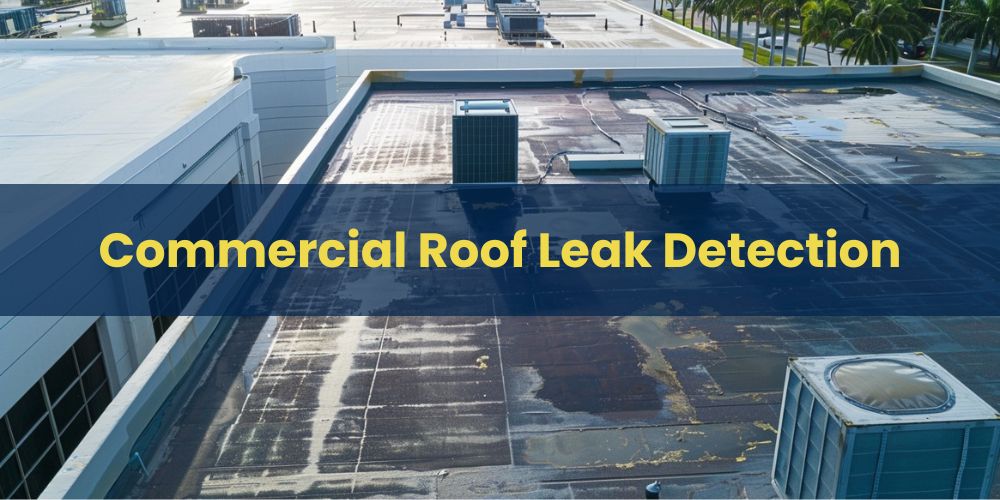
Commercial Roofing Pompano Beach provides commercial roof leak detection for flat, low-slope, and sloped commercial buildings across Pompano Beach, Florida. Commercial roof leak detection in Pompano Beach is performed under South Florida heat, Atlantic coastal humidity, salt-air exposure, storm-season rainfall, wind-driven moisture, drainage-sensitive roof geometry, and rooftop equipment density that directly affect water-entry behaviour, membrane continuity, seam performance, flashing stability, substrate moisture, insulation saturation, and long-term waterproofing reliability across warehouses, retail plazas, office buildings, medical facilities, hospitality properties, food-service buildings, industrial units, and multi-tenant commercial properties. Commercial roof leak detection identifies how water enters, travels, accumulates, and becomes visible inside a building by evaluating roof membranes, seams, laps, flashings, penetrations, drainage paths, gutters, scuppers, edge metals, fasteners, insulation layers, roof deck conditions, rooftop equipment interfaces, and prior repair areas. In Pompano Beach conditions, leak detection accuracy is determined by how exterior roof defects, interior leak symptoms, moisture migration pathways, stormwater loading, wind-driven rain, and building-use conditions are correlated into a clear commercial roof repair, restoration, maintenance, coating, or replacement decision.
- South Florida heat and UV exposure across Pompano Beach commercial roofs → accelerate membrane ageing, coating wear, sealant shrinkage, seam stress, adhesive fatigue, and surface brittleness across flat, low-slope, and sloped roof assemblies → leak detection must test membrane flexibility, seam continuity, lap integrity, coating erosion, flashing condition, and heat-related movement points rather than relying only on visible ceiling stains → unresolved heat-driven deterioration allows small cracks, open seams, exposed substrates, and failed sealants to become active water-entry points during rainfall.
- Atlantic coastal humidity, salt-air exposure, and wind-driven moisture near Pompano Beach → keep roof edges, fasteners, flashing interfaces, roof-to-wall transitions, penetrations, insulation edges, and metal terminations exposed to moisture-heavy environmental stress → leak detection must identify corrosion, loose fasteners, weakened adhesive bonds, failed compression points, deteriorated sealants, damp insulation, and concealed saturation zones → water can enter at perimeter details or penetrations and migrate laterally beneath the roof system before appearing inside the building far from the original entry point.
- Storm-season rainfall and drainage-sensitive commercial roof geometry across Pompano Beach → place sudden water volume onto drains, scuppers, gutters, crickets, valleys, low points, parapet edges, and roof-to-wall transition areas → leak detection must verify drainage flow, locate ponding zones, inspect blocked outlets, trace water paths, and compare standing-water areas with seams, patches, penetrations, and interior leak locations → sustained ponding pressure forces water through weak laps, membrane defects, flashing gaps, coating breaks, and repair transitions, activating recurring leaks and hidden moisture spread.
- Rooftop equipment density, coastal wind uplift, service penetrations, and prior repair zones → concentrate leak risk at HVAC curbs, exhaust fans, vents, pipe penetrations, pitch pockets, equipment supports, access routes, fastener rows, roof edges, corners, and patch boundaries → leak detection must assess flashing movement, curb detailing, pipe boot condition, pitch pocket failure, puncture damage, service-traffic wear, lifted edges, open laps, and repair-material compatibility → localised water-entry points can connect beneath the membrane or insulation layer and expand into multi-area leak conditions when not diagnosed as part of the complete roof assembly.
Commercial Roofing Pompano Beach delivers commercial roof leak detection as a system-level diagnostic service, assessing interior leak evidence, exterior roof defects, membrane condition, seam continuity, lap stability, flashing integrity, penetration detailing, pipe boot condition, HVAC curb interfaces, pitch pockets, edge metal securement, fastener condition, coating breaks, drainage behaviour, ponding exposure, gutter and scupper performance, wind-driven rain exposure, corrosion patterns, substrate moisture, insulation saturation, deck condition, moisture migration pathways, storm damage, service-traffic damage, prior repair compatibility, and remaining roof service life before defining the correct commercial roof leak repair, roof restoration, roof maintenance, roof coating, partial replacement, or full commercial roof replacement strategy.
How Does Commercial Roofing Pompano Beach Find the True Source of Commercial Roof Leaks?
Commercial Roofing Pompano Beach treats commercial roof leak detection as a source-tracing process, not as a visual search for the roof defect closest to an interior stain. In Pompano Beach, water can enter through one roof condition, move through insulation or deck layers, follow low-slope drainage direction, travel along structural members, and appear inside the building at a completely different point. South Florida heat, Atlantic humidity, salt-air exposure, storm-season rainfall, wind-driven moisture, rooftop equipment density, and drainage-sensitive commercial roof geometry all affect how water enters, moves, hides, and reappears. Commercial Roofing Pompano Beach identifies commercial roof leaks by connecting interior evidence, exterior roof conditions, moisture behaviour, drainage patterns, material failure, and prior repair history into one verified leak pathway.
The leak-source conditions investigated by Commercial Roofing Pompano Beach include:
- Interior leak displacement → water staining, ceiling drips, wet walls, ceiling grid damage, damp insulation, exposed equipment, or tenant disruption appears inside the building → the visible interior symptom does not automatically identify the roof entry point because water can travel laterally through insulation, deck flutes, wall transitions, or low-slope assembly layers → Pompano Beach wind-driven rain and storm-season water volume increase the distance between entry source and visible leak location → Commercial Roofing Pompano Beach maps interior evidence against roof slope, drainage direction, roof system layout, and likely water-migration routes before assigning a repair location.
- False-source roof defects → a visible puncture, crack, open seam, worn coating, loose fastener, or failed patch appears near the suspected leak area → that defect may be active, inactive, secondary, or unrelated to the interior leak depending on water flow, membrane continuity, and assembly saturation → South Florida heat and UV exposure create many visible surface defects that are not always the primary leak source → Commercial Roofing Pompano Beach separates cosmetic deterioration, future-risk defects, and active water-entry points before repair scope is defined.
- Hidden membrane and seam entry → water bypasses the roof surface through open laps, probe-open seams, split membranes, failed welds, bonded joint separation, coating breaks, patch edges, punctures, or fastened rows → heat movement, service traffic, coastal moisture, and repeated rainfall stress connection lines until small openings become active only under certain weather conditions → leaks may not appear during light rain but activate under ponding, wind-driven rain, or sustained stormwater exposure → Commercial Roofing Pompano Beach evaluates whether the membrane or seam defect is isolated or part of wider system deterioration.
- Penetration-led leakage → water enters at HVAC curbs, exhaust fans, vents, pipe penetrations, pitch pockets, roof hatches, skylights, parapet transitions, wall intersections, or equipment supports → these details interrupt the main roof surface and create fixed points inside a moving roof assembly → Pompano Beach rooftop equipment density, vibration, service access, heat expansion, and coastal wind-driven moisture place repeated stress on curb corners, pipe boots, sealant joints, flashing edges, termination bars, and transition materials → Commercial Roofing Pompano Beach traces whether the leak originates at the penetration itself, the surrounding flashing, the repair material, or the adjacent field roof.
- Drainage-pressure leak activation → water enters only when drains, scuppers, gutters, crickets, valleys, low points, parapet edges, or equipment-adjacent drainage paths retain stormwater against vulnerable details → blocked outlets, undersized discharge routes, wind-displaced debris, salt-air residue, and low-slope roof geometry in Pompano Beach can turn minor defects into active leaks by holding water over them → ponding pressure forces water through seams, laps, coatings, flashings, penetrations, and previous repair edges that may remain dry under normal runoff → Commercial Roofing Pompano Beach determines whether the leak is a defect problem, a drainage problem, or both.
- Moisture stored inside the roof assembly → insulation, cover board, deck surfaces, substrate layers, fastener lines, or concealed cavities contain water from a previous or current entry point → Atlantic humidity, repeated rainfall, and heat-driven vapor movement can keep moisture active beneath membranes, coatings, panels, asphaltic layers, and roof decks after the surface appears dry → concealed saturation, soft insulation, deck staining, corrosion, odour, mould-supporting dampness, and multiple interior leak points can develop without one obvious open defect → Commercial Roofing Pompano Beach uses moisture behaviour to decide whether the roof needs targeted leak repair, moisture removal, partial replacement, restoration, or full commercial roof replacement.
- Wind-driven rain pathways → water is pushed into roof edges, lifted seams, wall transitions, counterflashing gaps, vents, fastener rows, panel laps, equipment curbs, or perimeter details during storm conditions → coastal wind exposure in Pompano Beach can activate leaks that do not appear during vertical rainfall → lifted edges, displaced flashings, loose fasteners, open laps, cracked coatings, torn membranes, dented panels, and blocked drainage paths may create delayed or intermittent leak symptoms → Commercial Roofing Pompano Beach evaluates wind direction, edge exposure, storm damage, and uplift-prone details before assuming the leak is caused by a simple surface opening.
- Prior-repair distortion → previous patches, coating overlaps, mastics, sealant beads, welded repairs, repair plates, fastener replacements, incompatible membranes, and recurring leak locations change how water moves across and beneath the roof surface → Pompano Beach heat, salt-air moisture, storm rainfall, rooftop traffic, and roof movement cause old repair materials and original roof materials to age, bond, expand, and shed water differently → repair-boundary leaks, trapped moisture, coating incompatibility, patch-edge separation, and repeated sealant failure can make the current leak appear new when it is actually a failed repair pathway → Commercial Roofing Pompano Beach determines whether the leak source is original roof failure, repair incompatibility, hidden saturation, or system-wide breakdown.
- Delayed leak recurrence → a roof appears dry after a repair or storm event, then leaks again during later rainfall, humidity changes, or renewed ponding → delayed recurrence often means water remained stored inside the assembly, the wrong source was repaired, drainage pressure was not corrected, or multiple entry points were active at the same time → Pompano Beach conditions make this common because heat, humidity, stormwater, and wind can move moisture through the roof assembly in different ways at different times → Commercial Roofing Pompano Beach uses recurrence patterns to distinguish between a missed source, an incomplete repair, moisture migration, and replacement-level roof failure.
Commercial Roofing Pompano Beach defines commercial roof leak detection by evidence correlation: where water appears, where water enters, how water travels, where moisture is stored, and which roof condition makes the leak repeat. The diagnostic evaluation connects interior leak evidence, roof slope, drainage layout, membrane condition, seam continuity, flashing stability, penetration detailing, ponding exposure, wind-driven rain behaviour, storm damage, salt-air corrosion, substrate moisture, insulation saturation, prior repair performance, recurrence timing, and remaining roof service life. This allows Commercial Roofing Pompano Beach to identify whether the correct next step is commercial roof leak repair, drainage correction, moisture remediation, roof restoration, partial replacement, or full commercial roof replacement.
Have a question about a commercial roofing project?
Where Do Commercial Roof Leaks First Break Through on Pompano Beach Buildings?
Commercial Roofing Pompano Beach identifies commercial roof leak breakthrough points by locating where exterior waterproofing stress first becomes an active water-entry condition. A commercial roof leak may begin at a small seam opening, flashing gap, puncture, drainage-loaded lap, loose fastener, coated metal transition, roof edge, or prior repair boundary before travelling beneath the roof surface and appearing inside the building somewhere else. On Pompano Beach commercial buildings, South Florida heat, Atlantic coastal humidity, salt-air exposure, storm-season rainfall, wind-driven moisture, coastal uplift pressure, rooftop equipment density, service traffic, and low-slope drainage behaviour all influence where water first penetrates the roof assembly.
The most common commercial roof leak breakthrough points found by Commercial Roofing Pompano Beach include:
- Seams, laps, welds, and splice lines. Commercial roof leaks often first break through where membrane seams, modified bitumen laps, PVC or TPO welds, EPDM splice lines, metal panel laps, coating-reinforced seams, patch edges, and built-up roofing joints lose continuous contact → Pompano Beach storm rainfall, heat movement, ponding pressure, and wind-driven moisture can force water against these joint lines before the open roof field fails → open laps, probe-open welds, fishmouths, curling seam edges, mastic cracks, fabric lift, stained overlap lines, and capillary water movement can form active leak pathways → Commercial Roofing Pompano Beach determines whether seam repair, reinforced detailing, drainage correction, partial replacement, or wider commercial roof restoration is required.
- Flashing gaps at roof-to-wall and parapet transitions. Water commonly enters where roof fields meet parapet walls, counterflashings, base flashings, coping returns, termination bars, coated metal transitions, mastic edges, and roof-to-wall joints → Pompano Beach wind-driven rain, coastal humidity, salt-air exposure, uplift pressure, and daily heat movement repeatedly stress fixed vertical details → cracked mastics, loose terminations, open corners, split flashing plies, wall-side staining, lifted transition metal, and membrane separation can allow water behind the roof surface → Commercial Roofing Pompano Beach evaluates whether the breakthrough point is a rebuildable flashing defect or part of broader perimeter and wall-interface failure.
- HVAC curbs, exhaust fans, vents, and rooftop equipment bases. Commercial roof leaks frequently begin where rooftop equipment interrupts the waterproofing field and creates fixed stress points inside a moving roof assembly → Pompano Beach rooftop equipment density, service access, heat expansion, equipment vibration, curb-side runoff, and wind-driven moisture concentrate stress at curb corners, welded patches, pipe boots, pitch pockets, termination bars, and reinforced details → lifted curb flashing, cracked boots, open welds, loose pitch pockets, punctures, compression loss, and curb-side water entry can start leaks before the field membrane shows obvious damage → Commercial Roofing Pompano Beach determines whether the equipment interface can be rebuilt locally or whether repeated equipment-zone leakage requires partial replacement.
- Drain perimeters, scuppers, gutters, and ponding-loaded low points. Leak breakthrough often occurs where stormwater slows, collects, backs up, or remains against vulnerable roof details → Pompano Beach storm-season rainfall, wind-displaced debris, blocked outlets, undersized drainage routes, weak crickets, settlement depressions, and low-slope commercial roof geometry can hold water at drains, scuppers, gutters, valleys, parapet edges, and equipment-adjacent flow paths → ponding pressure can activate weak seams, coating breaks, membrane depressions, rusted fasteners, softened asphaltic areas, saturated substrate zones, and patch-edge leaks → Commercial Roofing Pompano Beach traces whether the leak began as a roof defect, a drainage failure, or both.
- Perimeter edges, corners, and uplift-loaded roof restraints. Roof leaks can first break through at perimeter edges before the central roof field appears damaged → coastal wind uplift, salt-air moisture, storm exposure, and roof-edge drainage stress in Pompano Beach load coping caps, edge metals, termination bars, fasteners, membrane restraints, gutter interfaces, fascia lines, parapet returns, and corner details → lifted edges, loose fasteners, open terminations, membrane flutter, panel movement, displaced edge metal, corner gaps, and edge-side staining can create hidden water-entry points → Commercial Roofing Pompano Beach evaluates whether edge securement, flashing rebuilds, fastener correction, gutter work, partial replacement, or full commercial roof replacement is needed.
- Fasteners, plates, clips, washers, and attachment rows. Water-entry points often begin around mechanical attachment components that have loosened, corroded, split, or lost compression → South Florida heat movement, Atlantic humidity, salt-air exposure, storm uplift, and rooftop service traffic can back out screws, crack washers, corrode plates, stretch holes, move clips, and distort attachment rows → rust halos, fastener-line staining, washer failure, plate movement, puncture enlargement, panel chatter, and membrane stress can allow water to enter through small attachment weaknesses → Commercial Roofing Pompano Beach determines whether the leak is a simple fastener repair, an attachment-stability issue, or evidence of wider uplift vulnerability.
- Coating breaks, exposed substrate, and thin-film failure points. On coated commercial roofs, leaks often break through where the coating film has cracked, thinned, blistered, peeled, softened, split, or separated from the substrate → Pompano Beach solar intensity, stormwater loading, salt-air residue, surface contamination, ponding exposure, and rooftop traffic can reduce coating adhesion, reflectivity, film thickness, and elastomeric movement → exposed substrate, fabric edge lift, coating blisters, delamination, hairline cracks, ponding stains, and patch-boundary splits can allow water past the restored surface → Commercial Roofing Pompano Beach evaluates whether coating repair, recoating, reinforced restoration, stripping, partial replacement, or full roof replacement is the correct response.
- Old patches, mastics, sealants, and repair-boundary transitions. Prior repair areas often become the first leak breakthrough points because repair materials age differently from the surrounding roof system → Pompano Beach heat, coastal humidity, salt-air residue, stormwater exposure, and service traffic can make mastics crack, sealants shrink, welded patches lift, coating overlaps peel, repair plates loosen, and embedded fabrics separate → patch-edge leaks, mastic splits, trapped moisture, failed welds, incompatible materials, and repeated leak recurrence can show that the original repair boundary has become the active leak path → Commercial Roofing Pompano Beach determines whether old repairs can be removed and rebuilt or whether repeated repair failure points to restoration or replacement.
- Metal roof laps, cut edges, corrosion points, and panel transitions. On commercial metal roofs, leaks often first break through where panel laps, cut edges, fastener lines, rusted washers, gutters, scuppers, ridge details, side laps, end laps, and flashing returns are weakened by corrosion or movement → Atlantic humidity and salt-air exposure near Pompano Beach can accelerate rust creep beneath coatings, around exposed fasteners, and along metal seams → rust bleed-through, panel-edge corrosion, lap separation, fastener staining, coating lift, and water entry at panel joints can create active leak paths → Commercial Roofing Pompano Beach evaluates whether corrosion treatment, fastener correction, seam reinforcement, metal roof coating, partial panel replacement, or full replacement is required.
- Interior-facing leak symptoms that trace back to remote roof openings. Commercial roof leaks may become visible as ceiling stains, wall moisture, tenant drip reports, odour, damp insulation indicators, interior corrosion, ceiling grid damage, or equipment-area water marks far from the actual roof entry point → Pompano Beach wind-driven rain, low-slope roof assemblies, insulation channels, deck flutes, wall interfaces, and concealed moisture pathways can move water away from the breakthrough location before it appears indoors → treating the visible interior symptom without tracing the exterior entry point can leave the true leak active → Commercial Roofing Pompano Beach correlates interior evidence with exterior roof conditions before defining the correct leak repair area.
Commercial Roofing Pompano Beach identifies commercial roof leak breakthrough points by connecting exterior defect location, Pompano Beach exposure condition, water-entry behaviour, hidden moisture movement, and the service decision each finding supports. Seam failures, flashing gaps, rooftop equipment details, ponding zones, perimeter edges, attachment points, coating breaks, old repair boundaries, metal roof corrosion points, and displaced interior leak symptoms are treated as connected leak-detection evidence rather than isolated roof observations. This helps determine whether the correct next step is commercial roof leak repair, drainage correction, moisture remediation, roof restoration, roof coating, partial replacement, or full commercial roof replacement.
Have a question about a commercial roofing project?
How Does Commercial Roofing Pompano Beach Follow Hidden Moisture Beneath the Roof Assembly?
Commercial Roofing Pompano Beach follows hidden moisture beneath the roof assembly by linking interior leak evidence, exterior roof defects, drainage behaviour, insulation condition, deck pathways, and storm exposure into one moisture-tracing model. Hidden moisture is not treated as a single wet spot. On Pompano Beach commercial buildings, water can enter through a seam, penetration, flashing gap, ponding-loaded patch, loose fastener, coated metal transition, or roof edge, then move laterally through insulation, cover board, deck flutes, wall interfaces, structural members, and low-slope assembly layers before appearing as a ceiling stain or recurring drip point. South Florida heat, Atlantic coastal humidity, salt-air exposure, storm-season rainfall, wind-driven moisture, rooftop equipment density, and drainage-sensitive roof geometry all affect how long moisture remains active and how far it travels beneath the visible roof surface.
The hidden moisture pathways traced by Commercial Roofing Pompano Beach include:
- Moisture spreading through insulation and cover board layers. Water that enters through a seam, puncture, flashing defect, or roof edge may not stay at the entry point → Pompano Beach storm rainfall, Atlantic humidity, and low-slope roof design can keep moisture active inside insulation boards, cover boards, facer layers, and substrate transitions → damp insulation, soft roof areas, delayed ceiling stains, odour, blistering, thermal movement, and recurring leak symptoms can appear away from the original defect → Commercial Roofing Pompano Beach determines whether the moisture can be isolated and dried or whether insulation removal, partial replacement, or full commercial roof replacement is required.
- Water travelling along deck flutes, joints, and structural pathways. Commercial roof leaks can move beneath the membrane through metal deck flutes, concrete deck cracks, wood deck joints, structural seams, beam lines, fastener penetrations, and wall transitions → wind-driven rain and storm-season water volume in Pompano Beach can push water into small roof openings and allow it to travel along the easiest concealed path → interior stains may appear several feet away from the true water-entry point when deck geometry redirects moisture → Commercial Roofing Pompano Beach correlates roof-level defects with interior symptoms before assigning a repair location.
- Moisture stored beneath ponding-loaded roof areas. Ponding zones can hold water long enough for small roof defects to become active leak paths → Pompano Beach storm-season rainfall, blocked drains, clogged scuppers, weak crickets, settlement depressions, debris movement, and low-slope geometry can keep water against seams, coatings, patches, penetrations, and flashing details → standing water can drive moisture into insulation, soften substrates, reactivate old repairs, and create leaks that only appear after sustained rainfall → Commercial Roofing Pompano Beach traces whether the hidden moisture problem began as a drainage failure, a membrane defect, or both.
- Leak migration from flashing and wall-interface defects. Water that enters at parapet walls, roof-to-wall transitions, counterflashings, coping returns, base flashings, termination bars, wall joints, and mastic edges can move behind the roof surface before reaching the interior → Pompano Beach wind-driven rain, coastal humidity, uplift pressure, and daily heat movement stress vertical transitions where the roof field meets fixed wall conditions → damp wall cavities, ceiling-edge stains, hidden insulation moisture, wall-side leaks, and recurring transition symptoms can develop without obvious field-membrane failure → Commercial Roofing Pompano Beach determines whether the issue is a local flashing repair, a wall-interface rebuild, or a broader roof-system moisture condition.
- Moisture movement around rooftop equipment and penetration clusters. HVAC curbs, exhaust fans, vents, pipe penetrations, pitch pockets, conduit supports, roof hatches, service lines, and equipment platforms create multiple possible entry points close together → rooftop equipment density in Pompano Beach concentrates vibration, service traffic, curb-side runoff, wind-driven rain, heat expansion, and flashing stress around fixed roof interruptions → water may enter at one side of a curb, move under the membrane, follow insulation seams, and appear inside the building away from the equipment zone → Commercial Roofing Pompano Beach traces the complete equipment interface before recommending sealant repair, flashing rebuilds, reinforced coating, partial replacement, or wider roof work.
- Moisture held beneath coatings, patches, and prior repairs. Old patches, mastics, coating overlaps, welded repairs, reinforced fabrics, sealant beads, repair plates, and recoated areas can trap moisture beneath a surface that appears sealed → South Florida heat, Atlantic humidity, salt-air residue, stormwater exposure, and rooftop service traffic can make repair materials separate, blister, soften, crack, or redirect water → trapped moisture, patch-edge leaks, coating blisters, hollow-sounding areas, delamination, and delayed leak recurrence can reveal that the visible repair is concealing active water movement → Commercial Roofing Pompano Beach determines whether prior repairs can be removed and rebuilt or whether the roof has moved beyond patch-based leak control.
- Wind-driven moisture beneath perimeter and edge details. Roof edges, corners, parapet returns, edge metals, gutter interfaces, termination bars, coping caps, fascia lines, membrane restraints, and panel ends can allow moisture beneath the assembly during wind-loaded storms → coastal uplift pressure and wind-driven rain in Pompano Beach can lift edge details while pushing water beneath perimeter components → edge-side stains, damp insulation edges, loose terminations, lifted membranes, gutter backflow, corroded fasteners, and delayed interior leaks can develop from perimeter moisture entry → Commercial Roofing Pompano Beach evaluates whether edge securement, flashing rebuilds, gutter correction, moisture removal, partial replacement, or full replacement is needed.
- Moisture following fasteners, plates, clips, and attachment lines. Water can travel through or around mechanical attachment points even when the surrounding membrane looks mostly intact → Pompano Beach heat movement, storm uplift, salt-air exposure, and rooftop service traffic can loosen screws, crack washers, corrode fasteners, move plates, stretch holes, and disturb attachment rows → fastener-line staining, rust halos, damp insulation below attachment points, membrane flutter, and recurring leaks along attachment paths can reveal concealed water movement → Commercial Roofing Pompano Beach identifies whether the leak requires fastener correction, attachment stabilisation, local repair, or wider roof-system work.
- Moisture recurrence after previous leak repair. A commercial roof may leak again after patching when moisture was already stored inside the assembly or the original source was misidentified → Pompano Beach humidity, heat, storm rainfall, and drainage pressure can reactivate trapped water or expose unrepaired entry points during later weather events → delayed stains, repeat tenant reports, new drip locations, odour, soft substrate, and blister recurrence can indicate that moisture was migrating before the repair was completed → Commercial Roofing Pompano Beach uses recurrence timing to distinguish a failed repair from stored moisture, secondary entry points, drainage pressure, or replacement-level roof failure.
- Interior symptoms that confirm concealed moisture travel. Ceiling grid staining, wall moisture, odour, tenant drip reports, damp insulation indicators, interior corrosion, equipment-area water marks, and repeated ceiling repairs can show that moisture is moving beneath the roof before it becomes visible inside → low-slope commercial roof assemblies in Pompano Beach can redirect water along insulation channels, deck seams, wall interfaces, and structural pathways → interior evidence is compared with exterior seams, penetrations, drains, flashings, roof edges, equipment zones, and prior repairs to avoid treating the wrong location → Commercial Roofing Pompano Beach uses this evidence to define whether the correct response is leak repair, moisture remediation, roof restoration, partial replacement, or full commercial roof replacement.
Commercial Roofing Pompano Beach follows hidden moisture beneath the roof assembly by connecting water-entry points, concealed travel paths, moisture storage areas, Pompano Beach weather exposure, and interior leak symptoms into one leak-detection diagnosis. Moisture inside insulation, cover boards, deck flutes, wall transitions, equipment zones, repair boundaries, perimeter edges, fastener lines, and previous leak areas is treated as active diagnostic evidence rather than a secondary observation. This helps determine whether the commercial roof needs targeted leak repair, drainage correction, moisture removal, reinforced restoration, partial replacement, or full commercial roof replacement.
Have a question about a commercial roofing project?
How Does Commercial Roofing Pompano Beach Distinguish Real Leak Sources from Misleading Roof Defects?
Commercial Roofing Pompano Beach distinguishes real commercial roof leak sources from misleading roof defects by testing whether a visible condition actually explains the water pattern inside the building. A puncture, cracked coating, open seam, loose fastener, failed patch, ponding stain, rust mark, or flashing gap may look like the leak source, but it may be inactive, secondary, cosmetic, or unrelated if water is entering elsewhere and travelling beneath the roof assembly. On Pompano Beach commercial buildings, South Florida heat, Atlantic coastal humidity, salt-air exposure, storm-season rainfall, wind-driven moisture, rooftop equipment density, coastal uplift pressure, and low-slope drainage behaviour can create several visible defects while only one condition is actively feeding the leak.
The leak-source verification checks used by Commercial Roofing Pompano Beach include:
- Interior symptom alignment. A visible roof defect becomes a stronger leak-source candidate when it aligns with ceiling stains, tenant drip reports, wall moisture, odour, damp insulation indicators, equipment-area water marks, ceiling grid damage, or interior corrosion → Pompano Beach wind-driven rain and low-slope roof construction can move water laterally through insulation, deck flutes, wall interfaces, and concealed pathways → the closest roof defect may not be the true entry point if the interior symptom sits along a different drainage or deck pathway → Commercial Roofing Pompano Beach compares interior evidence with roof slope, drainage direction, roof system layout, and concealed moisture routes before confirming the source.
- Weather-trigger matching. A real leak source usually matches the weather condition that activates the leak, such as vertical rainfall, wind-driven rain, sustained stormwater, ponding after heavy rain, or coastal uplift exposure → Pompano Beach storm-season rainfall, Atlantic moisture, and wind-loaded weather can activate different roof details at different times → a seam may leak only under ponding, a wall transition may leak only during wind-driven rain, and a drain-side defect may leak only after outlets back up → Commercial Roofing Pompano Beach checks whether the suspected defect matches the timing and weather pattern of the leak.
- Drainage relationship. A defect is more likely to be active when water naturally flows toward it, sits over it, backs up around it, or repeatedly loads it during storms → Pompano Beach low-slope commercial roof geometry, blocked drains, clogged scuppers, weak crickets, settlement depressions, and wind-displaced debris can redirect water toward seams, flashings, patches, coatings, and penetrations → a visible crack outside the water path may be less relevant than a smaller opening inside the ponding or runoff zone → Commercial Roofing Pompano Beach separates true drainage-activated leak sources from unrelated surface blemishes.
- Moisture continuity below the defect. A real leak source usually connects to damp insulation, soft substrate, wet cover board, deck staining, blistering, odour, corrosion, or recurring moisture below the suspected entry point → Atlantic coastal humidity and repeated Pompano Beach rainfall can keep moisture active beneath membranes, coatings, panels, asphaltic layers, and roof decks → a visible defect without moisture continuity may be future risk rather than the current leak source → Commercial Roofing Pompano Beach uses moisture evidence to confirm whether water is entering at the suspected condition or travelling from another location.
- Defect activity versus cosmetic ageing. South Florida heat and UV exposure can create chalking, coating wear, surface cracking, sealant shrinkage, granule loss, membrane ageing, and minor brittleness that may look serious but not actively leak → Pompano Beach commercial roofs often contain multiple ageing signals after years of solar exposure, salt-air residue, service traffic, and storm weathering → leak detection separates cosmetic deterioration and future-risk defects from active water-entry conditions → Commercial Roofing Pompano Beach avoids assigning leak repair to visible ageing unless the evidence shows active water movement.
- Penetration and equipment-zone source testing. HVAC curbs, exhaust fans, vents, pipe penetrations, pitch pockets, roof hatches, conduit supports, service lines, and equipment platforms often create several plausible leak points close together → rooftop equipment density in Pompano Beach concentrates vibration, service traffic, wind-driven moisture, curb-side runoff, and heat movement around fixed roof interruptions → a cracked sealant bead may be less important than a lifted curb flashing, open weld, failed pitch pocket, or water path entering behind the equipment base → Commercial Roofing Pompano Beach verifies the complete equipment interface before confirming the leak source.
- Prior repair influence. Old patches, mastics, welded repairs, coating overlaps, repair plates, reinforced fabrics, sealant beads, fastener replacements, and repeated leak repairs can make the leak appear to originate from a new roof defect → Pompano Beach heat, stormwater, salt-air exposure, and rooftop traffic can make previous repairs lift, crack, trap moisture, redirect water, or fail at their edges → the real source may be the repair boundary, trapped moisture beneath old work, or water redirected around the repair → Commercial Roofing Pompano Beach determines whether prior repair distortion is causing the current leak pattern.
- Perimeter and wind-uplift verification. Roof edges, corners, parapet returns, coping caps, edge metals, termination bars, gutter interfaces, membrane restraints, and panel ends can leak only during wind-loaded conditions → coastal uplift pressure and wind-driven rain in Pompano Beach can push water beneath lifted edges or loose perimeter details while leaving central roof defects inactive → a field membrane crack may be misleading if leak symptoms appear after wind events and align with exposed roof edges → Commercial Roofing Pompano Beach verifies whether the leak source is perimeter-driven before recommending repair scope.
- Multiple-defect separation. A commercial roof may have several defects, but not every defect is the current leak source → Pompano Beach commercial roofs with ageing membranes, old coatings, rooftop equipment, storm exposure, and prior repairs can show open seams, cracked sealants, worn coatings, rust stains, ponding marks, and loose fasteners at the same time → leak detection separates active entry points, secondary defects, maintenance items, and future-risk conditions so the repair does not chase the wrong problem → Commercial Roofing Pompano Beach defines the repair area only after the defect, water path, interior evidence, and moisture behaviour agree.
- Recurrence after previous leak repair. When a leak returns after a repair, the repaired defect may have been misleading, incomplete, or only one of several active entry points → Pompano Beach humidity, storm rainfall, ponding pressure, and wind-driven moisture can reactivate stored water or expose hidden secondary sources after the roof appears dry → delayed recurrence often indicates missed source tracing, trapped moisture, drainage-pressure activation, prior repair failure, or replacement-level roof-system deterioration → Commercial Roofing Pompano Beach uses recurrence timing to identify whether the real leak source was misread or whether wider roof work is now needed.
Commercial Roofing Pompano Beach distinguishes real leak sources from misleading roof defects by connecting interior symptoms, weather triggers, drainage behaviour, moisture continuity, defect activity, equipment interfaces, prior repairs, perimeter exposure, multiple-defect patterns, and recurrence timing into one verified leak-detection diagnosis. This prevents commercial roof leak repair from being aimed at the most visible roof defect instead of the condition actually moving water into the building. The result is a clearer decision between targeted leak repair, drainage correction, moisture remediation, reinforced restoration, partial replacement, or full commercial roof replacement under Pompano Beach’s humid, coastal, storm-exposed roofing conditions.
What Leak Evidence Shows Whether Local Repair Is Enough or Broader Roof Work Is Needed?
Commercial Roofing Pompano Beach determines whether a commercial roof leak can be handled with local repair or requires broader roof work by reading the evidence around the leak, not just the visible opening. A small puncture, open seam, loose fastener, cracked pipe boot, or failed patch may be repairable when the surrounding roof assembly is dry, stable, attached, drainable, and compatible with the repair material. Broader roof work becomes more likely when the leak evidence shows moisture migration, repeated recurrence, saturated insulation, drainage-driven activation, failed prior repairs, unstable attachment, widespread seam failure, perimeter movement, storm damage, or substrate deterioration under Pompano Beach’s South Florida heat, Atlantic coastal humidity, salt-air exposure, storm-season rainfall, wind-driven moisture, rooftop equipment density, coastal uplift pressure, and low-slope drainage stress.
The leak evidence Commercial Roofing Pompano Beach uses to separate local commercial roof leak repair from wider roof work includes:
- Isolated entry point with dry surrounding materials. Local commercial roof leak repair is usually enough when the leak source is clearly limited to one puncture, one pipe boot, one small flashing gap, one open weld, one failed fastener, or one repair edge → Pompano Beach rainfall may have activated the defect, but the surrounding membrane, insulation, deck, flashing, and drainage area remain stable → repair can remain local when moisture has not migrated laterally and the roof system can accept compatible patching, welding, flashing repair, sealant correction, or fastener replacement → broader roof work becomes more likely when nearby materials are soft, damp, detached, brittle, corroded, or repeatedly leaking.
- Recurring leak after previous repair. A leak that returns after patching, sealing, welding, coating, or flashing correction may indicate that the original source was missed or that water is travelling beneath the roof assembly → South Florida heat, Atlantic humidity, storm rainfall, and service traffic in Pompano Beach can make old repairs lift, crack, trap moisture, or move differently from the surrounding roof surface → one more patch may fail if the leak is caused by hidden saturation, drainage pressure, repair incompatibility, or a secondary entry point → broader roof work may involve removing failed repairs, tracing moisture, rebuilding details, correcting drainage, restoring a larger zone, or partially replacing the affected roof area.
- Interior leak location does not align with the roof defect. Local repair becomes less certain when ceiling stains, wall moisture, tenant drip reports, odour, damp insulation indicators, or interior corrosion appear away from the suspected exterior opening → Pompano Beach wind-driven rain, low-slope roof geometry, insulation channels, deck flutes, wall interfaces, and concealed pathways can move water away from the entry point before it appears indoors → the visible exterior defect may be only one possible source, a secondary defect, or unrelated surface wear → broader investigation is needed when interior evidence suggests lateral moisture movement beneath the roof assembly.
- Moisture has entered insulation, cover board, or deck layers. A leak moves beyond simple local repair when inspection evidence shows damp insulation, soft substrate, wet cover board, deck staining, blistering, raised membrane areas, odour, or recurring moisture below the roof surface → Atlantic coastal humidity and repeated Pompano Beach storm rainfall can keep concealed moisture active long after the roof surface appears dry → patching the visible opening may trap water inside the roof assembly and allow deterioration to continue → wider roof work may require drying, wet insulation removal, substrate correction, partial replacement, or full commercial roof replacement depending on moisture spread.
- Leak activation depends on ponding or drainage pressure. Local repair may not be enough when the leak appears during sustained rainfall, after standing water forms, near blocked drains, around scuppers, beside gutters, at low points, or along equipment-adjacent drainage paths → Pompano Beach storm-season rainfall, wind-displaced debris, limited roof slope, clogged outlets, weak crickets, and settlement depressions can keep water loaded against seams, patches, coatings, flashings, penetrations, and repair boundaries → a small defect may keep reopening if drainage pressure remains unchanged → broader roof work may require drainage correction, tapered work, reinforced detailing, coating repair, restoration, or partial replacement before leak repair can hold.
- Seam, lap, or weld failure repeats across multiple areas. Local repair is less reliable when several seams, laps, welds, splice lines, panel joints, fabric-reinforced details, or patch edges show similar failure patterns → Pompano Beach heat movement, stormwater loading, ponding exposure, and wind-driven moisture can stress connection lines across the roof system, not just at one leak point → repeated open laps, fishmouths, curling seams, failed welds, mastic cracks, stained overlap lines, and fabric lift suggest that waterproofing continuity is weakening across a larger area → broader work may involve seam reinforcement, roof restoration, recoating, partial replacement, or replacement-level planning.
- Flashing or penetration defects are part of a cluster. A single cracked pipe boot or curb-side gap may be repairable, but repeated problems around HVAC curbs, vents, exhaust fans, pitch pockets, skylights, conduit supports, wall transitions, or equipment platforms point to wider detailing failure → rooftop equipment density in Pompano Beach concentrates vibration, foot traffic, wind-driven rain, heat movement, curb-side runoff, and service access around roof interruptions → multiple open welds, split flashings, loose pitch pockets, punctures, failed sealants, or curb-side stains show that the leak risk is not isolated → broader roof work may require rebuilding a full equipment zone, reinforcing walkway routes, correcting drainage, or partially replacing contaminated or damaged areas.
- Perimeter movement or uplift evidence appears near the leak. Leaks near edges, corners, parapet returns, coping caps, gutter interfaces, edge metals, termination bars, or membrane restraints become more serious when uplift or movement evidence is present → coastal wind pressure, salt-air exposure, and storm conditions near Pompano Beach can loosen edge details before the main roof field visibly fails → lifted edges, membrane flutter, displaced edge metals, loose terminations, fastener movement, open corners, and edge-side staining indicate that surface sealing alone may not hold → broader roof work may require edge securement, flashing rebuilds, fastener correction, perimeter reinforcement, partial replacement, or full roof replacement.
- Corrosion, fastener deterioration, or attachment weakness accompanies the leak. Local leak repair may be inadequate when rust halos, fastener back-out, washer cracking, panel movement, plate displacement, clip failure, corroded termination bars, or deteriorated metal transitions appear around the leak area → Atlantic humidity and salt-air exposure near Pompano Beach can weaken metal components, coated metal interfaces, fasteners, gutters, scuppers, and edge details beneath visible roof surfaces → water entry may be tied to mechanical restraint failure rather than one small opening → broader work may require fastener replacement, corrosion treatment, attachment stabilisation, metal roof coating, panel repair, or partial replacement.
- Storm damage changes the roof’s behaviour. A leak may require wider work when it appears after heavy rain, tropical storm exposure, high-wind events, debris impact, drainage backup, or roof-edge movement → Pompano Beach storm conditions can create uplift damage, punctures, displaced flashings, blocked outlets, loosened fasteners, torn membranes, cracked coatings, and wind-driven rain pathways that are not limited to one visible defect → local repair may handle the first leak symptom while other storm-related weaknesses remain active → Commercial Roofing Pompano Beach determines whether the evidence supports emergency leak repair, documented storm repair, restoration, partial replacement, or full commercial roof replacement.
Commercial Roofing Pompano Beach recommends local commercial roof leak repair when the leak source is isolated, surrounding materials are dry, attachment is stable, drainage is controlled, seams remain serviceable, and the repair can be integrated into the existing roof system. Wider roof work becomes more appropriate when leak evidence shows moisture migration, repeated recurrence, saturated insulation, drainage-pressure activation, clustered detail failure, widespread seam breakdown, perimeter movement, corrosion, storm damage, failed prior repairs, or replacement-level substrate deterioration. This ensures commercial roof leak detection leads to the correct next step: targeted leak repair, moisture remediation, drainage correction, roof restoration, roof coating, partial replacement, or full commercial roof replacement under Pompano Beach’s humid, coastal, storm-exposed roofing conditions.
When Should a Pompano Beach Commercial Property Request Professional Roof Leak Detection?
A Pompano Beach commercial property should request professional roof leak detection when interior water evidence appears but the roof entry point is not obvious, especially when ceiling stains, tenant drip reports, wet walls, odour, damp insulation indicators, ceiling grid damage, equipment-area water marks, recurring leaks, or leaks that appear only during wind-driven rain do not clearly align with one visible roof defect. Commercial roof leak detection is also important after storm-season rainfall, tropical storm exposure, drainage backups, rooftop HVAC work, food-service exhaust contamination, repeated patching, ponding around drains or scuppers, loose edge details, open seams, flashing gaps, punctures near equipment, fastener corrosion, or prior repair failure because South Florida heat, Atlantic coastal humidity, salt-air exposure, coastal uplift pressure, rooftop equipment density, and low-slope drainage behaviour can move water beneath the roof assembly before it becomes visible inside the building.
Commercial Roofing Pompano Beach uses professional roof leak detection to identify whether the leak is caused by a true water-entry point, hidden moisture migration, drainage-pressure activation, wind-driven rain intrusion, penetration failure, perimeter movement, seam or lap breakdown, coating failure, fastener deterioration, prior repair distortion, or replacement-level roof-system failure. Targeted commercial roof leak repair may be enough when the source is isolated, surrounding materials are dry, attachment is stable, drainage is controlled, and the repair can be integrated into the existing roof system. Broader roof work becomes more likely when leak evidence shows saturated insulation, repeated recurrence, multiple entry points, ponding-driven activation, concealed substrate moisture, failed flashing clusters, unstable edges, widespread seam failure, storm damage, or repair boundaries that no longer stop water movement under Pompano Beach’s humid, coastal, storm-exposed commercial roofing conditions.