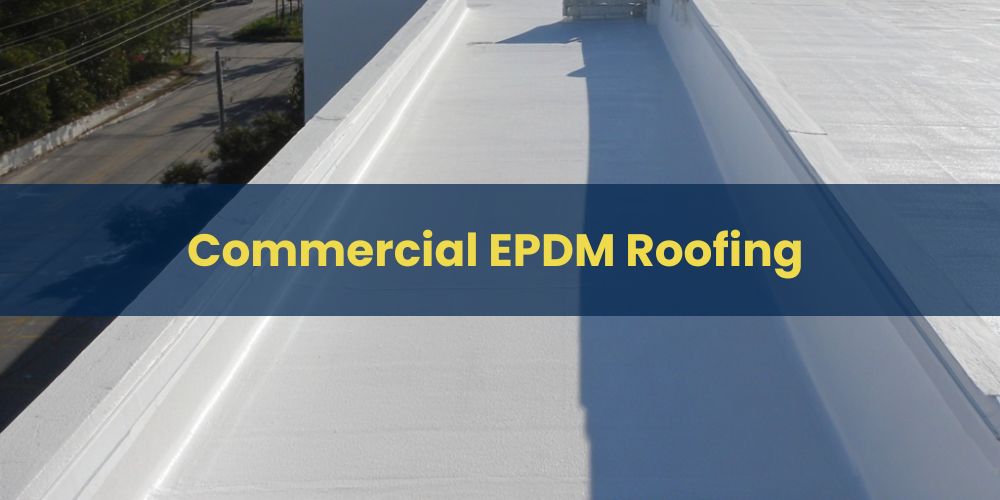
Commercial Roofing Pompano Beach provides commercial EPDM roofing repair, replacement, restoration, and maintenance for flat and low-slope commercial buildings across Pompano Beach, Florida. EPDM roofing systems in Pompano Beach operate under South Florida heat, Atlantic coastal humidity, salt-air exposure, storm-season rainfall, wind uplift pressure, and drainage-sensitive roof conditions that directly affect membrane elasticity, seam adhesion, flashing continuity, perimeter securement, substrate stability, and long-term waterproofing performance across warehouses, retail plazas, office buildings, medical facilities, service buildings, industrial units, and multi-tenant commercial properties. Commercial EPDM roofing systems use a synthetic rubber membrane with bonded seams, seam tape, splice adhesive, flashing membranes, termination bars, edge metal, pipe boots, curb flashing, and roof drainage details to create a flexible waterproofing assembly over large commercial roof spans. In Pompano Beach conditions, system performance is determined by how the EPDM membrane, seam bonds, adhesive layers, flashing interfaces, perimeter edges, rooftop penetrations, insulation substrate, and drainage paths respond to heat-driven movement, coastal moisture, stormwater loading, wind uplift forces, and repeated service traffic.
- South Florida heat and daily thermal movement in Pompano Beach → repeatedly expand and contract EPDM membrane fields across flat and low-slope commercial roof areas → seam tape, splice adhesive, bonding adhesive, flashing transitions, and perimeter terminations absorb repeated tensile and shear stress → adhesive fatigue, membrane shrinkage, seam tension, edge pullback, and loss of waterproofing continuity increase across exposed roof zones.
- Atlantic coastal humidity and salt-air exposure near Pompano Beach → keep seams, termination bars, edge metals, fasteners, flashing interfaces, and insulation transitions exposed to moisture-heavy conditions → adhesive bonds weaken, metal termination components corrode, substrate edges degrade, and flashing transitions lose stable contact with the membrane → concealed moisture migration, seam instability, perimeter leakage, and recurring interior water intrusion develop beneath or around the EPDM assembly.
- Storm-season rainfall and drainage-sensitive roof geometry across Pompano Beach commercial buildings → place sudden water volume onto drains, scuppers, gutters, crickets, low points, and roof-to-wall transition areas → blocked drainage paths, insufficient slope, or displaced debris allow ponding water to remain against seams, patches, penetrations, and flashing details → sustained water pressure accelerates seam separation, membrane deformation, insulation saturation, adhesive breakdown, and repeated leak activation.
- Coastal wind uplift, perimeter edge exposure, rooftop equipment, and service penetrations → concentrate mechanical stress at roof edges, corners, HVAC curbs, pipe boots, vents, pitch pockets, access points, equipment supports, and walkway zones → EPDM flashing, cover tape, termination bars, fasteners, bonded transitions, and membrane attachment points move differently from the surrounding field membrane → lifted edges, punctures, open laps, flashing separation, and localised water entry points expand into multi-point roof failure when not corrected at system level.
Commercial Roofing Pompano Beach delivers commercial EPDM roofing as a system-level service, assessing membrane elasticity, seam adhesion, seam tape condition, splice integrity, adhesive performance, shrinkage patterns, flashing continuity, termination bar security, edge metal condition, rooftop penetration detailing, pipe boot condition, curb flashing stability, drainage behaviour, ponding exposure, substrate moisture, insulation saturation, deck condition, wind uplift vulnerability, service-traffic damage, and prior repair compatibility before defining the correct EPDM roof repair, restoration, maintenance, partial replacement, or full commercial EPDM roof replacement strategy.
How Does Commercial Roofing Pompano Beach Evaluate Commercial EPDM Roof Performance?
Commercial Roofing Pompano Beach evaluates commercial EPDM roofing by reading the roof as a flexible rubber waterproofing assembly, not as a generic single-ply membrane. On Pompano Beach commercial buildings, EPDM performance depends on how the rubber sheet, bonded seams, splice adhesive, seam tape, cover tape, perimeter terminations, pipe boots, curb flashing, ballast zones, insulation substrate, and drainage paths behave under South Florida heat, Atlantic coastal humidity, salt-air exposure, storm-season rainfall, coastal wind uplift, and repeated rooftop service access. Commercial Roofing Pompano Beach determines whether an EPDM roof remains repairable, restorable, partially replaceable, or ready for full replacement by examining elasticity loss, shrinkage movement, seam bond reliability, adhesive fatigue, flashing pullback, ponding exposure, and concealed moisture behaviour.
The commercial EPDM performance factors evaluated by Commercial Roofing Pompano Beach include:
- Rubber membrane elasticity. Commercial Roofing Pompano Beach checks whether the EPDM sheet still stretches, relaxes, and returns without cracking, splitting, or pulling against fixed details. Pompano Beach heat and year-round solar exposure can accelerate surface ageing across exposed roof fields, especially where service traffic and stormwater have already weakened the membrane. Loss of elasticity changes the roof from a flexible waterproofing layer into a stressed sheet that transfers movement into seams, flashings, penetrations, and perimeter terminations.
- Shrinkage and pullback behaviour. Commercial Roofing Pompano Beach looks for membrane shrinkage at roof edges, parapet walls, drains, pipe penetrations, curb corners, pitch pockets, and repair boundaries. EPDM can retreat from fixed points as the membrane ages, especially across broad low-slope roof areas exposed to heat cycling and wind load. In Pompano Beach, shrinkage becomes more serious when it pulls seams open, distorts flashing details, lifts edge terminations, or creates tension around rooftop equipment zones.
- Bonded splice reliability. Commercial Roofing Pompano Beach evaluates seam tape, splice adhesive, cover tape, lap edges, patch perimeters, and field seams to determine whether the bonded seam system still functions as a continuous water barrier. Atlantic humidity, trapped moisture, surface contamination, and heat movement can weaken adhesive contact before the seam fully opens. Edge peel, loose cover tape, adhesive bleed, fishmouths, lap separation, and recurring seam-side leaks show when EPDM failure is coming from bond loss rather than from the rubber sheet itself.
- Adhesive memory beneath adhered EPDM. Commercial Roofing Pompano Beach studies fully adhered EPDM areas for bubbling, tenting, wrinkles, localised lifting, soft substrate feel, and irregular membrane movement. These symptoms can indicate that bonding adhesive has lost contact with insulation, cover board, or prepared substrate. Pompano Beach humidity and damp substrate conditions can keep moisture active beneath the membrane, while heat causes expansion and contraction above it. Adhesion loss is evaluated by spread and depth before repair, restoration, partial replacement, or replacement decisions are made.
- Ballast concealment and hidden abrasion. Commercial Roofing Pompano Beach treats ballasted EPDM differently from exposed EPDM because stone ballast, pavers, and weighted surfacing can hide membrane damage. Coastal wind movement, stormwater flow, roof traffic, and shifted ballast can create scuffs, punctures, trapped debris, compressed membrane areas, and concealed moisture pockets. In Pompano Beach, leak investigation on ballasted EPDM must account for what is hidden beneath the ballast layer before the true failure point can be confirmed.
- Perimeter restraint under coastal uplift. Commercial Roofing Pompano Beach inspects termination bars, edge metals, fasteners, adhesives, corner zones, wall transitions, parapet interfaces, and roof-edge restraints to determine whether the EPDM system remains mechanically secure. Coastal wind uplift and storm pressure in Pompano Beach concentrate load at edges and corners before the middle of the roof always shows damage. Edge pullback, loose terminations, fastener movement, metal corrosion, open corners, and membrane flutter indicate that waterproofing failure is tied to perimeter restraint, not only surface ageing.
- Pipe boot and curb flashing stress. Commercial Roofing Pompano Beach evaluates pipe boots, curb flashing, HVAC bases, exhaust fans, vents, pitch pockets, service lines, equipment supports, access paths, and walkway zones as high-movement EPDM details. Rooftop equipment density in Pompano Beach creates repeated service traffic, vibration, heat expansion, and wind-driven rain around fixed penetrations. Cracked boots, lifted flashing, loose cover tape, open curb corners, punctures, adhesive fatigue, and compression loss show when the detail must be rebuilt instead of patched at the visible leak point.
- Ponding exposure on rubber membrane fields. Commercial Roofing Pompano Beach reviews low points, drains, scuppers, gutters, crickets, parapet-edge flow paths, and roof-to-wall drainage areas to determine where stormwater sits against EPDM seams, patches, and flashings. Pompano Beach storm-season rainfall can keep water on low-slope roofs when outlets clog, slope is insufficient, or debris moves into drainage paths. Ponding does not only test the membrane surface; it increases stress at seam edges, adhesive zones, penetration flashings, and insulation below the rubber sheet.
- Repair-material compatibility. Commercial Roofing Pompano Beach reviews older patches, mastics, sealant beads, cover tape, seam tape, incompatible coatings, repair plates, and repeated leak locations to determine whether previous work still moves and bonds like the surrounding EPDM. South Florida heat, Atlantic humidity, salt-air residue, and rooftop traffic can make old repairs age differently from the original rubber membrane. Patch-edge lift, adhesive failure, cracked mastic, coating incompatibility, trapped moisture, and recurring leaks at repair boundaries show when the repair history has become part of the failure pattern.
- Replacement threshold for ageing EPDM. Commercial Roofing Pompano Beach determines whether the EPDM roof still has enough membrane elasticity, seam bond strength, flashing continuity, perimeter restraint, drainage reliability, and dry substrate condition to support continued repair or restoration. EPDM remains repairable when defects are isolated, seams remain bondable, shrinkage is limited, and moisture has not spread through the assembly. Partial replacement or full commercial EPDM roof replacement becomes more appropriate when shrinkage is widespread, seams fail across multiple zones, perimeter pullback is active, ponding repeatedly reopens repairs, or the rubber membrane can no longer maintain continuous waterproofing.
Commercial Roofing Pompano Beach defines commercial EPDM roof evaluation through rubber elasticity, shrinkage movement, bonded splice reliability, adhesive performance, ballast concealment, perimeter restraint, flashing stress, ponding exposure, repair-material compatibility, and replacement threshold. This allows Commercial Roofing Pompano Beach to distinguish EPDM roof conditions that can be maintained, repaired, or restored from conditions that require moisture removal, drainage correction, partial replacement, or full commercial EPDM roof replacement under Pompano Beach’s humid, coastal, storm-exposed commercial roofing environment.
Have a question about a commercial roofing project?
Which EPDM Roof Problems Are Most Common on Pompano Beach Commercial Buildings?
Commercial Roofing Pompano Beach identifies common EPDM roof problems by grouping them into the performance categories that determine whether a rubber membrane roof remains maintainable, repairable, restorable, partially replaceable, or replacement-level. On Pompano Beach commercial buildings, EPDM defects are shaped by South Florida heat, Atlantic coastal humidity, salt-air exposure at metal terminations, tropical storm rainfall, wind-driven moisture, coastal uplift pressure, rooftop equipment traffic, and low-slope drainage sensitivity. The most important problems are not only visible cracks or leaks. They are the causal performance failures that reduce membrane elasticity, weaken bonded splice continuity, overload perimeter restraint, trap moisture below the rubber sheet, and make prior repairs less reliable over time.
The most common EPDM roof problems found by Commercial Roofing Pompano Beach include:
- Rubber-sheet shrinkage and dimensional pullback. South Florida heat, long-term UV exposure, and repeated thermal cycling reduce the dimensional stability of ageing EPDM membrane fields → the rubber sheet contracts around fixed roof details such as parapet walls, drains, pipe penetrations, HVAC curbs, pitch pockets, edge metals, and repair boundaries → tension transfers into seams, flashings, cover tape, termination bars, and perimeter restraints → seam openings, flashing distortion, edge lift, and roof-edge water entry develop when the membrane can no longer move as a relaxed waterproofing layer → repair remains viable when shrinkage is isolated, but partial or full commercial EPDM roof replacement becomes more likely when pullback is active across multiple roof zones.
- Bonded splice network failure. EPDM waterproofing continuity depends on seam tape, splice adhesive, cover tape, lap edges, field seams, patch perimeters, and bonded transition areas remaining fully adhered → Atlantic humidity, trapped moisture, surface contamination, salt-air residue, and heat-driven rubber movement weaken the adhesive contact plane before full seam separation is visible → edge peel, adhesive bleed, loose cover tape, fishmouths, lap separation, and seam-side water entry form along the bonded splice network → waterproofing performance declines because separate EPDM sheets stop acting as one continuous membrane → reinforced seam repair is appropriate when bond loss is local, while restoration or replacement risk increases when splice failure repeats across the roof field.
- Adhesive contact failure beneath fully adhered EPDM. Fully adhered EPDM relies on bonding adhesive maintaining contact between the rubber membrane, insulation facer, cover board, or prepared substrate → Pompano Beach humidity, damp substrate conditions, trapped moisture, and roof-surface heat weaken the hidden adhesive layer beneath the visible membrane → bubbling, tenting, wrinkling, localised lifting, soft substrate feel, and irregular membrane movement appear at the surface → repair reliability decreases because the roof may look intact while the bond plane below it has lost support → targeted repair remains suitable when adhesion loss is contained, but restoration or replacement becomes more appropriate when bond failure spreads beneath large roof areas.
- Perimeter restraint loss under coastal uplift. Roof edges, corners, parapet interfaces, termination bars, edge metals, fasteners, adhesives, wall transitions, and membrane restraints absorb the highest wind and movement loads on many Pompano Beach commercial roofs → coastal uplift pressure, storm movement, membrane shrinkage, salt-air corrosion, and fastener fatigue weaken the edge system before the central roof field necessarily shows major damage → loose terminations, fastener movement, metal corrosion, open corners, edge pullback, membrane flutter, and perimeter leakage develop → the roof loses both mechanical restraint and waterproofing continuity at the edge → edge-focused repair may be enough when restraint loss is limited, but widespread perimeter movement raises partial replacement or full EPDM roof replacement risk.
- Pipe boot, curb flashing, and rooftop equipment stress. HVAC curbs, pipe boots, exhaust fans, vents, pitch pockets, service lines, roof hatches, access paths, and equipment supports interrupt the EPDM membrane field with fixed high-movement details → rooftop equipment density on Pompano Beach retail, hospitality, food-service, medical, industrial, and multi-tenant properties adds vibration, service traffic, heat movement, and wind-driven rain around these interfaces → cracked boots, lifted flashing, loose cover tape, open curb corners, punctures, adhesive fatigue, and compression loss develop at the detail level → water bypasses the main rubber membrane surface and enters at the interface → durable repair requires rebuilding the complete penetration or curb detail rather than sealing the visible symptom.
- Ponding-driven seam and adhesive stress. Low-slope EPDM roof areas depend on drains, scuppers, gutters, crickets, low-point relief, parapet-edge flow paths, and roof-to-wall drainage routes to remove stormwater quickly → Pompano Beach storm-season rainfall, blocked outlets, wind-displaced debris, insufficient slope, settlement depressions, or clogged scuppers hold water against seams, patches, penetrations, roof edges, and flashing transitions → sustained water contact increases seam-edge stress, softens adhesive zones, deforms the membrane, and raises insulation saturation risk → recurring leaks develop because ponding repeatedly loads the weakest bonded details → drainage correction becomes mandatory when water retention is the driver of repeated EPDM roof failure.
- Ballast-hidden membrane damage. Ballasted EPDM systems use stone ballast, concrete pavers, or weighted surfacing to hold the rubber sheet in position, but that same surface layer can conceal active damage → coastal wind movement, stormwater flow, shifted ballast, trapped debris, roof traffic, and uneven loading create hidden scuffs, punctures, compressed membrane areas, abrasion marks, and moisture pockets below the ballast layer → interior leaks may appear without an obvious exposed membrane defect → diagnosis becomes harder because the actual breach remains covered until ballast is moved and the EPDM sheet is inspected → repair planning must expose the membrane, verify moisture spread, and assess drainage behaviour before the true failure point can be confirmed.
- Service-traffic punctures and walkway-zone abrasion. Repeated access to HVAC equipment, exhaust fans, roof hatches, service routes, equipment supports, drain areas, and walkway zones concentrates foot traffic on specific EPDM membrane paths → year-round rooftop servicing in Pompano Beach compresses, scuffs, abrades, and punctures the rubber surface, especially near mechanical equipment and access points → small punctures combine with ponding water, wind-driven rain, weakened seams, or aged adhesives → leak activation increases because traffic-damaged membrane areas become direct water-entry points during storm rainfall → service-zone protection, walkway reinforcement, and compatible patching are required before the same wear pattern repeats.
- Concealed wet insulation and lateral moisture migration. Water entering through a seam, penetration, flashing defect, perimeter opening, ponding-loaded patch, or failed repair boundary can travel below the EPDM sheet before it becomes visible inside the building → Atlantic coastal humidity and repeated rainfall keep trapped moisture active inside insulation, cover board, deck surfaces, and concealed roof layers → damp insulation, soft substrate, deck staining, corrosion, odour, multiple interior leak points, and displaced ceiling stains develop away from the original entry source → the problem escalates from a surface defect into an assembly moisture issue → repair decisions must account for drying, moisture removal, insulation replacement, partial replacement, or full EPDM roof replacement when saturation is no longer isolated.
- Repair-boundary incompatibility and failed patch history. Older patches, mastics, sealant beads, cover tape, seam tape, repair plates, incompatible coatings, and repeated leak repairs often age differently from the original EPDM membrane → South Florida heat, salt-air residue, stormwater exposure, rooftop traffic, and rubber-sheet movement create differential expansion, bond failure, and material mismatch at repair boundaries → patch-edge lift, adhesive failure, cracked mastic, coating incompatibility, trapped moisture, and recurring leaks appear around old repair zones → the repair history becomes part of the failure mechanism rather than a solution → Commercial Roofing Pompano Beach evaluates whether the condition can be corrected with compatible repair materials or whether repeated repair failure indicates restoration, partial replacement, or full replacement threshold.
Commercial Roofing Pompano Beach evaluates common EPDM roof problems by connecting Pompano Beach exposure conditions with the EPDM components they affect, the failure patterns they create, and the repair, restoration, or replacement decisions they influence. This allows membrane shrinkage, bonded splice failure, adhesive contact loss, perimeter restraint failure, rooftop equipment stress, ponding pressure, ballast-hidden abrasion, traffic punctures, wet insulation, and failed repair boundaries to be understood as related performance problems rather than isolated roof defects. The result is clearer separation between isolated EPDM roof repair issues, drainage-correctable leak conditions, restorable rubber membrane assemblies, partial replacement zones, and full commercial EPDM roof replacement scenarios.
Have a question about a commercial roofing project?
When Can a Commercial EPDM Roof Be Repaired Instead of Replaced?
Commercial Roofing Pompano Beach determines whether a commercial EPDM roof can be repaired instead of replaced by separating repairable EPDM defects from replacement-level EPDM failure states. A repairable EPDM roof still has enough rubber-sheet elasticity, bonded splice integrity, perimeter restraint, flashing rebuildability, drainage control, and dry substrate stability to return the system to watertight performance. A replacement-level EPDM roof has moved beyond isolated failure because shrinkage, seam breakdown, adhesive loss, wet insulation, edge instability, ponding pressure, or failed repair history has spread across the assembly. In Pompano Beach, this decision is shaped by South Florida heat, Atlantic coastal humidity, salt-air exposure at metal terminations, storm-season rainfall, wind-driven moisture, coastal uplift pressure, rooftop equipment traffic, and low-slope drainage stress.
Commercial Roofing Pompano Beach uses the following EPDM repair-versus-replacement decision thresholds:
- Elastic rubber membrane with isolated damage → repair remains viable. The EPDM sheet still stretches, relaxes, and returns without widespread cracking, splitting, hardening, or surface fracture → South Florida heat and UV exposure may have caused local wear, punctures, scuffs, or small splits, but the rubber membrane still retains usable movement tolerance → compatible EPDM patching, local membrane replacement, seam reinforcement, or detail repair can restore waterproofing continuity → replacement threshold: full commercial EPDM roof replacement becomes more likely when brittleness, cracking, shrinkage, or surface fracture appears across multiple roof fields and the membrane can no longer absorb expansion, contraction, service traffic, or storm movement.
- Local shrinkage at one restraint point → repair can correct the tension path. Membrane pullback is limited to one edge, one parapet transition, one pipe penetration, one curb corner, one pitch pocket, one drain area, or one old repair boundary → Pompano Beach heat cycling and coastal uplift have created localised tension, but the wider EPDM sheet has not retreated from several fixed details at once → flashing can be rebuilt, cover tape can be replaced, perimeter securement can be tightened, and the affected restraint point can be stabilised → replacement threshold: partial or full commercial EPDM roof replacement becomes more appropriate when shrinkage is active at multiple edges, drains, curbs, penetrations, and seams because the roof geometry has lost relaxed membrane behaviour.
- Rebuildable seam tape or splice adhesive failure → reinforced repair is appropriate. Seam tape, splice adhesive, cover tape, field seams, lap edges, or patch perimeters show edge peel, fishmouths, adhesive fatigue, or localised separation within a defined area → Atlantic humidity, trapped moisture, salt-air residue, surface contamination, and heat movement have weakened the adhesive contact plane, but the bonded splice network has not failed throughout the roof → cleaning, compatible primer, new seam tape, cover tape reinforcement, lap correction, and moisture control can restore the seam as a continuous water barrier → replacement threshold: replacement risk rises when seam-side leaks repeat across multiple zones, cover tape fails in several areas, splice adhesive no longer bonds reliably, or water has entered beneath the membrane through widespread lap failure.
- Contained adhesion loss under fully adhered EPDM → local repair or partial replacement can work. Bubbling, tenting, wrinkling, localised lifting, soft substrate feel, or irregular membrane movement is limited to a small area where bonding adhesive has lost contact with insulation, cover board, or prepared substrate → Pompano Beach humidity, damp substrate conditions, and roof-surface heat have weakened the hidden bond plane, but the surrounding insulation and deck remain stable → the affected membrane can be opened, dried, re-adhered, patched, or locally replaced without rebuilding the entire roof → replacement threshold: full replacement becomes more likely when adhesion loss spreads across broad roof fields, moisture remains trapped beneath the membrane, or the substrate can no longer support a stable bonded EPDM assembly.
- Recoverable perimeter restraint → edge-focused repair is sufficient. Edge pullback, loose termination bars, fastener movement, open corners, metal corrosion, or edge flashing weakness is present but restricted enough to be mechanically re-secured → coastal uplift pressure and salt-air exposure have stressed the roof edge, but perimeter restraint has not failed continuously around the building → fasteners, termination bars, edge metals, adhesives, counterflashings, wall transitions, and EPDM flashing can be rebuilt locally → replacement threshold: replacement becomes more appropriate when edge movement is widespread, roof corners are lifting, membrane flutter is active, fasteners are unstable across long runs, or perimeter leakage continues after repeated repairs.
- Penetration or curb failure with stable surrounding membrane → detail rebuilding is the correct repair. The leak source is concentrated around HVAC curbs, exhaust fans, pipe boots, vents, pitch pockets, service lines, equipment supports, roof hatches, or walkway-adjacent details → rooftop equipment density, vibration, service traffic, heat expansion, and wind-driven rain in Pompano Beach have damaged the fixed interface, but the surrounding rubber membrane still performs correctly → cracked boots, open curb corners, loose cover tape, failed sealants, punctured flashing, or compression loss can be removed and rebuilt using compatible EPDM flashing materials → replacement threshold: replacement risk increases when equipment-zone failures are repeated across several rooftop units, moisture has spread beneath the field membrane, or the surrounding EPDM has become too brittle, shrunken, or contaminated to support new flashing work.
- Correctable ponding pressure → repair can succeed after drainage correction. Standing water is caused by blocked drains, clogged scuppers, wind-displaced debris, minor low points, blocked gutters, weak crickets, or correctable flow restrictions rather than full roof-slope failure → Pompano Beach storm-season rainfall has loaded seams, patches, penetrations, and flashing transitions, but insulation saturation and membrane deformation remain limited → drainage can be cleared or improved, water-loaded seams can be reinforced, and ponding-affected EPDM areas can be repaired locally → replacement threshold: replacement becomes more appropriate when ponding has repeatedly softened adhesive zones, deformed the membrane, saturated insulation, damaged the substrate, or reactivated leaks after previous drainage and repair work.
- Isolated moisture below the EPDM sheet → repair remains possible with moisture removal. Wet insulation, damp cover board, substrate staining, or moisture readings are confined to a small area near a confirmed entry point → Atlantic humidity and repeated rainfall have kept moisture active, but lateral migration beneath the EPDM membrane has not spread across connected roof zones → saturated material can be removed, the affected area can be dried or locally rebuilt, and the entry source can be sealed → replacement threshold: partial or full commercial EPDM roof replacement becomes necessary when moisture has travelled beneath the rubber sheet, saturated multiple insulation areas, affected deck stability, created repeated interior leaks, or made surface repair likely to trap water inside the assembly.
- Ballasted EPDM breach with limited hidden spread → repair can proceed after exposure. Ballast movement, hidden punctures, scuffs, trapped debris, compressed membrane areas, or localised abrasion are found after stone ballast or pavers are moved → coastal wind movement, stormwater flow, rooftop traffic, and uneven ballast loading have concealed the defect, but the surrounding EPDM field remains intact → the membrane can be exposed, cleaned, patched, reinforced, moisture-checked, and re-covered while drainage behaviour is reviewed → replacement threshold: replacement becomes more appropriate when ballast-hidden damage is widespread, punctures repeat across traffic paths, moisture pockets extend beneath large areas, or the ballasted system can no longer be inspected and maintained reliably.
- Failed prior repair with compatible rebuild potential → repair can still be justified. Old patches, mastics, sealant beads, cover tape, seam tape, repair plates, or coatings have failed in a defined area, but the surrounding EPDM remains clean, bondable, flexible, and dry → South Florida heat, salt-air residue, stormwater exposure, and rooftop service traffic caused the previous repair to age differently from the original rubber membrane → failed materials can be removed, the surface can be prepared, and compatible EPDM repair materials can be installed → replacement threshold: replacement risk increases when repair-boundary leaks are recurring, incompatible coatings contaminate the roof surface, old patches overlap across several zones, trapped moisture remains below repairs, or the roof no longer accepts reliable EPDM bonding.
Commercial Roofing Pompano Beach recommends commercial EPDM roof repair instead of replacement when the defect remains local, the rubber membrane still has elastic recovery, the seam system can be reinforced, the perimeter can be re-secured, the drainage issue can be corrected, the substrate remains dry or locally recoverable, and prior repairs can be rebuilt with compatible EPDM materials. Commercial EPDM roof replacement becomes the stronger decision when shrinkage affects multiple fixed details, bonded splices fail repeatedly, adhesive loss spreads beneath the membrane field, ponding has caused saturation, perimeter restraint is unstable, ballasted damage is concealed across broad areas, or failed patch history shows that the roof can no longer maintain continuous waterproofing under Pompano Beach’s coastal, humid, storm-exposed conditions.
Have a question about a commercial roofing project?
How Does Pompano Beach Weather Affect Commercial EPDM Roofing Systems?
Commercial Roofing Pompano Beach evaluates Pompano Beach weather as a performance driver for commercial EPDM roofing systems, not as a generic local climate reference. EPDM roof behaviour changes when South Florida heat affects rubber-sheet recovery, Atlantic humidity weakens adhesive contact planes, salt-air exposure degrades metal restraint components, storm-season rainfall loads low-slope drainage areas, wind-driven rain alters water-entry direction, and coastal uplift pressure tests perimeter securement. Commercial Roofing Pompano Beach links each weather condition to a specific EPDM material response, vulnerable roof component, failure mode, and repair-or-replacement threshold so that maintenance, repair, restoration, partial replacement, and full commercial EPDM roof replacement decisions reflect how the roof actually performs in Pompano Beach.
The weather-performance relationships affecting commercial EPDM roofing systems in Pompano Beach include:
- South Florida heat → rubber-sheet recovery loss → membrane shrinkage and movement stress. High roof-surface temperatures repeatedly expand and relax EPDM membrane fields across flat and low-slope commercial buildings → ageing rubber gradually loses elastic recovery, especially around broad exposed roof spans, service routes, and older repair zones → shrinkage tension transfers into seams, cover tape, pipe boots, curb flashings, edge metals, and termination bars → seam openings, edge pullback, flashing distortion, and repair-boundary stress develop → maintenance or local repair remains viable when movement is isolated, while partial or full commercial EPDM roof replacement becomes more likely when shrinkage affects multiple fixed details.
- Continuous solar exposure → surface ageing → reduced puncture and repair tolerance. Year-round Pompano Beach sun slowly changes the exposed EPDM surface from a resilient rubber layer into a more weathered, traffic-sensitive membrane skin → surface chalking, brittleness, fine cracking, scuff sensitivity, and patch-edge stress become more likely around rooftop equipment, walkways, drains, and sun-loaded roof fields → the membrane remains repairable when surface ageing is shallow and localised → replacement risk increases when surface fracture, splitting, or hardening spreads across the roof field and prevents compatible EPDM repairs from bonding or moving correctly.
- Atlantic coastal humidity → adhesive contact-plane stress → bonded splice weakening. Moisture-heavy air keeps seam tape, splice adhesive, cover tape, bonding adhesive, lap edges, patch perimeters, and flashing transitions exposed to prolonged damp conditions → surface contamination, trapped moisture, and heat movement reduce adhesive contact before a seam fully opens → fishmouths, edge peel, loose cover tape, adhesive fatigue, lap separation, and recurring seam-side leaks appear across the bonded splice network → reinforced seam repair remains viable when bond loss is confined, while restoration or replacement risk increases when humidity-driven splice failure repeats across multiple roof zones.
- Salt-air exposure → metal restraint degradation → perimeter waterproofing loss. Salt-laden coastal air does not primarily damage the EPDM rubber sheet, but it affects the metal components that hold, terminate, and drain the roof system → termination bars, fasteners, washers, edge metals, gutters, scuppers, counterflashing, and roof-to-wall metals lose compression, corrode, loosen, or shift under Atlantic humidity and salt-air contact → perimeter restraint weakens, edge movement increases, and water entry develops at corners, parapet interfaces, and termination lines → edge repair remains appropriate when metal failure is local, while replacement risk increases when perimeter instability becomes continuous around the roof.
- Storm-season rainfall → drainage overload → ponding-driven seam failure. Heavy rainfall places sudden water volume onto drains, scuppers, gutters, crickets, low points, parapet-edge flow routes, and roof-to-wall drainage areas → blocked outlets, wind-displaced debris, insufficient slope, clogged scuppers, or settlement depressions hold water against EPDM seams, patches, pipe boots, curb flashings, and roof edges → ponding pressure stresses seam edges, softens adhesive zones, deforms membrane areas, and increases insulation saturation risk → drainage correction and local repair remain viable when moisture is limited, while partial or full replacement becomes more likely when ponding has repeatedly saturated insulation or reopened repaired seams.
- Wind-driven rain → lateral water entry → displaced interior leak symptoms. Coastal rain in Pompano Beach can be pushed sideways into parapet transitions, lifted flashing, pipe boots, counterflashing gaps, open laps, curb corners, edge details, and wall intersections → water enters through details that may not leak during vertical rainfall → moisture then travels beneath the EPDM sheet, along insulation layers, through deck channels, or toward distant ceiling areas → visible interior stains may appear away from the actual entry point → leak detection must trace the weather-driven pathway before repair, while repeated displaced leaks indicate moisture migration that may require broader restoration or partial replacement.
- Coastal uplift pressure → perimeter restraint load → edge pullback and membrane flutter. Wind pressure concentrates at roof edges, corners, parapet returns, termination bars, fastener lines, membrane restraints, and rooftop equipment zones → EPDM sheet movement increases where restraint is weak or where shrinkage has already loaded the edge system → fastener movement, loose termination bars, open corners, membrane flutter, flashing lift, and edge pullback appear before the central roof field may show failure → edge-focused repair remains practical when uplift stress is contained, while full commercial EPDM roof replacement risk increases when perimeter restraint failure is widespread or repeatedly repaired.
- Heat and humidity cycling → trapped moisture persistence → concealed insulation deterioration. Once water enters through a seam, patch, pipe boot, curb flashing, perimeter opening, or ponding-loaded lap, the EPDM sheet can hold moisture inside the assembly instead of allowing easy upward drying → Atlantic humidity keeps insulation, cover board, and deck surfaces damp, while roof heat moves vapour laterally beneath the membrane → soft insulation, deck staining, corrosion, odour, repeated ceiling stains, and multiple interior leak points develop away from the original source → surface repair remains viable only when moisture is isolated, while partial replacement or full replacement becomes more likely when saturation has spread beneath the rubber sheet.
- Rooftop service exposure during hot, wet conditions → detail wear → equipment-zone leak recurrence. Pompano Beach commercial roofs often support year-round HVAC servicing, exhaust maintenance, food-service equipment access, and mechanical repairs during humid, hot, and rain-prone conditions → foot traffic, vibration, tool impact, and service-route wear concentrate around HVAC curbs, exhaust fans, pipe penetrations, pitch pockets, roof hatches, walkway zones, and equipment supports → cracked pipe boots, punctured membrane, loose cover tape, open curb corners, flashing lift, and compressed EPDM surfaces develop around service areas → compatible detail rebuilding remains viable when the surrounding field membrane is stable, while replacement risk increases when equipment-zone failures repeat across many penetrations.
- Repeated weather cycling → prior repair mismatch → loss of repair reliability. Older patches, mastics, sealant beads, cover tape, seam tape, repair plates, incompatible coatings, and previous leak repairs are exposed to repeated heat, humidity, salt-air residue, rainfall, wind movement, and rooftop traffic → repair materials expand, contract, age, bond, and shed water differently from the original EPDM membrane → patch-edge lift, cracked mastic, adhesive failure, coating incompatibility, trapped moisture, and recurring repair-boundary leaks develop → repair remains viable when failed materials can be removed and rebuilt with compatible EPDM components, while restoration or replacement becomes more appropriate when repair zones are numerous, contaminated, or no longer bondable.
Commercial Roofing Pompano Beach interprets Pompano Beach weather by linking each local exposure condition to a specific EPDM performance issue and roofing decision. South Florida heat is assessed through rubber-sheet recovery and shrinkage behaviour, Atlantic humidity through seam and adhesive reliability, salt-air exposure through metal restraint and perimeter stability, storm rainfall through drainage load and ponding pressure, wind-driven rain through leak-path displacement, coastal uplift through edge restraint, and rooftop service exposure through penetration and equipment-zone durability. This separates weather-related EPDM maintenance needs from repairable defects, drainage-correctable leaks, moisture-contaminated assemblies, restoration candidates, partial replacement zones, and full commercial EPDM roof replacement conditions.
What Does Commercial Roofing Pompano Beach Inspect Before EPDM Roof Restoration?
Commercial Roofing Pompano Beach inspects commercial EPDM roofs before restoration by determining whether the existing rubber membrane assembly is still capable of being renewed as a continuous waterproofing system. EPDM restoration is not approved because a roof can accept a coating or surface treatment. It is approved only when the membrane, seams, adhesive layers, flashings, perimeter restraints, drainage paths, substrate, and prior repairs can still work together after restoration. On Pompano Beach commercial buildings, this decision is shaped by South Florida heat, Atlantic coastal humidity, salt-air exposure at metal terminations, storm-season rainfall, wind-driven moisture, coastal uplift pressure, rooftop service traffic, and low-slope drainage behaviour.
The EPDM roof restoration inspection performed by Commercial Roofing Pompano Beach includes:
- Rubber membrane recoverability → restoration requires elastic EPDM behaviour. Commercial Roofing Pompano Beach verifies whether the EPDM sheet still stretches, relaxes, and returns without widespread cracking, splitting, hardening, or surface fracture → Pompano Beach heat and year-round solar exposure can reduce rubber-sheet recovery across exposed roof fields, service routes, ponding zones, and older repair areas → shallow ageing, isolated scuffs, and localised wear can usually be prepared for restoration → widespread brittleness, surface fracture, or field-wide cracking indicates that restoration may fail because the membrane can no longer move with the roof assembly.
- Bonded splice reliability → restoration depends on reinforceable seam continuity. Commercial Roofing Pompano Beach tests seam tape, splice adhesive, cover tape, lap edges, field seams, patch perimeters, and bonded transition areas before restoration is considered → Atlantic humidity, trapped moisture, salt-air residue, surface contamination, and heat movement can weaken adhesive contact beneath the visible seam edge → edge peel, fishmouths, loose cover tape, adhesive fatigue, lap separation, and seam-side leaks show where the bonded splice network is losing continuity → restoration remains viable when seams can be cleaned, primed, reinforced, and integrated into the renewed system, but replacement risk increases when seam failure is widespread.
- Adhesive contact plane → adhered EPDM must still be supported below the surface. Commercial Roofing Pompano Beach reads bubbling, tenting, wrinkling, localised lifting, soft substrate feel, and irregular membrane movement as signals from the hidden bond layer between EPDM, insulation, cover board, or prepared substrate → Pompano Beach humidity and damp substrate conditions can keep moisture active beneath the rubber sheet while roof heat moves the membrane above it → contained adhesion loss can be repaired before restoration → broad bond failure prevents reliable restoration because the renewed surface would sit over an unstable membrane layer.
- Shrinkage and pullback mapping → restoration requires controlled membrane geometry. Commercial Roofing Pompano Beach maps EPDM movement at roof edges, parapet transitions, drains, pipe penetrations, curb corners, pitch pockets, termination bars, edge metals, and repair boundaries → South Florida heat cycling and coastal uplift pressure can cause the rubber sheet to retreat from fixed details → limited pullback may be corrected with flashing rebuilds, cover tape reinforcement, and edge securement → active shrinkage across multiple fixed details indicates that restoration may not restore waterproofing continuity without partial or full commercial EPDM roof replacement.
- Flashing rebuildability → restoration cannot succeed over weak high-movement details. Commercial Roofing Pompano Beach pressure-tests the repairability of pipe boots, curb flashings, HVAC bases, exhaust fans, vents, pitch pockets, service lines, equipment supports, roof hatches, walkway zones, and roof-to-wall transitions before restoration begins → rooftop equipment density in Pompano Beach concentrates vibration, service traffic, heat expansion, and wind-driven rain around fixed details → cracked boots, lifted flashing, open curb corners, loose cover tape, punctures, adhesive fatigue, and compression loss must be rebuilt before restoration can perform → unrebuildable penetration clusters increase partial replacement or full replacement risk.
- Drainage and ponding behaviour → restoration must not lock in repeated water loading. Commercial Roofing Pompano Beach follows water movement across drains, scuppers, gutters, crickets, low points, settlement depressions, parapet-edge flow paths, and roof-to-wall drainage routes to identify where stormwater sits against EPDM seams, patches, flashings, and penetrations → Pompano Beach storm-season rainfall can overload low-slope drainage when outlets are blocked, slope is insufficient, or debris moves into flow paths → restoration remains viable when drainage can be cleared, improved, or paired with ponding-resistant detailing → restoration becomes unreliable when standing water has already softened adhesive zones, saturated insulation, or repeatedly reopened repairs.
- Substrate moisture boundary → restoration requires dry or locally recoverable layers. Commercial Roofing Pompano Beach traces moisture below the EPDM sheet by reviewing wet insulation, damp cover board, substrate staining, deck condition, soft areas, odour, corrosion, and displaced interior leak patterns → Atlantic humidity and repeated rainfall can keep moisture trapped beneath EPDM even after the surface appears dry → isolated wet areas may be removed or locally rebuilt before restoration → widespread lateral moisture migration means restoration would trap water inside the assembly and partial or full commercial EPDM roof replacement may be required.
- Ballasted EPDM visibility → hidden membrane damage must be exposed before restoration. Commercial Roofing Pompano Beach exposes relevant ballast zones because stone ballast, concrete pavers, or weighted surfacing can hide punctures, scuffs, compressed membrane areas, trapped debris, and moisture pockets → coastal wind movement, stormwater flow, and roof traffic in Pompano Beach can shift ballast and create hidden abrasion beneath the surface layer → restoration viability cannot be confirmed until affected ballast zones are moved and the EPDM sheet is inspected → widespread hidden damage reduces restoration suitability.
- Repair-material compatibility → old repairs must either integrate cleanly or be removed. Commercial Roofing Pompano Beach screens mastics, sealant beads, cover tape, seam tape, repair plates, incompatible coatings, old patches, prior leak repairs, and repeated repair boundaries before restoration → South Florida heat, salt-air residue, stormwater exposure, and rooftop traffic make old repair materials age differently from the EPDM membrane → patch-edge lift, cracked mastic, adhesive failure, coating incompatibility, trapped moisture, and recurring leaks indicate that prior repairs may undermine restoration → compatible repair zones can be rebuilt, but contaminated or widespread repair history may push the roof toward replacement.
- Restoration threshold classification → the roof must remain restorable as one EPDM assembly. Commercial Roofing Pompano Beach classifies the roof by membrane elasticity, seam strength, adhesion stability, perimeter restraint, flashing rebuildability, drainage performance, moisture status, ballast exposure, prior repair compatibility, and realistic remaining service life → restoration is appropriate when defects are isolated, seams are reinforceable, substrate moisture is limited, drainage can be corrected, and the membrane still accepts compatible restoration work → restoration is not appropriate when brittleness, widespread shrinkage, repeated seam failure, broad adhesion loss, trapped moisture, unstable edges, or incompatible repairs prevent the EPDM roof from functioning as a continuous waterproofing system.
Commercial Roofing Pompano Beach defines EPDM roof restoration inspection by testing whether the existing rubber membrane assembly is still recoverable as a continuous waterproofing system. The inspection reviews rubber membrane elasticity, bonded splice reliability, adhesive contact, shrinkage geometry, flashing rebuildability, drainage correction, substrate moisture, ballast-hidden damage, repair-material compatibility, and remaining service life before restoration is recommended. This separates commercial EPDM roofs that can be restored under Pompano Beach’s humid, coastal, storm-exposed conditions from EPDM roofs that require moisture removal, partial replacement, or full commercial EPDM roof replacement.
When Should a Pompano Beach Property Request a Commercial EPDM Roofing Assessment?
A Pompano Beach property should request a commercial EPDM roofing assessment when visible roof symptoms begin suggesting a deeper change in rubber membrane performance, bonded splice continuity, flashing stability, perimeter restraint, drainage behaviour, or substrate dryness. Interior staining after storm rainfall, edge peel at EPDM seams, loose cover tape, cracked pipe boots, lifted curb flashing, shifting ballast, edge pullback, ponding near drains or scuppers, reopened patches, and repeat leak repairs all indicate that South Florida heat, Atlantic coastal humidity, salt-air exposure at metal terminations, wind-driven moisture, rooftop service traffic, or low-slope water retention may be affecting the roof as a system rather than as an isolated defect. Commercial Roofing Pompano Beach uses a commercial EPDM roofing assessment to classify the roof’s next correct action before failure spreads across the assembly. Targeted EPDM roof repair or restoration may remain appropriate when the membrane retains elastic recovery, bonded seams are still reinforceable, moisture is isolated, drainage can be corrected, and perimeter securement can be restored. Partial replacement or full commercial EPDM roof replacement becomes more likely when shrinkage affects multiple fixed details, bonded splices fail repeatedly, wet insulation migrates laterally, edge restraint becomes unstable, ponding keeps reactivating leaks, or old repair zones can no longer bond with compatible EPDM materials under Pompano Beach’s humid, coastal, storm-exposed roofing conditions.